
24/7 Customer Support

Free returns

Same-day & Next-day Delivery

Quality Guaranteed

Unlock Your Welcome Offers: FREE Delivery | Up to 80% OFF | Free 30-day JoyPlus trial
Download the APP
Buying an espresso coffee machine can look straightforward until you compare pump pressure, grinders, pod compatibility, water tanks and milk systems. Marketing often focuses on a large bar figure or attractive stainless-steel finish, while the details that affect everyday use are easy to miss.
Before choosing a machine, watch for these common buying traps:
A manual espresso machine or semi-automatic espresso machine uses a portafilter. You add ground coffee, tamp it and start the extraction yourself. This offers more control but requires a suitable grind and a little practice.
A bean-to-cup coffee machine grinds whole beans automatically and usually delivers drinks at the touch of a button. It suits busy households, although the integrated grinder and brewing unit require regular cleaning.
A pod coffee machine is generally simpler to operate and produces less loose coffee mess. However, you are tied to compatible capsules, and the ongoing cost and waste can differ from using ground coffee or beans.
Many home machines are described as a 15 bar espresso machine or 20 bar espresso machine. These figures should be treated as pump specifications rather than a direct measure of flavour. The Sage Barista Pro, for example, lists a 15 bar pump and describes a 9 bar extraction process; the practical lesson is that the operating pressure and control system deserve attention.
Temperature stability is also important. Features such as NTC control, adjustable brew temperature or separate coffee and steam thermostats can make switching between espresso and milk preparation more manageable. They do not remove the need to use fresh coffee, the correct grind and sensible preparation.
If you regularly make cappuccinos, flat whites or lattes, look for a coffee machine with milk frother or a coffee maker with steam wand. A manual wand gives greater control over milk texture, while an automatic frothing mode can be easier for beginners.
For a compact kitchen, compare the complete dimensions rather than relying on the word “compact”. A 0.9–1.1 litre tank may be suitable for occasional use, while a 1.5–1.8 litre tank reduces refilling for families or shared offices. UK buyers should also check that the appliance is suitable for a 220–240V earthed socket, follow the supplied instructions and keep hot surfaces and steam outlets away from children.
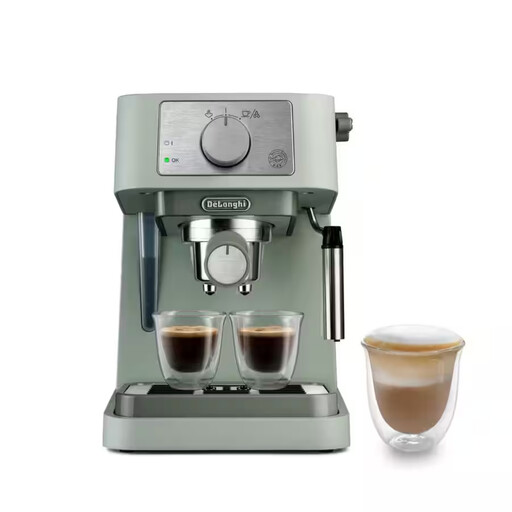
Why This Fits Their Persona: Its manual controls suit beginners who want to learn espresso preparation without buying an integrated grinder. The machine is listed at approximately 150 x 280 x 310 mm, making it suitable for many smaller UK worktops.
The specification identifies both ground-coffee and ESE pod compatibility, so you are not limited to one preparation method.
15 bar pump, manual stainless-steel steam wand, removable drip tray and single/double filter baskets.

Why This Fits Their Persona: Suitable for users who want an integrated grinder and hands-on control over dosing, extraction and milk texturing.
Its listed 30 grind settings and dose control provide more adjustment than a basic machine with no grinder.
Integrated conical burr grinder, 54 mm portafilter, 15 bar pump and manual steam wand.

Why This Fits Their Persona: A practical option for households making several drinks daily and preferring automatic grinding with simple drink selection.
The removable 1.8 litre tank and 13 grinder settings make capacity and adjustment clear rather than relying only on a one-touch claim.
Four listed one-touch recipes, built-in grinder, adjustable aroma and temperature, plus a manual steam wand.

Why This Fits Their Persona: Its listed 12 x 29 x 28.5 cm footprint is worth considering for flats, compact kitchens and home offices with limited worktop depth.
It accepts ground coffee and ESE pods, reducing the risk of purchasing a machine that cannot suit changing routines.
19 bar pump, 1.1 litre tank, 25-second preheat claim in the listing and automatic shut-off.
We have compiled a complete, real-time list of products that fully satisfy these strict selection criteria and UK safety regulations.
Not automatically. The pump rating is a maximum specification. Extraction quality also depends on temperature regulation, coffee dose, grind consistency and the machine’s design. Compare the complete brewing system rather than selecting by bar rating alone.
Electricity use depends on power rating, heat-up time, standby behaviour and how often the machine is used. Ground coffee, whole beans and capsules also have different per-drink costs. A pod machine may reduce preparation time, while a manual machine can offer more flexibility over coffee purchases.
Service life varies with construction, water quality, frequency of use and maintenance. Regular descaling, cleaning the brew path and steam wand, and following the manual can help preserve operation. Before ordering, confirm the warranty terms and whether consumable or replacement parts are available in the UK.