
24/7 Customer Support

Free returns

Same-day & Next-day Delivery

Quality Guaranteed

Unlock Your Welcome Offers: FREE Delivery | Up to 80% OFF | Free 30-day JoyPlus trial
Download the APP
Bringing the rich aroma and complex flavour of a café-quality coffee into your own kitchen is a satisfying daily ritual. Yet, the journey to finding the right espresso coffee machine is often filled with confusing jargon and features that sound impressive but fail to deliver. Many UK households end up with a countertop ornament that gathers dust after a few frustrating attempts.
Before you invest, it is crucial to understand the common pitfalls that lead to buyer's remorse. By sidestepping these traps, you can choose a machine that genuinely suits your lifestyle and budget.
compact coffee machine seems perfect for the typical British kitchen. However, some are designed so small that they cannot fit a standard-sized mug underneath the portafilter and their tiny drip trays require emptying after a single use.To make a smart purchase, focus on the core mechanics that dictate the quality of your coffee. Understanding these three elements will empower you to see past the marketing hype.
The heart of any espresso coffee machine is its pump. As mentioned, while many models are advertised as 15 bar or 20 bar espresso machines, this number refers to the maximum pressure the pump can generate, not the pressure used for brewing.
The key to a rich, balanced espresso with a stable crema is consistent pressure. More advanced machines often include an Over-Pressure Valve (OPV), a component that regulates the pressure to ensure it stays within the optimal 8-10 bar range during extraction. This prevents the bitter taste that results from forcing water through the coffee grounds too aggressively. For a true home barista machine, consistent, regulated pressure is more valuable than a higher bar rating alone.
How a machine heats water directly impacts both your waiting time and the taste of your coffee. There are two main types:
If you dream of making your own flat whites and lattes, the type of coffee machine with steam wand is non-negotiable.
cappuccino and latte maker, look for this style of wand.Instead of a one-size-fits-all approach, we have matched a few standout models to the people they are designed for.
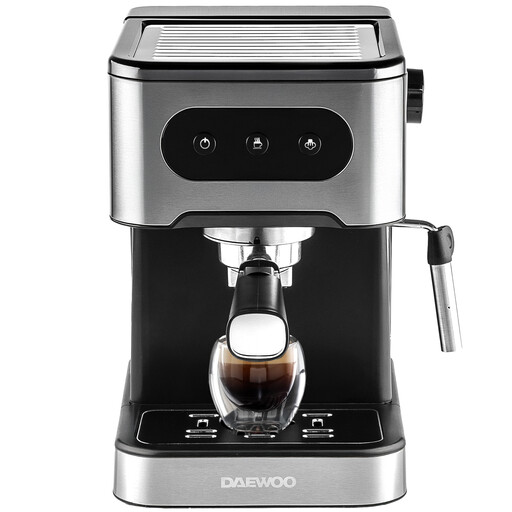
Why This Fits Their Persona: Perfect for those moving on from instant or basic pod machines. It offers the authentic experience of using a portafilter and steaming milk without an overwhelming number of settings. Its compact footprint is well-suited for smaller UK kitchens.
This is a straightforward ground coffee machine that avoids the cleaning and repair issues of overly complex automated models. Its simple dial controls focus on the essentials: brewing and steaming.
The manual steam wand provides genuine control over milk texturing, a feature often missing at this price point. It is also compatible with E.S.E. pods for added convenience.
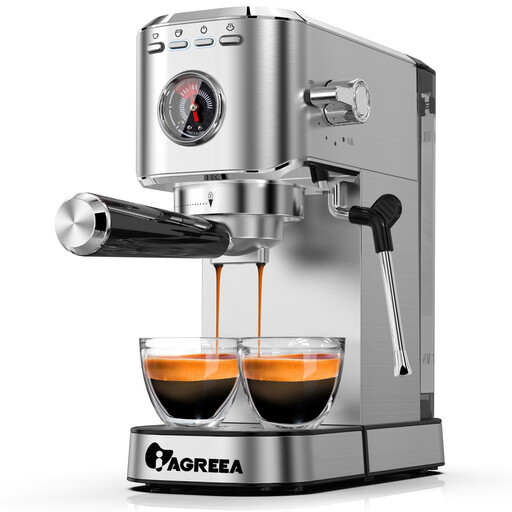
Why This Fits Their Persona: For the enthusiast who wants to perfect their craft. The pressure gauge provides instant, visual feedback, helping them to adjust their grind and tamp to achieve the perfect extraction. It is a tool for learning and refinement.
It sidesteps the pressure myth by making pressure a visible, controllable variable rather than just a marketing number. This focus on core performance gives the user more control than a fully automatic machine.
The combination of a pressure gauge, a powerful adjustable steam wand and a fast 1350W heating system provides a complete toolkit for aspiring baristas to experiment and improve.
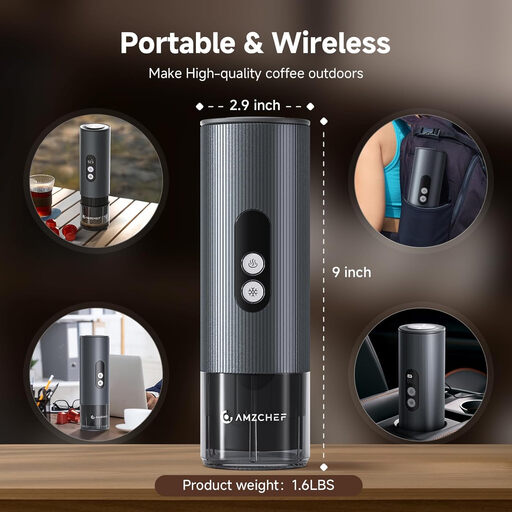
Why This Fits Their Persona: For those who refuse to compromise on coffee quality while camping, hiking or on a road trip. This device heats its own water and uses high-pressure extraction, delivering genuine espresso far from any kitchen or café.
This is a purpose-built portable device, not a compromised desktop machine. It solves the core problem of outdoor coffee—the lack of power and hot water—without sacrificing the quality of the extraction.
Its large 9000mAh battery can heat water and brew multiple espressos on a single charge. Compatibility with both NS capsules and ground coffee offers ultimate flexibility on the go.
We have compiled a complete, real-time list of products that fully satisfy these strict selection criteria and UK safety regulations.
Not necessarily. The ideal pressure for extracting espresso is around 9 bars. Both 15 and 20 bar pumps are more than capable of achieving this. The more important factor is how well the machine regulates this pressure for a consistent, even extraction. A 15 bar machine with good temperature and pressure stability will produce better coffee than an unregulated 20 bar machine.
This depends heavily on where you live, as the UK has notoriously hard water in many regions (particularly the South and East). For hard water areas, it is advisable to descale your machine every 1-2 months to prevent limescale build-up, which can affect performance and lifespan. In soft water areas, every 3-4 months should be sufficient. Always follow the manufacturer's specific instructions.
While you can technically use any coffee, you will get much better results using a fine, consistent grind specifically for espresso. Pre-ground coffee labelled "espresso" is a good start. If you use a standard filter grind, the water will pass through too quickly, resulting in a weak, under-extracted shot with no crema. For the best flavour, grinding your own beans just before brewing is recommended.