
24/7 Customer Support

Free returns

Same-day & Next-day Delivery

Quality Guaranteed

Unlock Your Welcome Offers: FREE Delivery | Up to 80% OFF | Free 30-day JoyPlus trial
Download the APP
A new espresso coffee machine can bring espresso, cappuccino, latte and Americano drinks into your daily routine. However, choosing between a manual espresso machine, bean to cup coffee machine and semi-automatic model is not simply a matter of comparing pump-pressure figures.
Marketing labels can hide practical differences. A machine advertised as a 20 bar espresso machine may not extract coffee at 20 bar, while a compact design may still need significant clearance for its water tank and steam wand. Before buying, focus on how the machine handles coffee preparation, milk, cleaning and the space available in your home.
A 15 bar or 20 bar label describes the pump’s maximum capability, not necessarily the pressure used at the coffee puck. Espresso extraction depends on several factors, including grind size, dose, tamping, temperature and pressure regulation.
Some 20 bar machines, such as the IAGREEA CM3050-2, list a 20-bar pump, while models such as the De’Longhi Stilosa and De’Longhi Magnifica Start list 15-bar pumps. These figures are useful for comparison, but they should not be treated as a standalone quality ranking.
A coffee machine with milk frother may use a manual steam wand, an automatic milk carafe or a simpler frothing attachment. Manual wands offer more control but require practice and cleaning after every use. Automatic systems are convenient for households making several milk drinks, although their milk-contact parts require careful rinsing and maintenance.
If you mainly drink black coffee, paying extra for a complex milk system may add cleaning rather than value.
Ground coffee machines require you to dose and tamp coffee. A coffee machine with built-in grinder adds grinding to the process but avoids buying a separate grinder. Bean-to-cup models reduce daily preparation, yet the grinder, grounds container, drip tray and internal brewing system still need regular care.
Also check the location of removable tanks and trays. A machine may fit beneath a cupboard but be awkward to refill if the tank lifts from the top.
Choose the machine type according to how involved you want the process to be:
A built-in grinder should offer useful adjustment rather than just a grinder label. For example, the De’Longhi Magnifica Start ECAM220.22.GB has 13 grind settings, while the Sage Barista Pro lists 30 settings for users who want finer control.
For cappuccino and latte drinks, confirm whether the machine includes:
The De’Longhi Magnifica Start ECAM220.60.B includes a LatteCrema Hot automatic milk system, whereas the IAGREEA CM3050-2 uses a manual steam wand. Neither approach is automatically right for everyone: the first prioritises convenience, while the second gives you more direct control.
Some machines also support cold drinks. A dedicated cold brew coffee machine function is different from pouring hot espresso over ice. The De’Longhi Dedica Duo EC890 models include a stated Cold Brew mode alongside espresso functions.
Measure the available worktop, including space around the machine for ventilation and access. Useful specifications include:
Follow the supplied instructions, keep hot surfaces and steam wands away from children, and never immerse the electrical body in water.

Why This Fits Their Persona: A straightforward option for a first home espresso machine, particularly where a small footprint is useful in UK kitchens or flats.
It presents a 15-bar pump alongside clear manual controls, rather than relying only on a high pressure number.
Manual steam wand, one-litre tank, ESE pod compatibility and a compact 150mm-wide design.

Why This Fits Their Persona: Suitable for coffee drinkers who want integrated grinding, manual steaming and detailed control over preparation.
Its specifications identify the grinder range, portafilter size and steam wand, making the preparation process clear.
Integrated burr grinder with 30 settings, 15-bar pump and professional-style steam wand.
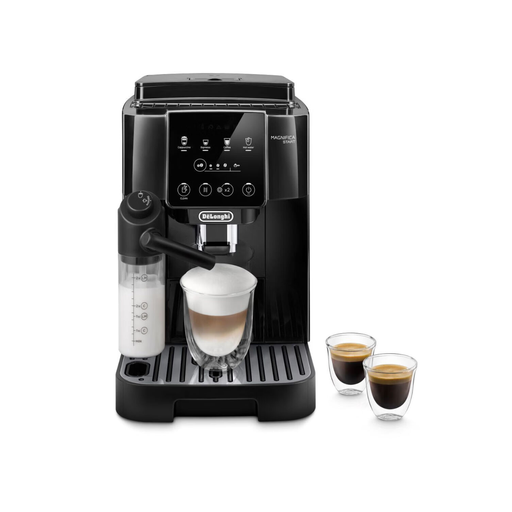
Why This Fits Their Persona: A practical automatic coffee machine for several daily drinks with minimal manual preparation.
The product description specifies its automatic milk system, cleaning function, grinder settings and tank capacity.
One-touch recipes, 250g bean hopper, 1.8L removable water tank and adjustable milk frothing.
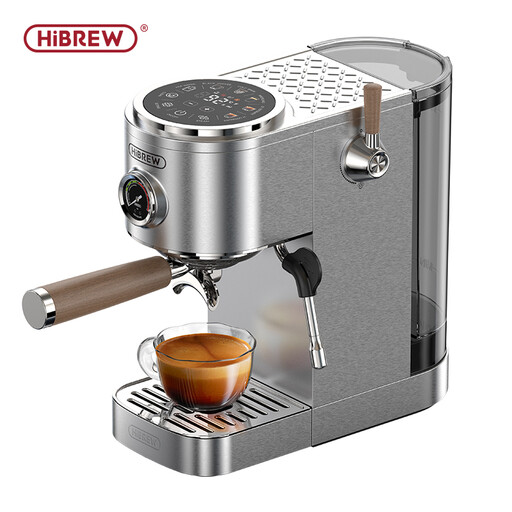
Why This Fits Their Persona: Designed for households that regularly switch between espresso, milk drinks, Americano and cold brew.
Its description distinguishes the 20-bar pump from OPV-controlled extraction and lists separate brewing and steaming functions.
Dual boilers, PID temperature control, touchscreen presets, 58mm portafilter and cold brew mode.
We have compiled a complete, real-time list of products that fully satisfy these strict selection criteria and UK safety regulations.
Running cost depends on electricity use, heating time, coffee beans, milk and cleaning products. A higher wattage does not automatically mean a higher daily cost because usage duration also matters. To estimate electricity cost, multiply the appliance’s kilowatt rating by hours used, then apply your electricity tariff. Automatic standby or shut-off features may reduce idle operation.
Lifespan varies with construction, water quality, frequency of use and maintenance. Rinse the group head as instructed, wipe the steam wand immediately after use, empty drip trays and grounds containers, and descale according to the manual. Hard-water areas may require closer attention to limescale warnings.
Not always. Some manual models accept pre-ground coffee or ESE pods, while a machine with built-in grinder handles whole beans within the appliance. For a semi-automatic espresso machine, a separate burr grinder can provide more control, but it also adds cost, counter space and another item to clean.