
24/7 Customer Support

Free returns

Same-day & Next-day Delivery

Quality Guaranteed

Unlock Your Welcome Offers: FREE Delivery | Up to 80% OFF | Free 30-day JoyPlus trial
Download the APP
Choosing among espresso coffee machines is rarely just a question of price. The right model depends on how much control you want, where you will use it, the drinks you make and how much cleaning you are prepared to do. A compact machine may suit a flat with limited worktop space, while a bean-to-cup model may be more practical for a busy household.
Before buying, watch for these common pitfalls.
A 15 bar espresso machine and a 20 bar espresso machine may both advertise impressive pump pressure. However, the number alone does not determine the final taste. Extraction also depends on grind size, coffee dose, tamping, water temperature and the filter system.
Treat the pressure figure as one specification rather than a complete quality guarantee. Features such as temperature control, pre-infusion and a pressure gauge can provide more useful information about how much control you have.
A pod coffee machine is convenient, but capsule compatibility affects your choice of coffee and your regular spending. Check whether the machine accepts a widely available capsule format, whether it supports more than one capsule size and how easy used pods are to recycle in your area.
Ground coffee and ESE pod-compatible machines offer different trade-offs. They may provide more flexibility, but require more preparation and cleaning.
Milk frothing creates additional maintenance. A steam wand should generally be wiped and purged after use, while drip trays, filter baskets and water tanks need regular washing. Machines with removable parts can simplify this routine.
Also measure the available area, including room to lift out the water tank and open the portafilter. A compact coffee machine can still be inconvenient if cupboards or shelves restrict access.
A manual espresso machine uses a portafilter and requires you to dose and tamp ground coffee. It offers control over the process and works well for people who enjoy preparing espresso, cappuccino or Americano drinks.
A semi-automatic espresso machine usually provides pump-assisted extraction while leaving the grinding, dosing and milk preparation to you. Some models, such as an integrated bean-to-cup machine, include a burr grinder but still require manual tamping and steam-wand use.
A pod coffee machine is simpler: insert a compatible capsule and start the cycle. This suits busy households, shared offices and users who value repeatable preparation over experimentation.
Pump pressure is normally listed in bars. The products below include machines rated at 15, 19 or 20 bar, but these figures should not be compared in isolation. Look for practical controls such as a pressure gauge, separate temperature control, pre-infusion or NTC temperature monitoring.
For milk drinks, check whether the machine has a manual steam wand and whether it can switch between brewing and steaming safely. A coffee machine with milk frother may require more practice than a one-touch system, but gives you greater control over foam texture.
Water tanks in the examples range from 0.7 litres to 1.7 litres. A smaller tank may be suitable for occasional use or a compact kitchen, while a larger tank reduces refilling for several drinks.
Before ordering, compare the machine’s width, depth and height with your worktop. UK buyers should also check that the appliance is suitable for a 220–240V earthed socket and follow the supplied safety instructions. Never touch a hot portafilter or steam wand immediately after use, and allow the appliance to cool before cleaning.
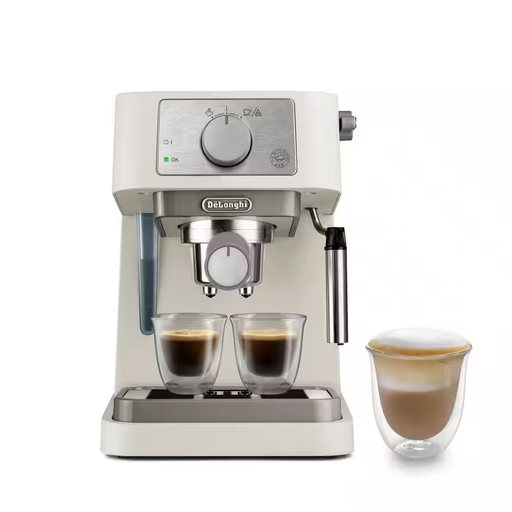
Why This Fits Their Persona: A straightforward option for beginners who want ground coffee or ESE pod compatibility without an integrated grinder. Its stated width is approximately 150mm, making it suitable for many smaller UK worktops.
The 1-litre removable tank, visible water indicator and removable drip tray make routine checks and cleaning more manageable.
15-bar pump, manual steam wand, single and double-shot baskets and ESE pod compatibility.
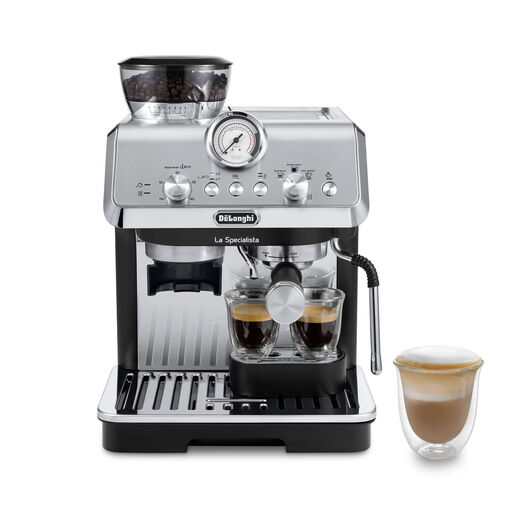
Why This Fits Their Persona: Suits coffee drinkers who want fresh beans, adjustable grinding and hands-on control for espresso and milk-based drinks.
Its eight grind settings, three infusion temperatures and included dosing tools offer tangible controls rather than relying only on a headline pressure number.
Integrated burr grinder, 15-bar pump, 1.7-litre removable tank and manual steam wand.

Why This Fits Their Persona: Designed for camping, travel, office use or homes where a full-size appliance is impractical. It weighs approximately 1.15kg and has a 50ml, 75ml and 100ml marked tank.
The detachable battery design supports battery replacement, while the digital display shows brewing temperature and time. Use only the specified original lithium batteries.
20-bar pump, 120W rated power and a compact 220mm by 75mm product size.
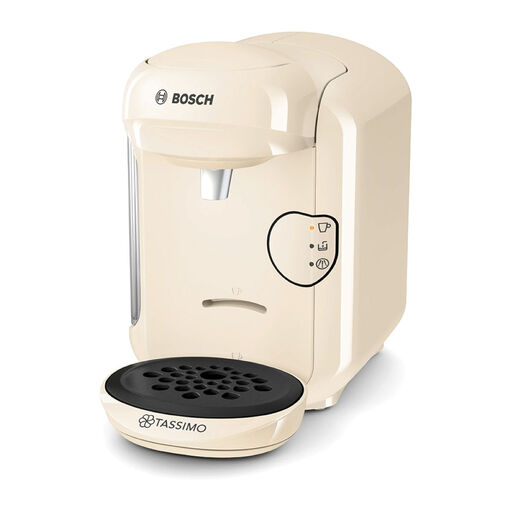
Why This Fits Their Persona: A one-touch pod coffee machine for households wanting coffee, tea, hot chocolate and milk drinks with limited preparation.
The compatible Tassimo T DISC format, removable 0.7-litre tank and automatic cleaning and descaling programmes make the operating routine clear.
One-touch operation, barcode-assisted drink settings, fast heat-up and automatic shut-off.
We have compiled a complete, real-time list of products that fully satisfy these strict selection criteria and UK safety regulations.
Running costs depend mainly on the coffee format. Ground coffee can offer flexibility and lets you choose different beans, while capsules add a cost per drink and may create more packaging. Electricity use depends on the machine’s power, heat-up time and standby behaviour. Auto shut-off can help avoid unnecessary idle operation.
Yes, provided it includes a steam wand or another milk-frothing system. A manual wand requires practice to texture milk, while a pod or fully automatic machine may use a dedicated milk capsule or automated process. Always clean the wand immediately after steaming to prevent residue build-up.
There is no single lifespan because usage, water hardness, cleaning and maintenance vary. Regularly rinse the brewing system, empty the drip tray, clean removable parts and descale according to the manufacturer’s instructions. Keeping the machine on a stable, dry surface and using suitable drinking water can also support reliable operation.