For several breakfast affogatos, choose an espresso machine around the portions you need to make and the preparation you are willing to do between servings. A traditional manual machine suits hands-on preparation, an integrated-grinder model keeps grinding and brewing in one appliance, and an automatic bean-to-cup machine reduces manual steps but still needs regular maintenance. Check the exact model’s double-shot or two-cup function rather than treating tank size as a serving count.
Who each setup suits
Hosts serving several people
If you are making multiple affogatos close together, look at how the machine handles successive portions as well as refilling. Gaggia’s Classic specification lists simultaneous brewing of two coffee cups; a two-cup claim on one model should not be assumed for another.
Fresh-bean buyers avoiding a separate grinder
If you want to grind beans as part of the espresso routine, an integrated-grinder machine keeps those functions together. The Sage Barista Express Impress and De’Longhi La Specialista Arte are manual examples, so you would still handle a portafilter.
Households wanting fewer preparation steps
If the espresso is mainly for pouring over ice cream, an automatic bean-to-cup workflow may appeal more than dosing and tamping by hand. JURA describes touch-button espresso preparation on its E8, while its instructions also set out cleaning and descaling tasks.
What matters when choosing
Traditional manual
Choose when: You are happy to prepare a portafilter and use ground coffee or a separate grinder.
Trade-off: Each additional serving involves more hands-on preparation; Gaggia’s Classic specification does, however, list brewing two coffee cups simultaneously.
Manual with integrated grinder
Choose when: You want to grind beans and prepare espresso without a separate grinder.
Trade-off: Grinding is built into the machine, but portafilter handling and worktop clearance still matter on the cited Sage and De’Longhi models.
Automatic bean-to-cup
Choose when: Reducing manual espresso preparation is your main breakfast priority.
Trade-off: Touch-button operation does not remove the cleaning and descaling routine described in JURA’s E8 instructions.
| Concern | What to check | Who this matters to |
|---|
| Serving several portions |
Check the exact model’s double-shot controls, whether it brews two cups simultaneously, and how readily its tank can be refilled. |
If I am assembling affogatos for several people, I want successive espressos without interrupting serving to change my setup. Around 36% of consumers put serving pace and repeatability first. |
| Fresh grinding and control |
Decide between a separate grinder, an integrated grinder and automatic grinding; check the dose options you intend to use. |
When the coffee itself is my priority, I want to choose how beans are ground and how each shot is prepared. Roughly 29% of consumers prioritise fresh grinding and preparation control. |
| A simpler equipment setup |
Decide whether ground coffee or an existing grinder meets your needs, then check the filters and accessories supplied with the exact model. |
If I make affogatos only occasionally, I do not want extra equipment that I would seldom use. Around 21% of consumers make a restrained equipment setup their primary concern. |
| Space and hands-on effort |
Measure the worktop and access to the tank or bean hopper; compare preparation steps with the cleaning routine. |
With limited worktop space or a busy morning, I want the machine to fit and the coffee routine to stay manageable. About 14% of consumers put space and low-intervention preparation first. |
Buying pitfalls
-
Assuming tank capacity equals a fixed number of affogatos
Water is used for more than the espresso itself, including rinsing and any steaming. A larger tank alone therefore does not establish how quickly you can serve several people.
Use tank capacity to judge refill convenience, then check double-shot controls or confirmed simultaneous two-cup brewing if serving pace matters most.
-
Choosing a manual machine before deciding how to grind coffee
A traditional portafilter machine and a manual machine with an integrated grinder create different preparation routines.
Decide whether you will use ground coffee, a grinder you already have or an integrated-grinder model before comparing other controls.
Using whole beans with a machine that relies on a separate grinder means making room for that grinder too.
-
Measuring only the machine’s footprint
An integrated grinder’s hopper and a removable water tank may need access beyond the machine’s stated width and depth.
Measure height and the space needed to fill beans and remove the tank at the place where you will use it.
-
Treating automatic espresso as maintenance-free
JURA’s E8 instructions include rinsing, cleaning and descaling; relevant milk-system care depends on how the machine is used.
Check the instructions for the exact machine and decide whether that routine suits your household before choosing automation for convenience.
Filters and cleaning or descaling products may also need replacing over time.
Brands to consider
Sage
The Barista Express Impress is a reference point for buyers who want grinding and manual espresso preparation in one machine.
- Sage lists a 250 g bean hopper, 2 L tank, 25 grind settings and single- and double-shot controls for this model.
- Assisted tamping does not make it a one-touch bean-to-cup machine; portafilter preparation remains part of the routine.
De’Longhi
The La Specialista Arte is a manual integrated-grinder option for households wanting to prepare espresso from beans.
- De’Longhi lists a 1.7 L tank, 15 grinder settings and two-dose capability for the cited model.
- The integrated grinder does not remove portafilter preparation from the breakfast routine.
Gaggia
The Classic illustrates a traditional manual setup for buyers using ground coffee or a separate grinder.
- Gaggia’s Classic specification lists a 2.1 L tank and simultaneous brewing of two coffee cups.
- Its traditional filter-holder workflow calls for dosing and preparation rather than automatic bean-to-cup operation.
JURA
The E8 illustrates an automatic route for households prioritising fewer manual espresso-making steps.
- JURA describes touch-button espresso preparation and lists espresso doppio in the E8 instructions.
- Those instructions also describe an ongoing rinsing, cleaning and descaling routine.
Espresso machines on Joybuy
These machines cover manual espresso preparation, manual models with integrated grinders and automatic bean-to-cup preparation. For family affogatos, compare the portion controls and morning workflow of each model; a single- or double-shot option does not by itself confirm simultaneous two-cup brewing.
 No image available
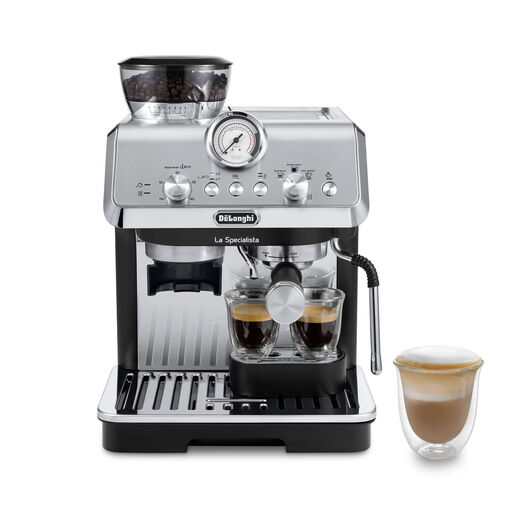
De’Longhi La Specialista Arte EC9155.MB, silver and black
Consider this manual model if you want to prepare espresso from beans without arranging a separate grinding setup. Portafilter preparation remains part of the routine; check whether the exact configuration meets your needs for serving two people at once.
View on Joybuy
 No image available
De’Longhi Magnifica Start ECAM220.22.GB, black and grey
This fully automatic bean-to-cup model suits a household that wants less manual preparation before pouring espresso over ice cream. Its named variant has a milk nozzle and four one-touch recipes; check its instructions for the cleaning routine and confirm two-cup operation if that matters to your breakfast service.
View on Joybuy
 No image available
HiBREW H20 espresso machine with built-in grinder
This model is relevant if you want to grind beans in the same appliance while retaining a manual espresso workflow. Its title specifies 20 grind levels and a 1.8 L water tank. Confirm whether its portion controls meet your needs for serving two people at once.
View on Joybuy
 No image available
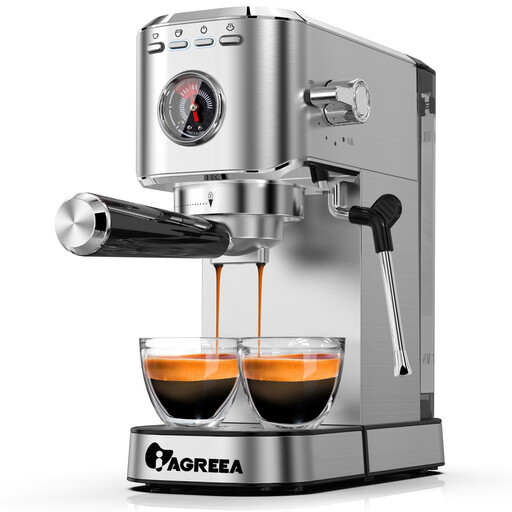
IAGREEA 20Bar espresso machine, 1.1 L tank
This manual espresso machine offers single- and double-shot options for choosing a portion. Its title also specifies a removable 1.1 L tank, pressure gauge and steam wand. Check how you will grind the coffee and whether the machine can brew two cups simultaneously if that affects your serving plan.
View on Joybuy
 No image available
De’Longhi Dedica Duo EC890.G, green
Consider this pump espresso model if you want a manual preparation routine and also expect to use its cold-brew or milk-steaming functions. For repeated breakfast affogatos, check the tank capacity, your coffee-grinding setup and whether it brews two cups simultaneously.
View on Joybuy
Frequently asked questions
Do I need a milk frother to make affogatos?
No: an affogato centres on espresso poured over ice cream. Prioritise the espresso workflow, and consider a steam wand or milk system if you also plan to make milk-based drinks.
Will a two-cup function help when serving family affogatos?
It can help when two servings need espresso at the same time. Gaggia’s Classic specification lists simultaneous brewing of two coffee cups, but check the exact model: a double-shot setting alone does not establish that it brews into two cups at once.
What water-tank size should I choose for several servings?
Choose tank size for convenient refilling, not as a guaranteed affogato count. The cited De’Longhi La Specialista Arte, Sage Barista Express Impress and Gaggia Classic specifications list 1.7 L, 2 L and 2.1 L respectively; rinsing and any steam-wand use also draw water.
Does an automatic bean-to-cup machine need regular cleaning?
Yes: automatic preparation still comes with model-specific care. JURA’s E8 instructions describe rinsing, cleaning and descaling, so read the instructions for the machine you choose and account for any milk-system care that applies to your use.


