Hosts planning double-shot service
If friends may want either a double espresso or two separate cups, establish which serving format the machine supports. A two-shot setting alone does not establish that it fills two cups at once.


Choose a manual espresso machine if you want to prepare each double shot yourself and can supply suitably ground coffee; choose a bean-to-cup model if simpler preparation matters more when friends visit. A manual machine with an integrated grinder offers a middle route, but still involves preparing the portafilter. Whichever route appeals, check whether the exact model makes one double espresso or serves two cups, as well as its worktop fit, maintenance instructions and UK electrical compatibility.
If friends may want either a double espresso or two separate cups, establish which serving format the machine supports. A two-shot setting alone does not establish that it fills two cups at once.
If you want to handle grinding, dosing and portafilter preparation, consider a traditional manual machine or a manual model with an integrated grinder. Both keep you involved in preparing each drink.
If you would rather select a drink than prepare a portafilter for each guest, look at the programmed drinks and double-shot function on the exact bean-to-cup model.
Choose it when: You enjoy preparing the shot yourself and have suitable grounds or a separate grinder.
Bear in mind: You will prepare the portafilter again for subsequent drinks.
Choose it when: You want to grind beans in the machine while keeping a hands-on espresso routine.
Bear in mind: An integrated grinder does not make dosing and portafilter preparation one-touch tasks.
Choose it when: Programmed drinks and less manual preparation are your priorities when serving friends.
Bear in mind: You give up the portafilter-led preparation routine and need to follow the machine's cleaning instructions.
For consumers choosing a machine to make double espressos when friends visit, settle the serving format first; then weigh preparation effort against your interest in grinding and making each shot yourself.
| Concern | What to check | Who this matters to |
|---|---|---|
| Serving format | Check the exact model's double-shot setting and whether it explicitly supports two cups at once. | If I am making coffee for a friend as well as myself, I need to know whether I can fill two cups or must prepare drinks in succession. Around 37% of consumers put that serving question first. |
| Preparation effort | Check which drinks are programmed and what preparation each drink still requires. | When several friends ask for espresso, I would rather spend less time preparing each serving by hand. For around 27% of consumers, low-effort repeatability is the primary concern. |
| Grinding and control | Choose between pre-ground coffee, a separate grinder and an integrated grinder; check the preparation controls you want to use. | If I enjoy working with beans and adjusting how I prepare a shot, I want that involvement even when guests are waiting. Hands-on control comes first for around 18% of consumers. |
| Space and upkeep | Measure usable worktop width, depth and height, including refill access; read the cleaning and descaling instructions. | My machine needs to fit where I can refill and clean it, not just where I can set it down. Around 18% of consumers chiefly prioritise worktop fit and manageable upkeep. |
A double shot may be served in one cup. Gaggia states that the Classic E24 can brew two coffee cups simultaneously, while Sage describes one- and two-shot volumetric controls for the Bambino Plus; those descriptions answer different serving questions.
Decide whether you need one double espresso or two separate cups, then check the exact model's instructions for that format.
A portafilter needs ground coffee. An integrated-grinder model such as Sage's Barista Express Impress handles grinding within the machine, but does not remove the manual preparation routine.
If you buy whole beans for a manual machine without an integrated grinder, plan for a suitable separate grinder; otherwise, check the coffee grounds you intend to use.
A machine that fits across the worktop may still be awkward to refill or clean if its tank, hopper or drip tray cannot be accessed.
Measure the usable depth and height as well, then read the exact model's refill, cleaning and descaling instructions before choosing a position for it.
Electrical Safety First states that the UK supply is 230 V at 50 Hz and warns that using an appliance at a different voltage can be dangerous. A travel adaptor does not convert voltage or frequency.
Check the exact machine's electrical rating and plug arrangement before purchase. Do not use an incompatible voltage variant with only a plug adaptor.
These manufacturer-described models illustrate different preparation routines; the features of one model should not be assumed to apply across its brand's range.
Sage's Bambino Plus illustrates a compact manual route, while the Barista Express Impress combines manual espresso preparation with an integrated grinder.
De'Longhi offers both manual and automatic approaches: the Dedica Arte is a manual espresso machine, while the Magnifica Start ECAM220.22.GB is a bean-to-cup model.
The Gaggia Classic E24 represents a traditional portafilter route for someone willing to manage preparation and cleaning manually.
These options are for hosts considering hands-on espresso preparation, including models described with an integrated grinder. Check the serving format on the exact machine if you need two separate cups rather than one double espresso.
 No image available
Consider this model if you want to grind beans in the machine while preparing espresso yourself.
The product name specifies 20 grind levels, a steam wand and a 1.8 L water tank. Confirm its double-shot serving format and UK plug arrangement before buying.
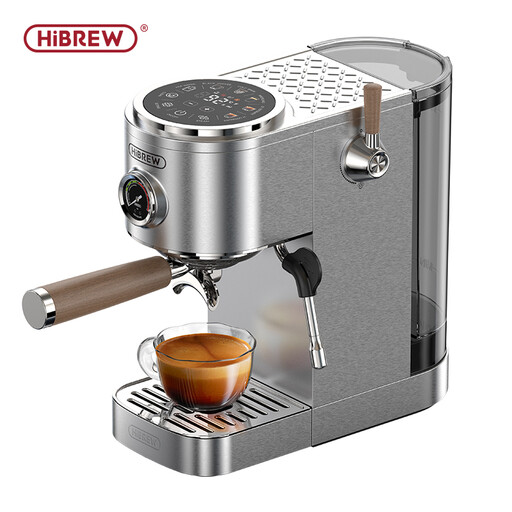 No image available
Consider this model if you prefer a semi-automatic espresso routine to selecting a bean-to-cup drink.
Its product name specifies a dual-boiler design, touchscreen controls and a stainless-steel finish. Check how its double-serving controls work, along with its UK plug arrangement and cleaning instructions.
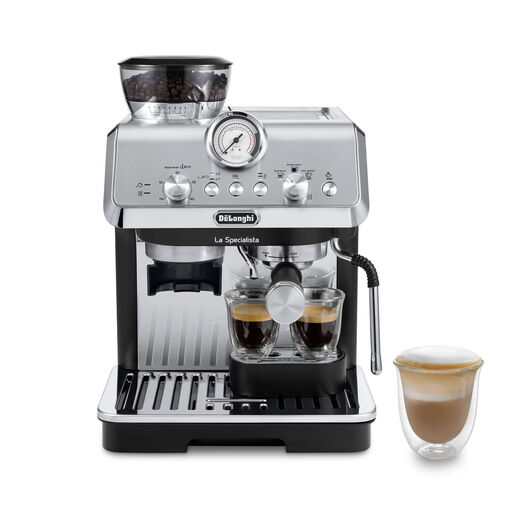 No image available
Consider this semi-automatic model if you want to take part in preparing espresso rather than rely on a one-touch guest-serving routine.
The product name identifies a milk frother and the silver-and-black EC9155.MB variant. Check whether its serving controls meet your double-espresso needs and confirm its UK plug arrangement.
Not necessarily: a double shot can go into one cup. Sage specifies two-shot volumetric control for the Bambino Plus, whereas Gaggia explicitly states that the Classic E24 can brew two coffee cups simultaneously. Check which of those serving formats the exact machine supports.
You need a way to supply ground coffee, but it need not be a separate grinder if you use suitable pre-ground coffee or choose a machine with one built in. Sage specifies an integrated grinder for the Barista Express Impress; a traditional portafilter machine without one needs grounds supplied separately.
Check the exact model's electrical rating and plug arrangement against the UK supply. Electrical Safety First gives the UK supply as 230 V at 50 Hz and identifies the Type G plug; a travel adaptor alone does not convert voltage or frequency.
Choose a maintenance routine you are willing to follow, using the exact model's instructions. Gaggia lists manual descaling for the Classic E24, while De'Longhi lists programmable water hardness for the Magnifica Start ECAM220.22.GB; those are different features, not interchangeable cleaning schedules.