What matters when choosing
Start with the coffee you intend to use and the time you want to spend preparing it; then check whether the machine fits your space and whether you will use its milk-drink features.
| Concern | What to check | Who this matters to |
|---|
| Short-break workflow |
Check for a double-shot preset or suitable basket, and decide whether grinding happens separately. |
I want my usual double espresso without a long sequence of preparation steps; around 31% of consumers put this workflow need first. |
| Worktop space |
Measure width, depth and height, allowing room to fill the tank and handle the portafilter. |
A narrow gap is my main constraint, so the machine must fit where I can actually use it; compact fit comes first for around 25% of consumers. |
| Manual control |
Confirm basket options, coffee format and whether you want to operate a manual steam wand. |
I would rather spend time adjusting extraction than rely mainly on presets; around 25% of consumers give that hands-on control priority. |
| Milk and repeat drinks |
Compare steam-wand operation and whether independent brew and steam controls serve your routine. |
When I regularly make milk drinks or several drinks in succession, those tasks shape my choice; they are the primary need for around 19% of consumers. |
Joybuy product choices
These choices cover a compact Dedica Duo for a double-shot preset and bean-to-cup machines for consumers considering a more consolidated whole-bean routine. Compare the preparation you would actually do, as well as the space each machine needs.
 Image unavailable
De'Longhi Dedica Duo EC890.G, Green
Consider this manual machine if a Double Espresso preset and a narrow worktop fit your break-time routine.
De'Longhi lists a 15 cm width and a manual milk wand for the Dedica Duo. Check the full working space and confirm the coffee format you plan to use.
View on Joybuy
 Image unavailable
Sage the Barista Touch Impress with Cold Extraction SES882BSS4GUK1, Brushed Stainless Steel
This bean-to-cup option is for consumers who want preparation guidance alongside their double-espresso routine.
The product is identified with an Impress Puck System and Cold Extraction. Check its dimensions and maintenance instructions against the space and time you have available.
View on Joybuy
 Image unavailable
Sage the Barista Pro SES878BSS4GEU1, Brushed Stainless Steel
Consider this model if you want to use whole beans without placing a separate grinder beside the espresso machine.
The Joybuy listing identifies a 30-setting grinder, 54 mm portafilter and manual steam wand. Grinding and tamping still require your involvement; check the machine's dimensions and accessory compatibility.
View on Joybuy
 Image unavailable
HiBREW H20 All-in-One Coffee Machine
This model may suit a whole-bean double-espresso routine when you prefer the grinder and coffee machine in one appliance.
Its product name specifies a built-in grinder with 20 grind levels, a 1.8 L water tank and a steam wand. Check its working footprint and maintenance instructions before choosing it for a short break.
View on Joybuy
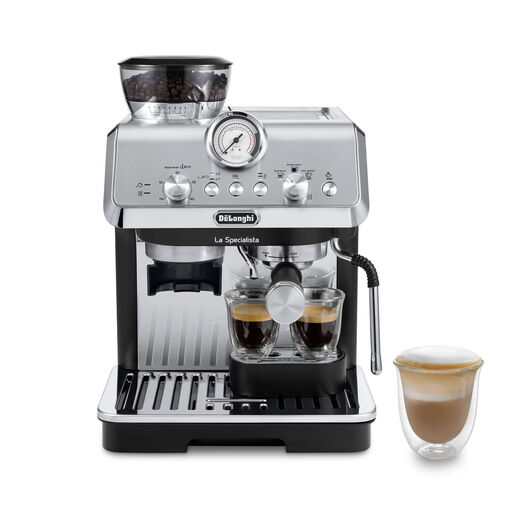 Image unavailable
De'Longhi La Specialista Arte EC9155.MB, Silver/Black
Consider this manual bean-to-cup model if you are willing to take an active part in preparing your double espresso.
The product name identifies a milk frother. Check how its grinding, dosing and tamping routine fits your break, and measure the available working space.
View on Joybuy
Common questions
Do I need a bean-to-cup machine for a double espresso?
No. A manual machine can prepare a double espresso from ground coffee: De'Longhi lists a Dose 2 function and ground-coffee compatibility for the Dedica Style. An integrated grinder becomes relevant if you want to use whole beans without a separate appliance.
What should I measure for a small kitchen?
Measure the machine's width, depth and height, then allow space to refill its tank and use the portafilter. De'Longhi lists the Dedica Style at 149 × 330 × 305 mm, illustrating why width alone does not establish whether a machine fits.
When should I consider a dual-boiler machine?
Consider one if you regularly prepare milk drinks or successive drinks and want separate control over coffee and steam temperatures. Rancilio lists two boilers and two temperature controllers for the Silvia Pro X; those features are not a prerequisite for making one black double espresso.
What electrical checks matter when ordering online?
Check the appliance's voltage, plug, seller and conformity information for the delivery location. The Office for Product Safety and Standards publishes electrical-equipment guidance for supply in or into Great Britain; if delivery is to Northern Ireland, check the provisions applicable there rather than assuming the Great Britain guidance covers it.
How should I plan for cleaning and descaling?
Follow the instructions for the exact machine rather than adopting a single interval for every model. Check the manual for its cleaning and descaling steps before buying, especially if a short preparation routine matters to you; Electrical Safety First also advises using and maintaining coffee machines properly.


