
24/7 Customer Support

Free returns

Same-day & Next-day Delivery

Quality Guaranteed

Unlock Your Welcome Offers: FREE Delivery | Up to 80% OFF | Free 30-day JoyPlus trial
Download the APP
Bringing the café experience into your home is an appealing thought, but the journey to finding the right espresso machine is often filled with confusing marketing claims and features that sound impressive but deliver little value. Many UK households end up with a stylish appliance that gathers dust after a few months. As a Joybuy Product Recommendation Officer, my role is to help you see past the hype and focus on what truly matters for a great cup of coffee.
Before you invest, let’s look at the common pitfalls that lead to buyer's remorse.
home espresso machine can quickly become an impractical nuisance. Measuring your available space before you shop is a non-negotiable step.iced coffee machine would be ideal. Versatility—the ability to handle different drink styles, from a flat white to a cold brew—is a key factor for long-term satisfaction.To avoid these traps, focus on the functional core of the machine. These three parameters will have the biggest impact on your daily coffee ritual.
Instead of just looking at the maximum bar pressure, check for features that promote consistency. A thermoblock heating system is common in home machines and offers a key advantage: speed. It heats water on demand, meaning your machine is ready to brew in under a minute. More advanced models may feature dual thermoblocks or dual boilers, allowing you to pull an espresso shot and steam milk simultaneously—a great feature for a busy cappuccino maker. Also, look for mentions of PID (Proportional Integral Derivative) temperature control, which ensures the water is at the precise temperature for optimal extraction.
If you enjoy lattes, cappuccinos or flat whites, the coffee machine with milk frother is a must. You’ll generally find two types:
Finally, consider the type of semi-automatic espresso machine that fits your lifestyle and your kitchen.
Based on these practical considerations, here are a few machines that align with different user needs and kitchen realities in the UK.
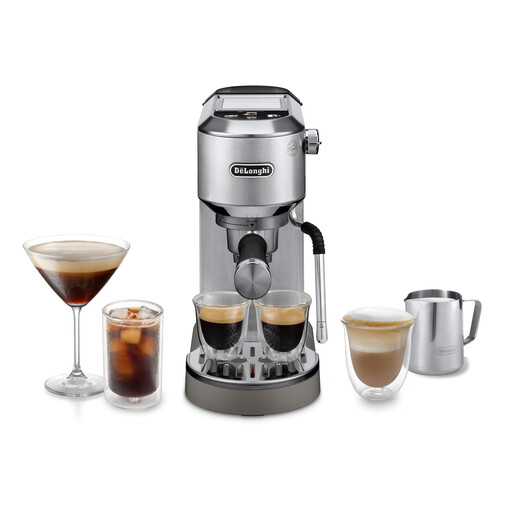
Why This Fits Their Persona: Its ultra-slim 15cm width is a perfect solution for the typical space-conscious UK kitchen. It delivers quality espresso and milk drinks without dominating the countertop and its unique cold brew function adds year-round versatility.
It directly counters the "countertop hog" and "one-trick pony" pitfalls. Its compact design saves precious space, while the dedicated Cold Extraction Technology makes it a true multi-season machine.
The combination of a 15-bar pump, My LatteArt steam wand for quality milk texturing and the innovative cold brew function in such a small footprint is its main strength.
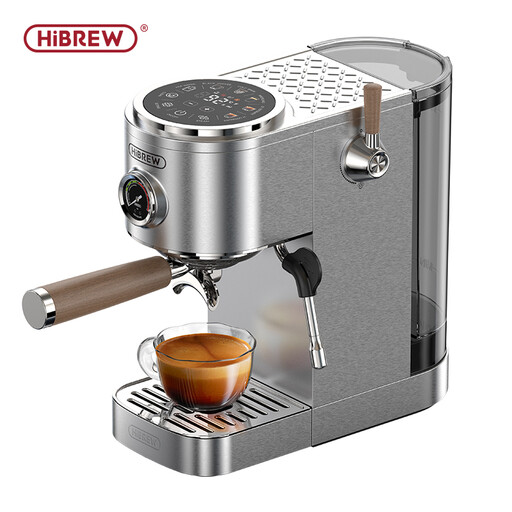
Why This Fits Their Persona: This user wants to experiment and have more control. The dual-boiler system, PID temperature control and commercial-style 58mm portafilter provide the tools for serious home brewing without the price tag of a high-end commercial machine.
It sidesteps the "more bars" myth by focusing on what actually improves espresso: stable pressure (via an OPV) and precise temperature control (via PID). The features are practical, not just marketing points.
The dual-boiler system is a standout feature at this price point, allowing for simultaneous brewing and milk steaming. The intuitive touchscreen also simplifies access to its advanced programmable functions.
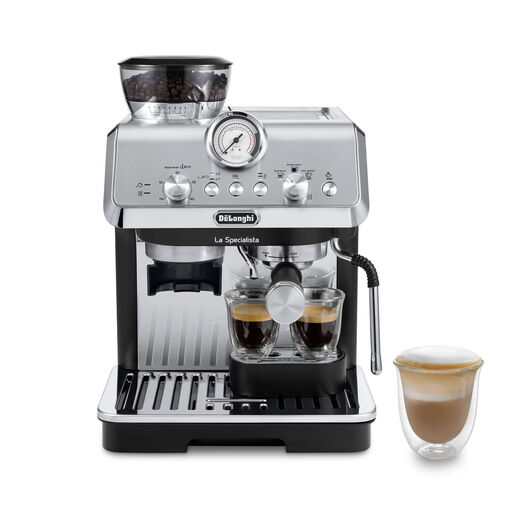
Why This Fits Their Persona: This is for someone who wants the freshness of a bean to cup coffee machine without needing separate equipment. The integrated grinder, dosing funnel and tamper provide a guided, all-in-one workflow from bean to cup.
It prevents the analysis paralysis of having to buy and pair a separate grinder and accessories. The included professional barista kit gives you everything needed to start, removing hidden extra costs and complexity.
The integrated conical burr grinder with 8 grind settings and three infusion temperature profiles allows you to tailor the extraction to different coffee beans, all within one cohesive unit.
We have compiled a complete, real-time list of products that fully satisfy these strict selection criteria and UK safety regulations.
This largely depends on the water hardness in your area. For most parts of the UK, which have moderate to hard water, descaling every 2-3 months is a good practice. Many machines have an indicator light that will alert you when it's time. Using filtered water can also help reduce the frequency of descaling and prolong the life of your machine.
Yes, you can. The drink you are looking for is an Americano. Simply pull a single or double shot of espresso into your cup and then top it up with hot water from the machine's steam wand or a kettle. This gives you a larger, less intense drink that is similar in volume to a standard filter coffee but with the distinct flavour profile of espresso.
With proper care and regular maintenance (like descaling and cleaning), a good quality home espresso machine can last for 5 to 10 years. Models from reputable brands often have better build quality and available spare parts, which can extend their lifespan significantly compared to cheaper, unbranded alternatives.