
24/7 Customer Support

Free returns

Same-day & Next-day Delivery

Quality Guaranteed

Unlock Your Welcome Offers: FREE Delivery | Up to 80% OFF | Free 30-day JoyPlus trial
Download the APP
The dream of pulling a perfect, café-quality espresso shot in your own kitchen is more attainable than ever. Yet, the market for the espresso machine with grinder is filled with potential missteps. Many machines promise a professional experience but hide design flaws that lead to frustration and wasted money. As your Joybuy Product Recommendation Officer, my role is to help you see past the marketing and focus on the features that truly matter for making exceptional coffee at home or in a small commercial setting.
Before you invest, be aware of these common purchasing pitfalls:
To avoid these issues, focus your search on three non-negotiable technical specifications. These are the pillars of a machine that will deliver consistent, high-quality results for years to come.
The journey to a great espresso starts with the grind. A bean to cup coffee machine is only as good as its integrated grinder. Look for machines that specify a burr grinder (ideally steel or ceramic) over a blade grinder. Burr grinders crush beans to a uniform size, which is essential for an even extraction. Furthermore, demand a wide range of grind settings—at least 15-20. This allows you to dial in the perfect grind size for different coffee beans and brewing conditions, giving you complete control over the flavour of your shot.
For anyone who enjoys milk-based drinks like lattes or cappuccinos, a dual heating system coffee machine is a significant upgrade. These machines have separate heating elements for brewing and steaming, allowing you to do both simultaneously. This not only saves time but also ensures that both functions operate at their optimal, stable temperatures.
For ultimate consistency, consider a PID coffee machine. A Proportional-Integral-Derivative (PID) controller is a digital thermostat that keeps the water temperature incredibly stable, typically within 1°C of the target. This precision eliminates temperature swings that can make your espresso taste bitter or sour, ensuring every shot is as good as the last.
A 58mm portafilter espresso machine is the universally recognised commercial standard for a reason. The larger diameter allows for a wider, more evenly distributed coffee puck. This enables water to flow through the grounds more uniformly during extraction, reducing the risk of "channelling" (where water finds a path of least resistance) and leading to a richer, more balanced flavour. Opting for a 58mm machine also opens up a vast market of high-quality, third-party accessories to elevate your coffee-making.
Based on these critical criteria, here are our recommendations matched to different user needs.
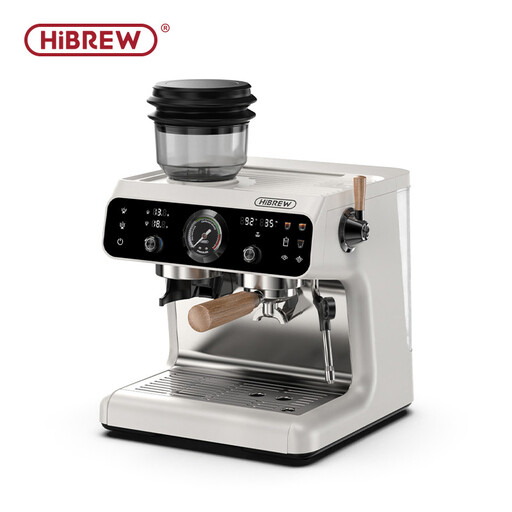
Why This Fits Their Persona: This user wants an all-in-one solution that delivers a genuine café experience without a prohibitive learning curve. The H7B combines pro-level features in a single, intuitive unit perfect for a UK kitchen counter.
It features a high-precision burr grinder with 30 settings and a professional 58mm portafilter, directly countering the common pitfalls of poor grinding and non-standard parts.
The dual heating system with PID temperature control allows for simultaneous brewing and steaming with exceptional thermal stability.
Why This Fits Their Persona: An ideal commercial coffee machine for a small cafe, boutique hotel or office. It offers reliability and consistency in a compact, user-friendly package that staff can operate with minimal training.
The dual heating system prevents the "bottleneck" of single boiler machines, allowing for efficient service during busy periods without compromising on quality for guests or clients.
The intuitive one-touch operation and clear touch screen simplify the coffee-making process, ensuring consistent results regardless of the operator.

Why This Fits Their Persona: This user prefers a modular setup. They may already own a high-quality separate grinder or want the freedom to choose one later. Their priority is the core brewing technology of the espresso machine itself.
By being a dedicated espresso unit without a built-in grinder, it completely sidesteps the risk of a subpar integrated grinder, allowing you to pair it with a specialist grinder of your choice.
It focuses investment on a powerful 20-bar pump and a dual boiler heating system, prioritising the two most important factors for excellent, consistent espresso extraction.
Whether for your home or a commercial setting like a boutique hotel, finding the right equipment is key. We have compiled a complete, real-time list of products that satisfy these strict selection criteria and UK safety regulations.
Regular maintenance is key to longevity and taste. This includes daily rinsing of the portafilter and steam wand, weekly backflushing with a cleaning tablet to clear coffee oils from the group head and periodic descaling (every 2-3 months, depending on your water hardness) to remove mineral buildup from the internal components. For machines with a grinder, you should also periodically clean the burrs to remove old coffee grounds.
The lifespan of a machine depends heavily on its build quality and how well it is maintained. A well-built machine with a stainless steel body and quality internal components, like the ones recommended, can be expected to last for many years with proper care. Regular cleaning and descaling are the most important factors in extending its operational life.
While there is an initial investment, making coffee at home is significantly more cost-effective in the long run. A typical cup of coffee from a high-street café in the UK can cost ?3-?4. A bag of quality coffee beans (250g) can make around 12-15 double espressos, bringing the cost per cup down to a fraction of that, even after factoring in the cost of milk and electricity. The machine can pay for itself over time, especially for daily coffee drinkers.