
24/7 Customer Support

Free returns

Same-day & Next-day Delivery

Quality Guaranteed

Unlock Your Welcome Offers: FREE Delivery | Up to 80% OFF | Free 30-day JoyPlus trial
Download the APP
Bringing the café experience into your home is an appealing thought. The aroma of freshly brewed espresso, the gentle hiss of a steam wand and the first sip of a perfectly crafted latte can elevate any morning. However, the journey to finding the right espresso machine with milk frother is often cluttered with confusing marketing claims and technical jargon. Many buyers end up with a machine that gathers dust after a few months of frustration.
As the Joybuy Product Recommendation Officer, my role is to help you navigate this landscape. We will look past the hype and focus on what truly matters for making great coffee at home. Before you spend your hard-earned money, let's uncover the common pitfalls that lead to buyer's remorse.
espresso machine with grinder seems like the ultimate convenience. However, many integrated grinders, especially in lower-priced models, are of poor quality. They can produce inconsistent grounds, which is the number one enemy of good espresso. This can leave you with a machine whose weakest link compromises its entire performance.coffee machine with steam wand offers control to create silky microfoam, but it requires practice. An automatic frother is effortless but provides a stiffer, less integrated foam and little room for customisation. Choosing the wrong type for your goals can lead to disappointment.To choose a reliable home coffee machine, you need to understand a few core features that directly impact the quality of your drink.
The heart of any barista coffee machine for home is its ability to push hot water through finely-ground coffee at a stable pressure and temperature.
Your choice here depends entirely on your desired involvement and drink preference. A good cappuccino and latte machine will excel in this area.
ground coffee fall into this category.espresso machine with grinder, handle everything from grinding the beans to frothing the milk at the touch of a button. They offer ultimate convenience but less control over the final result.Based on these practical considerations, here are a few machines matched to different user needs and kitchen realities across the UK.
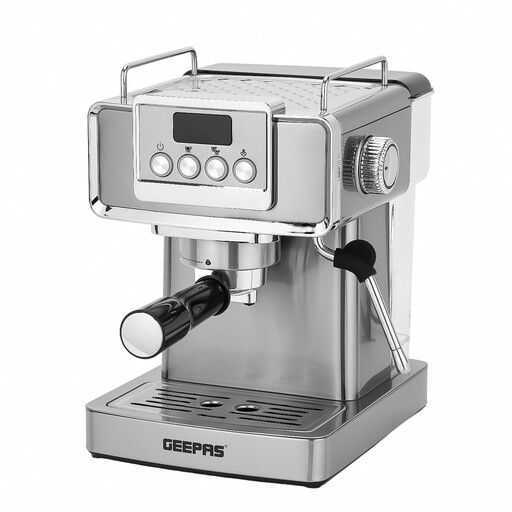
Why This Fits Their Persona: This machine is an excellent starting point for someone eager to learn the craft of espresso making. It provides the essential tools—a high-pressure pump and a manual steam wand—without an overwhelming price tag, allowing you to focus on mastering your technique with ground coffee.
It avoids the integrated grinder gamble. By focusing on being a solid ground coffee machine, it encourages you to pair it with a separate, quality burr grinder of your choice, giving you better control over your final brew.
The manual steam wand offers the hands-on experience needed to learn how to properly texture milk for lattes and cappuccinos. The 1.8-litre water tank is also generous for its class.

Why This Fits Their Persona: For those who want fresh, bean-to-cup coffee without the multi-step process, this machine is a strong contender. It integrates grinding, brewing and steaming into a single, streamlined unit, perfect for busy mornings.
It directly addresses the integrated grinder pitfall by including an adjustable burr grinder with 20 settings and PID temperature control. These features are typically found in more advanced setups and ensure consistency in grind and temperature.
The combination of a highly adjustable grinder, PID control and a pre-infusion function provides a level of quality and convenience that is difficult to find in its category.
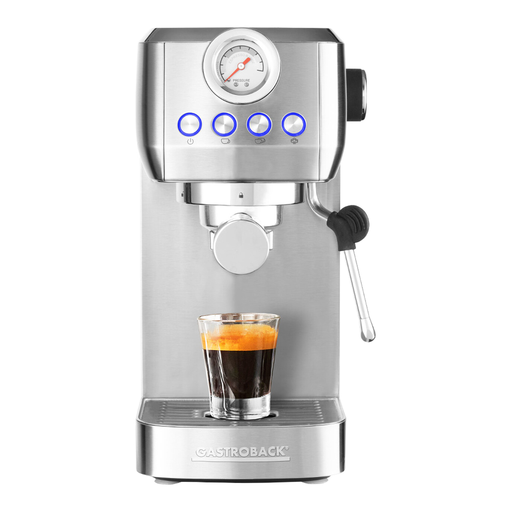
Why This Fits Their Persona: Living in a UK home often means making the most of limited counter space. This machine is designed for that exact scenario. At only 15cm wide, it delivers serious performance without dominating your kitchen.
It proves that small size doesn't mean compromising on quality. It avoids the trap of underpowered compact machines by using a professional-grade 15-bar ULKA pump and a dual-circuit thermoblock system for stable brewing.
Its ultra-slim footprint is its standout feature. The inclusion of a pressure gauge (manometer) also gives you valuable real-time feedback on your extraction, a feature often missing on compact models.
We have compiled a complete, real-time list of products that fully satisfy these strict selection criteria and UK safety regulations.
Not necessarily. The ideal pressure for extracting espresso is around 9 bars. Both 15-bar and 20-bar pumps are more than capable of achieving this. The crucial factor is the machine's ability to maintain a stable pressure throughout the shot. A machine with a high-quality 15-bar pump that delivers consistent pressure will produce better coffee than a machine with a poor-quality 20-bar pump that fluctuates. Don't let the higher number be the sole deciding factor.
This depends on the hardness of the water in your area of the UK. In hard water areas, you may need to descale every 1-2 months, while in soft water areas, every 3-4 months might be sufficient. Most machines have an indicator light, but a good rule of thumb is to descale regularly to prevent limescale build-up, which can affect temperature, pressure and the lifespan of your machine. Always use a descaling solution designed for coffee machines.
You can, but you may not get the results you are hoping for. Most pre-ground coffee is not fine enough for a non-pressurised portafilter basket, which is standard on many semi-automatic espresso machine models. This can lead to a fast, watery shot with little crema. For a better experience, using a pressurised (or dual-wall) filter basket, which some machines include, can help. However, for the most authentic flavour, grinding your own beans just before brewing is always recommended.