
24/7 Customer Support

Free returns

Same-day & Next-day Delivery

Quality Guaranteed

Unlock Your Welcome Offers: FREE Delivery | Up to 80% OFF | Free 30-day JoyPlus trial
Download the APP
Tired of the daily expense of café-bought coffee, or simply looking to upgrade from instant or pod machines? Bringing the authentic coffee shop experience into your kitchen is more accessible than ever. An espresso machine with milk frother is the key to unlocking barista-quality lattes, cappuccinos and flat whites from the comfort of your home.
However, the market is filled with options, and technical terms like 'bar pressure' and 'thermoblock' can be confusing. As the Joybuy Product Recommendation Officer, my role is to help you navigate these choices. This guide will walk you through the essential features to consider and present a selection of machines that offer a great balance of performance, style and value for UK homes.
Before diving into specific models, let's clarify a few key features. Understanding these will help you identify the right barista style coffee machine for your needs.
You will often see machines advertised with 15 bar or even 20 bar pressure. 'Bar' is a unit of atmospheric pressure. To extract true espresso, hot water needs to be forced through finely-ground coffee at high pressure. The industry standard for this extraction is around 9 bars.
So why do machines advertise higher numbers? A higher-rated pump provides a reliable buffer, ensuring the machine can consistently deliver the necessary 9 bars at the group head (where the coffee is made), even if the coffee grind isn't perfect. Both 15 and 20 bar machines are more than capable of producing a rich, flavourful espresso with a stable crema.
Kitchen counter space is a valuable commodity. Before you buy, measure the area where you plan to place your new machine, paying attention to height, especially if you have overhead cabinets. Many modern machines are designed as a compact espresso machine, offering a slim profile without sacrificing performance. Look for models with removable water tanks and drip trays, as this makes them much easier to clean and maintain in a tight space.
For many, the ability to create silky, frothed milk is the main reason to upgrade. A coffee machine with steam wand gives you complete manual control. While it takes a little practice, a steam wand allows you to texture milk precisely for different drinks—from the fine microfoam needed for a latte to the thicker, airier foam for a classic cappuccino. This hands-on approach is central to the home barista experience.
Here are a few recommendations that stand out for their features, design and suitability for creating excellent coffee at home.

Why It Stands Out: The IAGREEA machine is built around a powerful 20-bar Italian pump, designed to maximise flavour extraction from your coffee grounds. Its durable stainless-steel housing gives it a premium look that fits well in modern kitchens. With separate thermostats for brewing and steaming, it offers a degree of precision often found in more expensive models, ensuring both your espresso and milk are at their ideal temperatures.
Pros:
Who is it for? This is an excellent choice for the aspiring home barista who values both aesthetics and performance. If you want a machine that looks the part and has the power to pull consistently great shots of espresso, the IAGREEA CM3050-2 is a strong contender.

Why It Stands Out: The GASTROBACK Piccolo Pro is a masterclass in efficient design. At just 15 cm wide, it's one of the most compact yet feature-rich machines available. It doesn't skimp on professional features, boasting a 15-bar ULKA pump, a pressure gauge (manometer) for real-time feedback and a dual-circuit thermoblock for rapid heating. Its versatility is another key selling point, as it works with both ground coffee and E.S.E. (Easy Serving Espresso) pods.
Pros:
Who is it for? This machine is perfect for those with limited counter space who refuse to compromise on quality. The added flexibility of using E.S.E. pods makes it a great option for households where convenience is just as important as control.
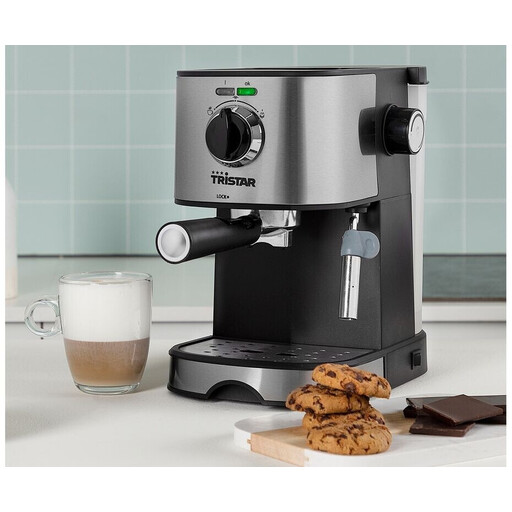
Why It Stands Out: The Tristar CM-2275BS is a straightforward and effective cappuccino maker for home use. It focuses on the essentials, delivering them well. It features a reliable 15-bar pressure pump, the ability to brew one or two cups at once and a simple rotary control dial. Its compact, dark finish allows it to blend in discreetly, while the 1.2-litre water tank is generous for a machine of its size. It’s a practical and accessible entry point into the world of home espresso.
Pros:
Who is it for? This is an ideal machine for beginners or anyone seeking a no-fuss, affordable way to start making authentic coffee at home. If you want to move away from pods and learn the basics of pulling shots and steaming milk, the Tristar offers a solid starting point.
If you already own an espresso maker without a steam wand or prefer an automated process, a standalone milk frother can be a fantastic addition to your setup. These devices are designed specifically to heat and froth milk to perfection with the touch of a button.
Explore our full range of milk frothers for espresso machines to find the perfect partner for your setup.
Both 15-bar and 20-bar pumps are more than capable of producing the 9 bars of pressure required for a proper espresso extraction. The higher rating simply provides a larger performance buffer. The quality of your coffee beans and the consistency of your grind will have a more noticeable impact on the final taste than the difference between a 15 and 20-bar pump.
No, you can only use E.S.E. (Easy Serving Espresso) pods in a machine that is specifically designed to be compatible with them. These machines, like the GASTROBACK Piccolo Pro, come with a special filter basket that fits the pods. A standard ground coffee machine will not accommodate them.
A coffee machine with steam wand gives you manual control to inject hot steam into milk, allowing you to create different textures for various drinks (e.g., silky microfoam for a flat white or thick foam for a cappuccino). It requires some practice. An automatic frother is a separate, one-touch device that heats and whips milk to a consistent texture, offering convenience over customisation.