
24/7 Customer Support

Free returns

Same-day & Next-day Delivery

Quality Guaranteed

Unlock Your Welcome Offers: FREE Delivery | Up to 80% OFF | Free 30-day JoyPlus trial
Download the APP
Choosing between today’s espresso machines is not simply a matter of selecting the highest bar rating or the most attractive finish. UK buyers also need to consider counter space, socket requirements, cleaning routines, coffee format and how much control they actually want over each cup.
A compact machine may suit a flat with limited worktop space, while a portable espresso maker could be more useful for camping or commuting. The right choice depends on how and where you drink coffee.
Many machines advertise 15-bar or 20-bar pumps. This describes the pump’s maximum capability, not necessarily the pressure at which coffee is extracted. Grind size, dose, tamping, water temperature and the quality of the coffee also affect the result.
A 20-bar espresso machine can offer useful pressure capacity, but the number should be assessed alongside temperature control, pre-infusion and the portafilter design.
Coffee oils collect in the filter basket, group head and drip tray. Steam wands also need wiping and purging after milk preparation. A machine with removable parts and a visible or removable water tank is generally easier to maintain than one that is difficult to access.
Limescale is another practical concern in many UK homes. Check whether the machine supports descaling and follow the manufacturer’s instructions for your water type.
A machine may look compact from the front but still need room above it for a water tank or behind it for ventilation. Measure the available space, including clearance for removing the tank and opening the brewing area.
For small kitchens, a compact espresso machine with a narrow width can be more useful than a larger model with extra functions that are rarely used.
A semi-automatic espresso machine uses ground coffee in a portafilter. It gives you control over the dose, grind and extraction, but requires more preparation and cleaning.
A manual coffee machine is suitable for people who enjoy adjusting their brew and frothing milk themselves. By comparison, a capsule coffee machine offers quick, repeatable preparation with less mess, although you are tied to compatible capsules and their ongoing cost.
A bean-to-cup coffee machine usually grinds beans automatically and can be convenient for households that want freshly ground coffee without manual dosing. It is typically larger and may involve more internal cleaning.
Look for a clearly stated pump rating, but do not treat it as the only performance measure. Features such as low-pressure pre-infusion, NTC temperature control or separate brewing and steaming thermostats can help make operation more consistent.
The supplied models range from 15-bar to 20-bar pump systems. These figures are useful for comparison, but they do not by themselves guarantee a particular taste or crema.
A coffee machine with milk frother should have a steam wand that can be wiped and cleaned easily. A manual wand gives more control but requires practice, while an automatic milk system may be simpler for frequent users.
For capacity, a 0.7-litre tank may suit occasional use, whereas 1.1 to 1.7 litres is more practical for multiple drinks. Stainless steel housing can provide a wipe-clean exterior, but check the machine’s dimensions and weight before buying.
UK models should be suitable for the local electrical supply, normally 220–240V, 50Hz, and should be used with an appropriate earthed socket. Always read the supplied safety and installation instructions.

Why This Fits Their Persona: A straightforward option for new home users who want espresso and milk-based drinks without a large appliance.
The visible water tank makes refill levels easier to monitor, while the detachable drip tray supports routine cleaning.
15-bar extraction, steam function, visible water tank and high-temperature, pressure-release and power-off safety features.
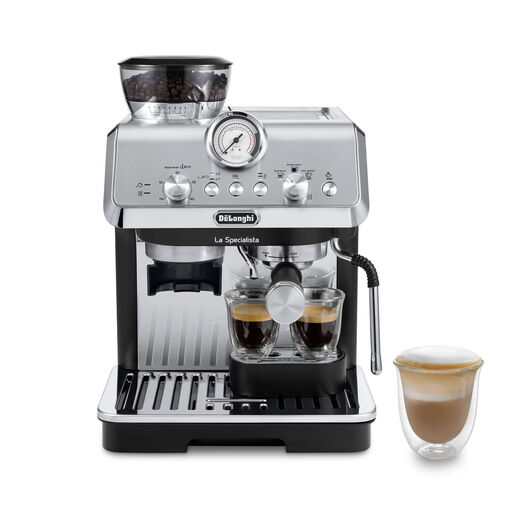
Why This Fits Their Persona: Suits coffee drinkers who want integrated grinding alongside manual tamping, extraction and milk steaming.
Its integrated grinder avoids the need to buy a separate grinder, while eight grind settings provide adjustment rather than a fixed setting.
15-bar pump, three infusion temperatures, 1.7-litre removable tank and manual steam wand.

Why This Fits Their Persona: A handheld format for camping, travel, caravanning or use away from a conventional kitchen worktop.
The digital display shows temperature and brewing time, while marked 50ml, 75ml and 100ml levels help avoid overfilling.
20-bar pump, 7500mAh battery, USB-compatible charging and a stainless steel marked water tank.
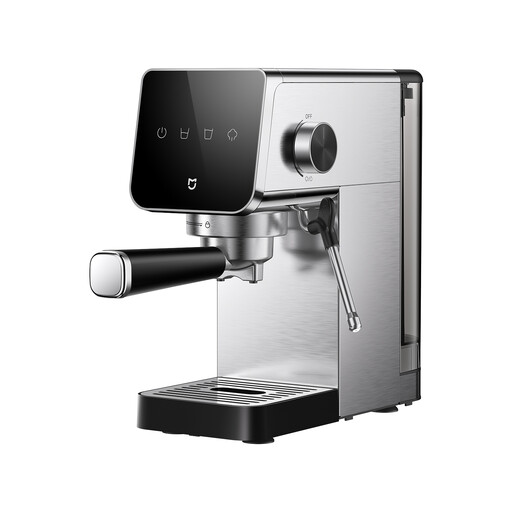
Why This Fits Their Persona: Its 13.7cm-wide body is suited to narrow worktops, flats and compact coffee corners.
The stated dimensions make it easier to check fit before purchase, while low-pressure pre-infusion and NTC temperature control provide useful specification detail beyond the pump rating.
20-bar pump, 0.9-litre tank, rotary steam wand, touch controls and single or double serving options.
We have compiled a complete, real-time list of products that fully satisfy these strict selection criteria and UK safety regulations.
Electricity is only one part of the cost. Ground coffee, beans, capsules, milk and descaling products also contribute. Capsule systems may be convenient but require compatible pods, while manual and semi-automatic machines allow you to choose coffee from different suppliers.
Switching the machine off when it is not needed and using the correct cup volume can help reduce unnecessary energy and water use.
Lifespan depends on construction, frequency of use, water quality and maintenance. Empty the drip tray regularly, rinse removable parts, clean the steam wand after milk use and descale according to the instructions. Do not force a portafilter or operate the machine without sufficient water.
Many semi-automatic models can dispense hot water for an Americano or longer drink. They do not brew filter coffee in exactly the same way, but a larger espresso followed by hot water can suit users who want more than short shots. Check the listed functions before purchasing.