Short-shot control seekers
If ristretto is the point of the trip, look for a way to stop or programme the extraction rather than relying on a standard espresso button. A ground-coffee workflow also means preparing the dose and tamp consistently.


Choose a compact plug-in espresso machine if the cottage has a suitable socket and worktop and the machine lets you stop or programme a short shot. A hand-powered maker is easier to pack, but it needs a separate hot-water source and more hands-on preparation; check how you would control the output before relying on it for ristretto.
If ristretto is the point of the trip, look for a way to stop or programme the extraction rather than relying on a standard espresso button. A ground-coffee workflow also means preparing the dose and tamp consistently.
A compact plug-in machine may fit a small cottage kitchen, provided there is also a suitable socket and a stable, dry, heat-resistant place to use it.
A portable manual maker avoids packing a countertop machine. It makes more sense if you can obtain hot water and are happy to manage the coffee preparation and pumping yourself.
Choose it when: You have a suitable indoor socket and worktop and want to stop or programme a short extraction without hand-pumping each drink.
Allow for: Carrying or sourcing the coffee, preparing it and cleaning a mains appliance during your stay.
Choose it when: Packing a countertop machine is impractical and you can obtain hot water at the cottage.
Allow for: Manual pressing and more attention to the grind, dose and tamp.
| Concern | What to check | Who this matters to |
|---|---|---|
| Short-shot control | Check whether the exact model lets you stop the shot manually or programme its output. Confirm that it accepts the coffee format you intend to use. | I want to make a shorter ristretto-style extraction, not assume the one-cup button will do it for me. Around 36% of consumers put that output control first. |
| Worktop and power | Measure the available space and check the appliance rating against the supply. Sage instructs Bambino Plus users to choose a stable, level, dry, heat-resistant indoor surface. | In a cramped kitchen, I need to know where a plug-in machine can sit and be used safely. For around 29% of consumers, suitable space and power are the main concern. |
| Travel and hot water | Check whether the maker heats water and what coffee preparation and manual pressing it requires. Wacaco says its Picopresso does not heat water. | I would rather carry a hand-powered maker than a countertop machine, provided I can obtain hot water. Portability is the first priority for around 21% of consumers. |
| Coffee format | Confirm ground-coffee or E.S.E.-pod compatibility for the exact model, then check whether its output can be adjusted for a short shot. | For a short stay, I want coffee that is straightforward to pack and prepare without losing sight of the shot I want. Around 14% of consumers put that flexibility first. |
A standard preset does not establish the reduced-water, short extraction you want. The setting may need adjusting for your coffee and preferred output.
Choose an exact model that lets you stop or programme the shot, then check the output when you prepare your recipe.
Wacaco says the Picopresso does not heat water and requires attention to grind size, tamping and pulling technique.
Before travelling, check that you can obtain hot water safely and bring coffee prepared for the maker you choose.
A narrow machine still needs an appropriate supply and a suitable surface. Sage instructs Bambino Plus users to operate it indoors on a stable, level, dry, heat-resistant surface.
Check the cottage counter and socket before bringing a plug-in machine; ask the host if the setup or permission is uncertain.
The Bambino Plus is a compact plug-in option for a conventional portafilter workflow with manual and programmable shot control.
The Dedica EC685 is a slim plug-in option for a cottage worktop, with ground-coffee and E.S.E.-pod compatibility.
The Picopresso is a hand-powered option for travellers who would rather pack a portable maker than a countertop machine.
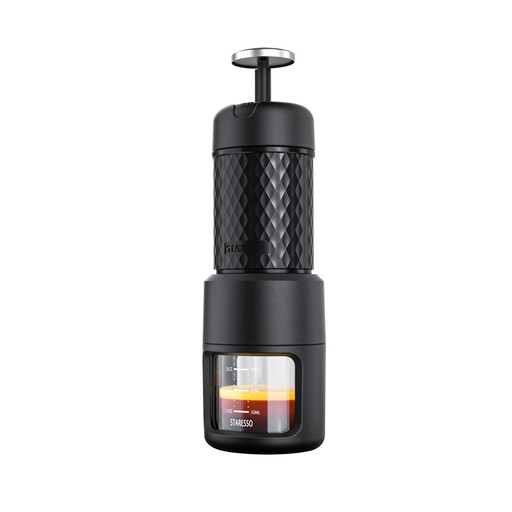
These hand-powered STARESSO models suit travellers considering a portable setup rather than a plug-in cottage machine. If ristretto is your aim, check how you would stop each shot at the output you want.
 No image available
Consider this model if you want to pack a hand-powered maker and use either capsules or ground coffee. Its product name specifies a 304 stainless-steel liner. Check how you would stop the shot at your preferred short output, and plan for a separate hot-water source.
 No image available
Consider this ground-coffee model if you want to avoid packing a plug-in espresso machine. It uses a manual workflow; check its shot-stopping method for ristretto and make sure you can obtain hot water at the cottage.
Not necessarily: a one-cup preset does not tell you whether the machine will produce the reduced-water short extraction you want. Look for manual stopping or programmable shot volume, then adjust the output to your coffee and taste.
It can be if you can obtain hot water and are willing to prepare the coffee and press each shot by hand. Wacaco says its Picopresso does not heat water, so plan for a separate safe hot-water source.
Check the appliance rating against the available supply and make sure there is a suitable indoor worktop. Sage instructs Bambino Plus users to choose a stable, level, dry, heat-resistant surface; ask the cottage host if the socket, space or permission is uncertain.
Do not assume one test method or interval applies to every cottage setup. Health and Safety Executive guidance for employers in low-risk environments says equipment must be maintained to prevent danger but does not prescribe a particular maintenance method or frequency. Operators should check the obligations that apply to their property; guests can ask the host about a supplied appliance if concerned.
Follow the instructions for the exact model and clear away used coffee after brewing. Check its guidance for the drip tray, cleaning and descaling rather than treating all espresso machines alike; De'Longhi provides model-specific support material for Dedica machines.