Mixed-caffeine family hosts
If you serve both regular and decaf coffee, the way you change beans or load ground coffee matters more than a long drink menu. De'Longhi and JURA document different routes for doing this on the models discussed below.


Choose the decaf workflow before comparing drink menus: interchangeable bean hoppers suit households that regularly switch between whole-bean coffees, while a ground-coffee chute suits an occasional decaf drink. For a family meal, weigh automatic milk preparation against hands-on texturing and check how many drinks you can prepare comfortably in sequence. Neither decaf route guarantees that no caffeine remains in the brewing path.
If you serve both regular and decaf coffee, the way you change beans or load ground coffee matters more than a long drink menu. De'Longhi and JURA document different routes for doing this on the models discussed below.
An automatic Flat White programme can reduce hands-on milk preparation when several people want a drink. Check the model's milk-system cleaning routine as part of that choice; JURA specifies daily frother cleaning after milk preparation for its E8.
A steam wand gives you direct control over milk texturing, but preparing and steaming for each drink takes active work. Sage's Barista Express Impress pairs assisted puck preparation with a manual steam wand.
Choose when: Your family regularly alternates between regular and decaf whole beans; De'Longhi lists Bean Switch on the Rivelia LatteCrema EXAM440.55.W.
Allow for: A hopper change is not a guarantee that the brewing path contains no grounds from the previous coffee.
Choose when: Decaf is occasional and you would rather leave regular beans in the hopper; JURA lists a ground-coffee chute and Flat White on its E8.
Allow for: You must load ground coffee for the drink, and the chute does not establish caffeine-free separation.
Choose when: You want to prepare the espresso and texture the flat white's thinner microfoam yourself.
Allow for: Each drink needs more attention; an integrated grinder alone does not establish an easy regular-to-decaf changeover.
| Concern | What to check | Who this matters to |
|---|---|---|
| Decaf changeover | Check the exact variant for interchangeable hoppers or a ground-coffee chute. For strict caffeine avoidance, ask the manufacturer about retained grounds and the brewing path. | If I regularly serve both coffees, I want to change to decaf without emptying a fixed hopper each time. Around 33% of consumers would put this changeover need first. |
| Milk preparation | Confirm whether the model offers a Flat White programme, automatic milk preparation or a steam wand, and check its cleaning instructions. | When several guests want flat whites, I would rather spend less time steaming milk for each cup. Around 27% of consumers would make low-effort milk preparation their primary concern. |
| Serving sequence | Compare water capacity and the documented brew-and-steam sequence; do not assume simultaneous operation. | I want to keep drinks moving around the table without an inconvenient refill or wait between steps. For around 20% of consumers, that serving sequence would matter most. |
| Hands-on control | Look at grinder adjustment, assisted preparation and the type of milk wand on the exact machine. | If I enjoy adjusting espresso and texturing milk myself, I can accept a more involved routine. Around 20% of consumers would prioritise that control. |
Bean switching and ground-coffee functions describe how coffee is loaded, not whether the shared brewing path is free of retained grounds. That distinction is especially important when caffeine avoidance is a strict requirement.
Ask the manufacturer for model-specific guidance on retained grounds, purging and the brewing path before relying on a machine for strict caffeine avoidance.
Automatic milk preparation still brings a cleaning routine. JURA's E8 instructions call for daily fine-foam-frother cleaning when milk has been prepared.
Read the exact model's care instructions and decide whether that routine fits the way you will use the machine.
A flat white calls for relatively thin microfoam, while an automatic machine follows its programmed milk treatment. A menu label alone does not tell you how closely the result matches the texture you want.
Check the exact machine's recipe and milk settings, or choose a steam wand if direct texture control is more important to you.
Refills and the order of brewing and steaming can interrupt a run of drinks. Sage describes dual-boiler operation as allowing milk steaming while an espresso shot is extracted, but that ability should not be assumed for other machines.
Check tank capacity and the documented preparation sequence against the number of people you normally serve.
Relevant if you want to explore a compact bean-to-cup route for regular and decaf drinks.
Relevant if an automatic Flat White programme and a ground-coffee route suit your occasional decaf needs.
Relevant if you prefer assisted espresso preparation or manual control of milk texture.
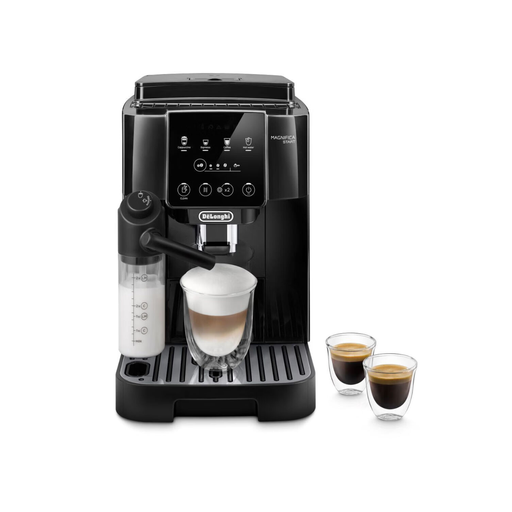
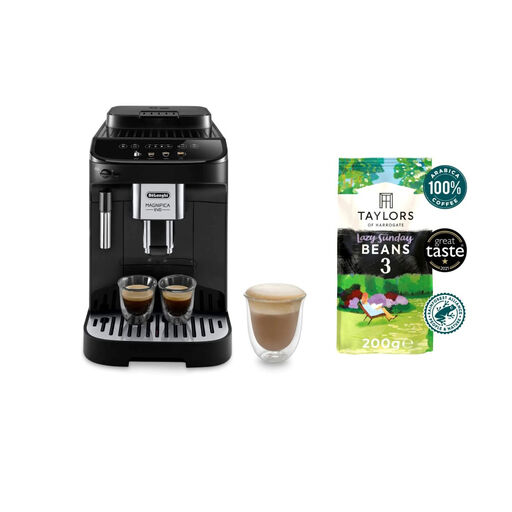
These De'Longhi bean-to-cup choices offer either automatic milk preparation or a manual milk frother. For a decaf flat white at a family meal, confirm the exact variant's decaf changeover and milk settings before choosing between them.
 No image available
Consider this bean-to-cup model if you prefer automatic milk preparation to using a steam wand. The listing names four one-touch recipes; check whether its settings produce the flat white you want and how you would change from regular to decaf coffee.
 No image available
This bean-to-cup variant is another option if you want less hands-on milk preparation when serving family. Confirm its flat-white settings and decaf changeover procedure for the exact model rather than assuming either from its automatic-milk description.
 No image available
Consider the milk-frother variant if you are willing to texture milk yourself for each flat white. This bundle includes Taylors of Harrogate Lazy Sunday Coffee Beans 200g; check whether those beans meet your decaf needs, and confirm the machine's regular-to-decaf changeover procedure separately.
 No image available
This bean-to-cup model suits someone prepared to use its milk nozzle rather than rely on automatic milk preparation. Its name specifies four one-touch recipes; check the exact milk-texturing guidance and decaf changeover procedure before planning several flat whites.
An automatic machine with a documented ground-coffee function is a practical route. De'Longhi lists that function and Flat White for the Rivelia LatteCrema EXAM440.55.W, while JURA lists Flat White and a powder chute for its E8; neither feature proves zero caffeine carryover.
Consider one when your household frequently alternates between regular and decaf whole beans. De'Longhi lists Bean Switch on the Rivelia LatteCrema EXAM440.55.W, but ask the manufacturer about retained grounds and purging if strict caffeine avoidance matters.
Aim for the relatively thin, silky microfoam used in a flat white rather than a thick cap of foam. Sage's milk-frothing guidance gives approximately 60–65°C as a target for dairy milk; check the machine's instructions as you practise texturing.
Follow the exact machine's milk-system instructions rather than treating automatic preparation as maintenance-free. JURA specifies daily fine-foam-frother cleaning on the E8 when milk has been prepared.
Confirm the machine's voltage, plug arrangement and intended supply market with the seller. The Office for Product Safety & Standards states that the Electrical Equipment (Safety) Regulations 2016 set requirements for placing electrical equipment on the Great Britain market; Northern Ireland has separate guidance.