For a breakfast table where some people want regular coffee and others want decaf, choose the coffee-input route before comparing drink presets. Interchangeable bean hoppers make changing beans more convenient, while a one-touch machine with a pre-ground function lets you keep ground decaf separate; neither route should be assumed to prevent coffee carry-over. A portafilter lets you dose ground decaf directly, but preparing several lattes takes more hands-on work.
Who each workflow suits
Households making regular and decaf drinks
If both kinds of latte are served at the same breakfast, look at how the machine accepts each coffee. Interchangeable bean storage or a pre-ground route may be more useful than a long list of drink presets. De'Longhi and Melitta describe these routes for selected models, though bean switching alone does not establish complete separation.
Families wanting less morning preparation
If several people want milk drinks, automatic milk preparation and saved drink preferences can reduce the steps between orders. Check water capacity and the cleaning required after milk use as well as the drink menu.
Hands-on espresso makers with limited space
A compact portafilter machine suits someone willing to measure and prepare ground decaf for each drink. It gives direct control over the coffee loaded into the basket, but it does not turn a sequence of family lattes into a one-touch task.
What matters at breakfast
For a family breakfast involving decaf lattes, decide whether coffee switching, serving several drinks, hands-on preparation or worktop space is your main priority. Then check the milk workflow on the exact machine.
| Concern |
What to check |
Who this matters to |
| Regular and decaf switching |
Look for interchangeable hoppers or a pre-ground function. If caffeine carry-over matters, ask about retained coffee in the exact model. |
I need regular and decaf drinks at the same breakfast without repeatedly emptying a hopper; around 36% of consumers put switching first. |
| Serving several lattes |
Check automatic milk recipes, water capacity and which cleaning steps remain after each use. |
When several drinks are waiting, I would rather repeat a straightforward milk-drink routine than prepare each espresso by hand; roughly 29% of consumers prioritise easier serving. |
| Control over each dose |
Check whether ground decaf goes directly into a portafilter, whether a grinder is built in and how the milk wand works. |
I want to choose the coffee loaded for each latte and am content to prepare it myself; around 14% of consumers place hands-on control first. |
| Worktop space |
Measure width, depth and height, including access to the water tank and space for milk equipment or a separate grinder. |
In a smaller kitchen, I need the complete setup to fit, not just the machine; about 21% of consumers make space their primary concern. |
Mistakes to avoid
-
Assuming a bean switch means complete decaf separation
Changing hoppers can be convenient, but it does not by itself establish what remains in a grinder. Melitta says coffee from the previous variety may remain in the Barista SE mill system and that a complete change can take two to three cups; that statement applies to the Barista SE, not every switching machine.
If avoiding caffeine carry-over is medically necessary, obtain written clarification from the manufacturer about the exact model rather than relying on a multi-hopper description.
-
Choosing one-touch milk drinks without a decaf input route
An automatic latte menu is less useful for a mixed breakfast if the coffee input does not suit your decaf routine. De'Longhi lists a pre-ground function for Magnifica Plus and both interchangeable hoppers and a pre-ground function for Rivelia LatteCrema.
Check the precise model's instructions for selecting ground coffee or changing beans before deciding how each drink will be made.
-
Underestimating portafilter preparation
Directly loading ground decaf offers control over each dose, but making several lattes still involves preparing individual coffees. Sage's Bambino Plus has an automatic steam wand, not an integrated bean-to-cup workflow.
Choose a portafilter routine if someone is willing to prepare each espresso, including during a busy breakfast.
Using whole decaf beans with the Bambino Plus also calls for a separate grinder.
-
Equating automatic milk preparation with no upkeep
De'Longhi describes one-touch cleaning after milk use on Magnifica Plus, but that does not replace the machine's wider care and descaling routine.
Read the model's milk-system and descaling instructions so the regular cleaning steps fit your household routine.
Cleaning supplies and, where applicable, filters remain part of ongoing use.
Brands to consider for these workflows
De'Longhi
Its Magnifica Plus and Rivelia LatteCrema lines are relevant to households considering automatic milk drinks alongside different ways of supplying decaf.
- De'Longhi specifies a pre-ground function, LatteCrema Hot preparation and four profiles for Magnifica Plus ECAM322.70.SB; Rivelia LatteCrema adds interchangeable bean hoppers.
- Interchangeable hoppers should not be treated as evidence of zero retained coffee. Confirm the exact model's switching and cleaning instructions if separation matters.
Sage
Its portafilter machines suit buyers willing to take a more active role in making decaf espresso.
- Sage specifies a 54 mm portafilter, 18 g dose and automatic steam wand for the Bambino Plus. The Barista Express Impress instead includes a grinder and assisted tamping.
- The Bambino Plus needs a separate grinder for whole beans; the Barista Express Impress retains manual milk texturing and a single integrated bean-hopper workflow.
Melitta
The Barista SE provides a reference point for households considering a bean-to-cup machine with two-compartment bean storage.
- Melitta specifies four saved preferences and a Double Cup mode for numerous drinks on the Barista SE.
- Melitta says coffee from a previous variety may remain in this model's mill system and that a full change can take up to two to three cups.
Joybuy product choices
These semi-automatic espresso machines offer ways to make a latte with ground decaf. Choose between automatic milk frothing and a manual steam wand according to how much preparation you want to do; neither is a one-touch bean-to-cup option.
 No image available
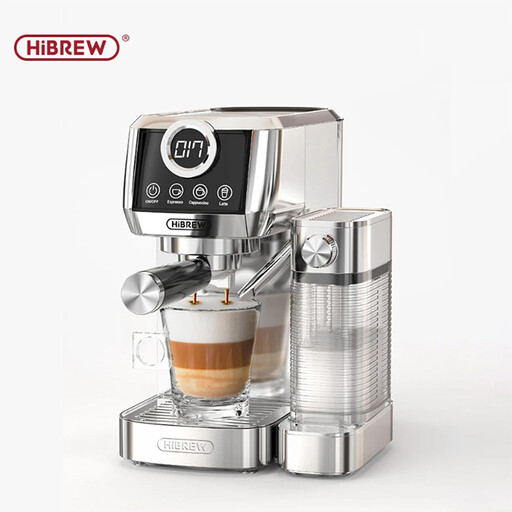
HiBREW H13A 20Bar 3-in-1 stainless-steel espresso machine
Consider this for a ground-decaf latte when you want automatic milk frothing but are comfortable with a semi-automatic espresso routine.
The product name specifies ground-coffee use and automatic milk frothing. Check the milk-system cleaning instructions and ask about retained coffee if strict decaf separation matters.
View on Joybuy
 No image available
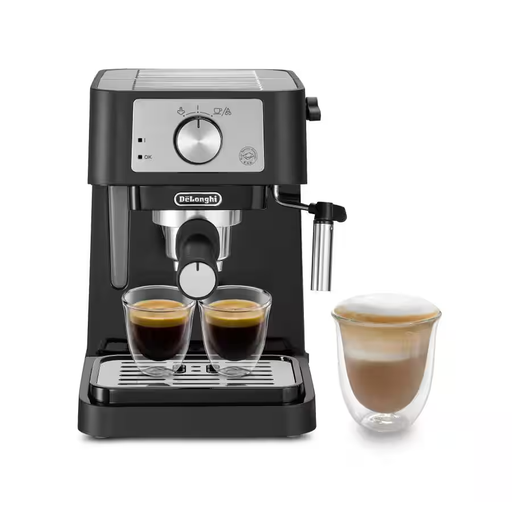
De’Longhi Stilosa EC260.BK 15 Bar espresso machine, black
Consider this compact machine if you want to prepare a ground-decaf espresso yourself and texture milk with a manual steam wand.
Making several breakfast lattes involves preparing each espresso and steaming the milk. Check the wand-care instructions and ask about retained coffee if strict decaf separation matters.
View on Joybuy
Common questions
How can I make regular and decaf lattes at the same breakfast?
Choose a coffee-input routine that lets you prepare both: interchangeable bean hoppers suit frequent changes between whole-bean varieties, while a pre-ground function offers a separate way to supply ground decaf. De'Longhi specifies interchangeable hoppers for Rivelia LatteCrema and a pre-ground function for Magnifica Plus; check the exact machine's instructions before settling on a routine.
Can I use pre-ground decaf for a milk drink on a bean-to-cup machine?
Yes, if the exact model permits pre-ground coffee in the milk-drink workflow you want. De'Longhi lists both a pre-ground function and milk-drink recipes for Magnifica Plus ECAM322.70.SB; confirm the preparation steps for your chosen recipe in its manual.
Does automatic milk cleaning remove the need for maintenance?
No. De'Longhi describes one-touch cleaning after milk use on Magnifica Plus, but owners still need to follow the model's care and descaling instructions.
Does a two-hopper machine prevent regular coffee entering a decaf drink?
A two-hopper feature alone cannot establish that for a particular machine. Melitta warns that coffee from the previous variety may remain in the Barista SE mill system after switching; if avoiding caffeine carry-over is essential, seek written guidance for the exact model you plan to use.


