Family-meal hosts who want fewer steps
If you expect to make several drinks in succession, look at bean-to-cup models whose exact recipe list and milk system suit the drinks your family requests.


Choose a bean-to-cup machine with the iced milk drinks you want if reducing repeated preparation is your priority; choose a manual espresso machine if you would rather control each shot and accept more steps. A dedicated iced-latte programme is not essential: Sage Appliances UK gives a recipe using double espresso, cold milk and ice. Check the exact milk workflow, glass clearance and cleaning requirements before deciding.
If you expect to make several drinks in succession, look at bean-to-cup models whose exact recipe list and milk system suit the drinks your family requests.
If adjusting and preparing each shot matters more to you than serving quickly, a manual machine gives you a more involved routine for every iced latte.
If available width is a constraint, consider a compact manual machine, while allowing for separate milk preparation and enough room for your usual glass.
For iced lattes at a family meal, decide how much preparation you want to repeat for each drink, then compare milk handling, drink settings and kitchen fit.
| Concern | What to check | Who this matters to |
|---|---|---|
| Serving several people | Check whether the exact model prepares coffee and milk automatically, and compare its water and bean capacities with your serving routine. | When several people want drinks in succession, I would rather not repeat every preparation step; around 33% of consumers put a lower-effort serving routine first. |
| Control over each shot | Check the grinder and manual controls, and whether you are willing to grind, dose and extract for each drink. | If I enjoy adjusting the espresso in each iced latte, I can accept a slower routine; roughly 27% of consumers prioritise hands-on control. |
| Iced-drink functions | Read the exact recipe list and distinguish an iced milk drink from iced coffee or Cold Brew alone. | I want to select a cold drink rather than work out its milk steps each time; about 20% of consumers make a dedicated iced-drink function their primary concern. |
| Kitchen fit | Compare the machine’s width, depth, height and glass clearance with your worktop and usual iced-latte glass. | My available worktop space limits what I can use, even if preparing milk separately takes longer; around 20% of consumers put fit first. |
A Cold Brew or iced-coffee setting does not establish how the machine handles milk. De’Longhi lists Cold Brew on the Dedica Duo, which has a manual steam wand, while its Eletta Explore range lists separate cold and iced milk drinks.
Check the exact model’s recipes and whether milk is prepared automatically, frothed separately or added cold by hand.
A stated tank or hopper size cannot tell you how many iced lattes you will make before refilling; drink size and preparation steps matter too.
Compare capacities alongside the drinks you plan to serve, rather than relying on a cup-count assumption.
Automatic milk preparation does not remove the need to clean milk-contact parts. De’Longhi’s care guidance calls for removing milk residue and following the machine’s cleaning instructions.
Before buying, check how the exact carafe or steam wand is cleaned and what its descaling routine requires.
A machine may fit the worktop while leaving too little space beneath its outlet for your iced-latte glass.
Measure the intended space and glass, then compare width, depth, height, clearance and electrical specifications with the exact model.
A manual-espresso option for households that want to take part in preparing each shot.
Its cited UK models span compact manual preparation and bean-to-cup machines with listed iced drinks.
A bean-to-cup option worth comparing when you want a listed iced-coffee recipe.
These choices cover a bean-to-cup model, capsule machines with milk frothers and manual espresso machines. For a family meal, compare how each makes the coffee and handles milk for every serving.
 No image available
Consider this bean-to-cup model if you want to reduce manual coffee preparation when serving several iced lattes. Its title identifies hot and cold drinks; check the exact iced milk recipes, cleaning steps and glass clearance against your routine.
 No image available
For consumers comfortable with a pod-based routine and a separate milk step, this model is listed with an integrated hot-and-cold milk frother, a glass mug and a 1.1 L water tank. Check that its capsule system and the amount of milk prepared per cycle suit your household.
 No image available
This pod machine suits a routine where coffee and milk can be prepared as separate steps for each iced latte. Its listed features include a hot-and-cold milk frother and a 1.0 L water tank; check capsule compatibility and how much cold milk the frother handles at once.
 No image available
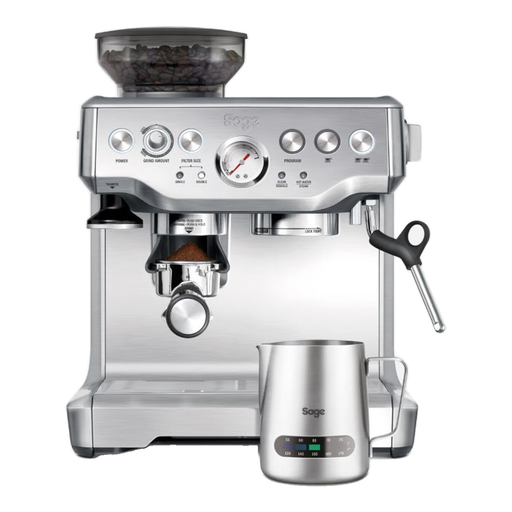
Choose this manual route if preparing each espresso shot is part of the appeal and you can allow time for repeated drinks. The title lists a steam wand and Temp Control milk jug; an iced latte can instead be assembled with espresso, cold milk and ice.
 No image available
Consider this manual machine if worktop fit matters and you are content to prepare milk separately. Its title lists Cold Brew and a steam wand, but Cold Brew is not an automatic iced-latte recipe; measure the exact machine and your glass before ordering.
No. Sage Appliances UK gives an iced-latte recipe using double espresso, cold milk and ice. A dedicated programme may change the preparation steps, so check what it actually does with milk.
Not necessarily. Cold Brew and iced milk drinks are distinct settings: De’Longhi UK lists Cold Brew on the manual Dedica Duo, while its Eletta Explore models list separate cold and iced milk drinks. Check the exact model’s recipe list and milk workflow.
Clean milk-contact parts according to the machine’s instructions after use. De’Longhi’s care guidance addresses removing milk residue; also check the selected model’s deeper-cleaning and descaling routine.
Electrical products displaying the crossed-out wheelie-bin symbol should not go in household rubbish, according to GOV.UK guidance. Check the appropriate local electrical recycling arrangements when disposing of an old machine.