What should a care home check?
Start with the people who will drink the tea, then check the exact product label and whether its flavour and format work for the drinks service.
| Priority | What to check | Your needs |
|---|
| Resident suitability |
Check care plans, swallowing requirements and the support needed to drink. Consider the ingredients of each blend rather than treating all herbal teas alike. |
I want drinks residents can choose and receive in a way that fits their individual assessments. For providers in England, the Care Quality Commission says hydration support must take account of people’s needs and preferences. |
| Ethical certification |
Inspect the mark on the exact pack. The Fairtrade Foundation distinguishes the classic FAIRTRADE Mark, covering ingredients that can be Fairtrade certified, from its mark identifying a particular Fairtrade-sourced ingredient; Fair for Life is a separate scheme. |
Our purchasing policy may require a particular mark, or it may allow a wider range of certified ethical-trade products. I need the label recorded accurately rather than a general claim about the brand. |
| Flavour and serving format |
Check the blend’s ingredients, bag or envelope format and preparation instructions. Offer a choice of flavours where that fits residents’ preferences and service arrangements. |
I want an infusion residents will choose, in a format staff can prepare and serve as required. A caffeine-free description alone does not establish that a particular blend suits everyone. |
| Mint and other botanicals |
Review ingredients against individual care plans and seek relevant clinical or pharmacist advice where a concern has been identified. Royal Papworth Hospital lists mint as a possible reflux trigger. |
If mint worsens someone’s reflux, I want another drink available rather than making a mint infusion the standard herbal choice. |
Brand references
These brand-level details can help form a shortlist; the certification and ingredients still need checking on the product selected.
Clipper
Clipper says all its teas and coffees are Fairtrade certified. Its shop lists an Organic Fairtrade Peppermint Infusion in 25 envelopes.
- The named peppermint pack gives teams a specific Fairtrade-labelled herbal product to assess.
- Check the pack’s ingredients and format against residents’ needs before ordering it for service.
Pukka
Pukka says its teas are certified to the Fair for Life standard. That scheme should be named as such, rather than described as the FAIRTRADE Mark.
- A stated ethical-trade certification offers a route to consider when policy allows schemes beyond the FAIRTRADE Mark.
- Check the exact pack’s certified ingredients and review mint blends for residents who find mint aggravates reflux.
Twinings
Twinings has a UK trade channel and an Organic & Fairtrade tea collection.
- The trade channel gives purchasing teams a place to check foodservice formats.
- Check an individual herbal infusion’s certification before describing it as Fairtrade.
Herbal tea on Joybuy
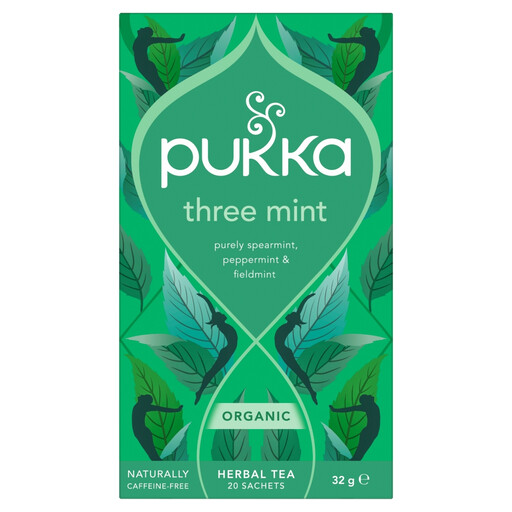
This Pukka mint option is relevant to a care home considering Fair for Life certification; it is not a substitute for a product carrying a required FAIRTRADE Mark.
 No image available
Pukka Organic Three Mint Herbal Tea 20 Sachets 32g
For a drinks service considering a caffeine-free mint infusion: this listing describes 20 sachets (32g). Pukka identifies Fair for Life as its tea certification, but check the label and ingredients on the exact pack before ordering. The product information gives conflicting blend descriptions, and mint may not suit a resident whose reflux is aggravated by it.
View on Joybuy
Common questions
Is Fair for Life the same as the FAIRTRADE Mark?
No. Fair for Life is a separate certification, while the Fairtrade Foundation also distinguishes between its classic FAIRTRADE Mark and Fairtrade Sourced Ingredient Mark. If purchasing policy names a particular mark, check for it on the exact product pack.
Can herbal tea contribute to a care-home resident’s fluid intake?
Yes, tea can be one of the drinks offered, provided it fits the resident’s assessed needs. Leeds City Council’s care guidance includes tea among fluids and advises staff to refer to the person’s care plan or assessment.
Should mint herbal tea be offered to every resident?
No single blend will suit everyone. Check individual preferences and care plans; Royal Papworth Hospital identifies mint as a possible reflux trigger, so a non-mint option may be needed for a resident affected by it.
What should a home check before ordering a larger tea format?
Check the exact product’s certification label, ingredients, bag or envelope format, case quantity, storage instructions and expiry date, as well as whether it works for the home’s drinks service. A brand’s general retail or trade information does not establish those details for every herbal infusion.


