
24/7 Customer Support

Free returns

Same-day & Next-day Delivery

Quality Guaranteed

Unlock Your Welcome Offers: FREE Delivery | Up to 80% OFF | Free 30-day JoyPlus trial
Download the APP
Switching to an electric vehicle is a significant step, but the journey doesn't end at the dealership. One of the first and most important purchases you'll make is an EV charging cable. With a market full of technical jargon and varying standards, it's easy to make a poor choice that leads to slow charging, premature failure or even safety risks.
As the Joybuy Product Recommendation Officer, my role is to help you navigate these choices. We've seen where UK drivers often go wrong. Before you spend a penny, let's look at the three most common pitfalls to avoid when buying an EV charging cable in the UK.
To make a confident purchase, you only need to focus on a few core parameters. Getting these right ensures your cable is safe, efficient and built to last.
For public and home AC charging in the UK and Europe, the Type 2 connector is the established standard. Nearly all new electric vehicles sold here, from Tesla to Hyundai and Volkswagen, use a Type 2 inlet. If you're buying a cable for a public charging station or a home wallbox, you will almost certainly need a Type 2 charging cable. Older vehicles or imports from other regions might use a Type 1 connector, so it's always worth a quick check of your vehicle's charging port.
This is where buyers often get confused. Your charging speed is determined by the weakest link in the chain: the charging station's output, the cable's rating and your car's On-Board Charger (OBC) capacity.
The need for reliable power extends to all our gadgets. A high-quality USB C to USB C fast charge cable is now essential for modern laptops, tablets and smartphones. When choosing one, look for its maximum power output (e.g., 60W for standard laptops, 100W+ for more powerful models) and durable construction. For powering multiple devices, a multi-port UK travel adapter or a dedicated car charger with both USB-C and USB-A ports can keep everything running smoothly on the go.
We've matched some reliable charging solutions to common UK driver profiles. This isn't about finding a single "best" product, but the right tool for your specific needs.
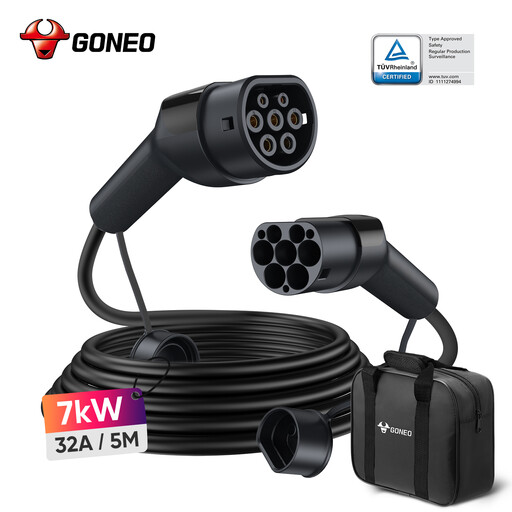
Why This Fits Their Persona: This cable is ideal for the majority of UK EV owners who have a standard 7kW wallbox installed at home. The 5-metre length is practical for most driveways and garages without creating excess cable clutter.
It directly addresses the power mismatch trap by being rated for 7.2kW. Its IP54 rating and durable TPU jacket counter the durability pitfall and it is T?V certified for safety.
Perfectly matched for the most common UK home charging setup. The included carry bag helps with tidy storage and transport.
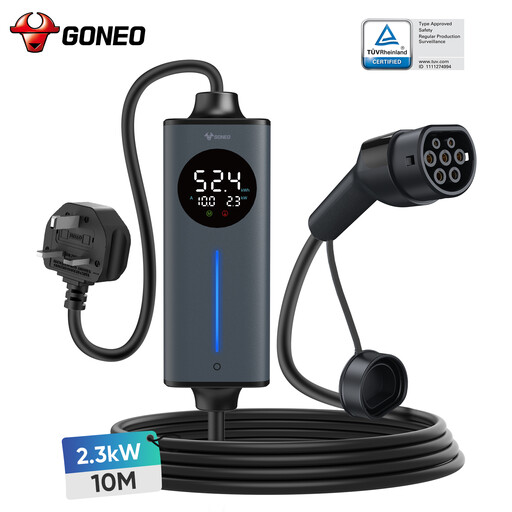
Why This Fits Their Persona: For those without a dedicated wallbox, this portable charger is a lifeline. The generous 10-metre length provides crucial flexibility, easily reaching a standard 3-pin socket from the driveway or when parked awkwardly.
This charger has an excellent IP66 waterproof rating, making it highly resilient to British weather. It also features multiple built-in safety protections, including leakage detection and temperature monitoring, to avoid safety risks.
Offers true plug-and-play convenience with no installation needed. The adjustable current and delayed charging function allow you to manage energy use and take advantage of off-peak electricity tariffs.
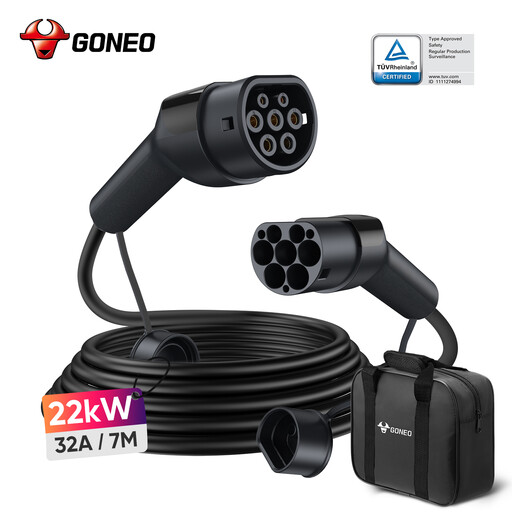
Why This Fits Their Persona: For drivers of high-end EVs with 11kW or 22kW on-board chargers, this cable unlocks the fastest possible AC charging speeds at compatible public stations. The 7-metre length is a practical choice for reaching charge points in various car park layouts.
By being specifically rated for 22kW, it avoids leaving charging performance on the table. It is also T?V certified and features a robust TPU jacket, addressing both safety and durability concerns for high-power usage.
Enables maximum AC charging speed for compatible vehicles, significantly reducing waiting times at public chargers compared to a standard 7kW cable.
We have compiled a complete, real-time list of products that fully satisfy these strict selection criteria and UK safety regulations.
Yes, it can be safe, provided the charger itself is high quality and your home's wiring is in good condition. Reputable portable chargers include multiple safety layers, such as dual leakage protection (RCD), earth detection and over-temperature sensors that automatically reduce power or shut down if a fault is detected. If you plan to use one regularly, it is always a good idea to have a qualified electrician inspect the socket you intend to use.
The lifespan of an EV charging cable depends heavily on its build quality and how it's treated. A cable with a high-quality TPU (Thermoplastic Polyurethane) jacket will far outlast a cheaper PVC one, as it offers better resistance to abrasion, oil and extreme temperatures. Look for features like reinforced connectors and high bend-test ratings. To maximise its life, always coil the cable loosely for storage—never wrap it tightly—and use the protective caps to keep dirt and moisture out of the connectors.
This depends on two things: your vehicle's maximum AC charging rate (its On-Board Charger or OBC) and the power source.