
24/7 Customer Support

Free returns

Same-day & Next-day Delivery

Quality Guaranteed

Unlock Your Welcome Offers: FREE Delivery | Up to 80% OFF | Free 30-day JoyPlus trial
Download the APP
An extension lead can solve a simple socket shortage, but choosing the wrong one may create clutter, inconvenience or an avoidable electrical risk. A cable that is too short encourages daisy-chaining, while a crowded power strip may leave large adaptors blocking nearby sockets.
Marketing language can also make comparison difficult. “Fast charging”, “high power” and “fireproof” describe useful features, but only when supported by clear specifications and suitable UK use. This guide explains the practical checks to make before buying a power strip, multi-socket extension lead or cable reel.
A 13 amp extension lead may show a maximum load of up to 3,120W, but that is the total load across the connected appliances, not the rating for every socket individually. Kettles, heaters, irons and power tools can use substantial wattage, so check the combined load before plugging them into one unit.
USB ports are usually rated separately from mains sockets. A strip offering several USB connections does not necessarily provide maximum charging speed to every port at once.
A six-socket extension lead may appear more useful than a four-socket model, but socket spacing, cable length and switch arrangement can matter more. Bulky laptop chargers may cover adjacent outlets, and a long extension lead can become a trip hazard if it is not routed carefully.
For a desk, a one-metre lead may be tidier. For a workshop or garden-adjacent indoor task, a 15-metre cable with a cable tidy extension lead design may be more practical.
Features such as overload protection, insulated shutters and flame-retardant housings are useful design details, but they do not make an extension lead suitable for wet conditions, damaged cables or excessive loads. Always follow the product instructions, fully unwind cable reels during use and avoid connecting one extension lead to another.
For ordinary UK household use, look for a fitted 13A UK three-pin plug and clear information about applicable standards such as BS 1363 or BS 1363-2. A product described as a universal or EU-socket adapter may not be a direct replacement for a standard UK extension lead.
For example, the LDNIO wall adapter listing includes two universal outlets and USB ports, but its supplied specification identifies an EU dual round-pin plug. Check the plug format and wall-socket compatibility carefully before ordering for a UK home.
Choose the shortest practical cable for a neat installation, while allowing enough reach without tension. A switched extension lead can be convenient beside a desk or TV unit, while an individually switched extension lead lets you isolate selected appliances without unplugging them.
For workshops, storage areas or occasional outdoor-adjacent work, the Morrisons 15-metre model includes an integrated cable tidy. Its cable must be fully unwound before use, and the connection point should remain sheltered and dry.
Check the stated maximum load in watts and amps. Some products provide a 13A, 3,120W rating, while the LDNIO SC4408C is specified at 10A and 2,500W. Do not assume that USB charging capability increases the mains load capacity.
Useful features may include:
These features support safer organisation, but they do not remove the need to inspect the lead and manage appliance wattage.
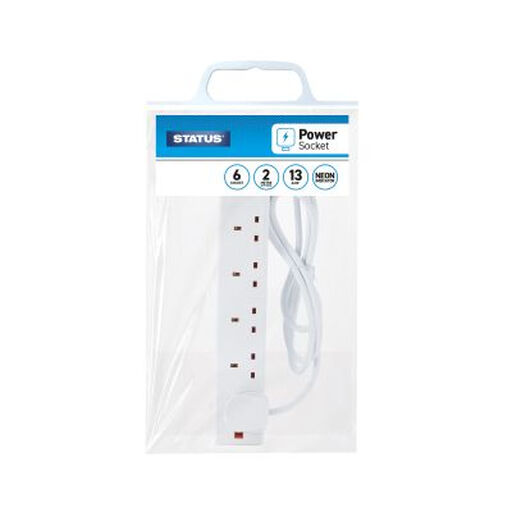
Why This Fits Their Persona: A practical option for students, renters and home users who need several indoor sockets within a two-metre reach.
Its six outlets reduce the temptation to add another strip, while the 13A rating and BS1363-2 compliance are clearly stated. Keep the total load within 3,120W.
Six sockets, a two-metre cable, neon indicator and wall-mountable design.
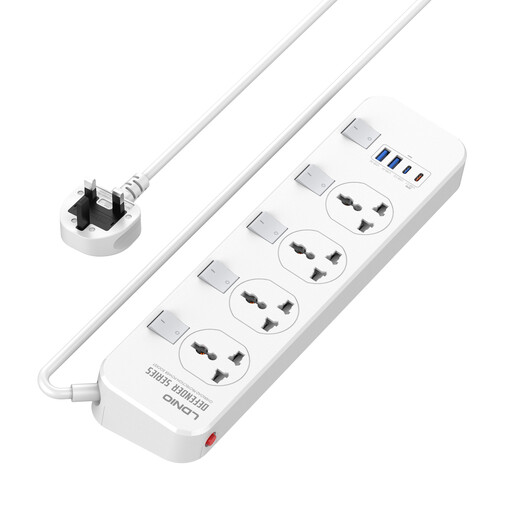
Why This Fits Their Persona: Suitable for a home office, media unit or shared workspace needing mains outlets and USB charging in one desk-friendly unit.
The 2m cable, widened socket spacing and overload reset button address common clutter and overload concerns. Its specified limit is 2,500W or 10A.
Four independently switched outlets, four USB ports and USB-C1 with up to 20W PD charging.
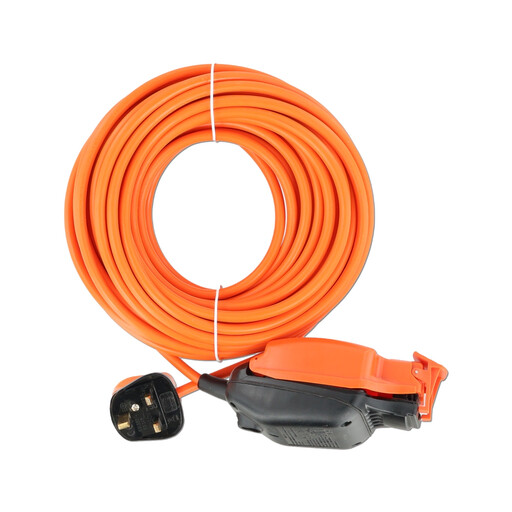
Why This Fits Their Persona: Designed for users who need reach for a tool, light or appliance around a home, workshop or sheltered garden connection.
The 15m cable is stored using an integrated tidy, but the lead must be fully unwound before use and kept away from damp conditions.
15m reach, cable storage and a stated 13A, 3,120W maximum load.
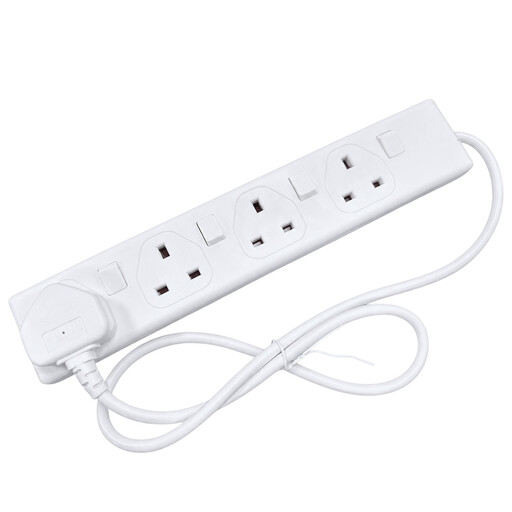
Why This Fits Their Persona: A short, manageable option for a monitor, laptop, lamp and desk accessories where excess cable would create clutter.
The one-metre cable avoids unnecessary loops, while four separate switches reduce repeated unplugging of desk devices.
We have compiled a complete, real-time list of products that fully satisfy these strict selection criteria and UK safety regulations.
It is safer to switch off or unplug an extension lead when it is not needed, particularly when connected appliances are idle. Follow the manufacturer’s instructions and unplug the unit during long periods of non-use. Do not leave damaged, hot or unusually noisy equipment connected.
There is no universal lifespan. Service life depends on cable movement, storage, load and physical damage. Inspect the plug, sockets and full cable regularly. Replace the unit if the casing is cracked, the cable is frayed or the socket becomes loose; do not attempt to repair a non-rewireable extension socket.
The lead itself generally does not determine household electricity consumption. Connected appliances draw the power. However, an individually switched extension lead can make it easier to turn off unused devices and reduce standby consumption. Use each switch sensibly and stay within the stated load rating.