Who needs which drive?

Active-project animators

If current scenes, caches, renders and assets live on the external drive, check the workstation’s actual data interface before choosing an SSD by its headline speed. Samsung, Kingston and SanDisk Professional specify different host requirements for their faster portable drives.

Large-library home creators

If the drive mainly holds completed projects, source assets and backup copies, capacity and a repeatable backup routine may matter more than fast direct-from-drive work. Keep a backup disconnected when it is not needed, as the UK National Cyber Security Centre advises.

Mixed Mac-and-Windows collaborators

If project files move between macOS and Windows, decide on the file system before loading the drive. Apple identifies ExFAT as a Windows-compatible choice for disks over 32GB, while its advice for certain Mac creative applications differs.

What matters when choosing?

Portable HDD for archives

Choose when: Completed projects and backup copies need room, but you do not rely on the drive for responsive live editing.

Trade-off: This capacity-focused route does not offer SSD-class active-project performance; an archive drive must not be your only copy.

USB portable SSD for active work

Choose when: You frequently move large project folders or work directly from the external drive.

Trade-off: The drive’s stated maximum depends on a compatible port, cable and, where specified, host features such as UASP.

Higher-performance SSD

Choose when: Your workflow needs faster transfers and the workstation supports the particular USB or Thunderbolt mode the drive requires.

Trade-off: A USB-C socket alone does not establish compatibility with a drive’s fastest mode. Kingston, for example, specifies USB 3.2 Gen 2x2 for the XS2000’s maximum performance.

Concern What to check Who this matters to
Active-project access Match the drive’s required data mode to the workstation port and cable; USB-C describes the connector, not the available speed. If I work from the drive, I want to limit waiting when moving project folders and accessing active files. Around 33% of consumers put active-project access first.
Archive capacity Allow room for existing projects, upcoming work, assets and renders; check the capacity available after formatting. When completed jobs and source assets accumulate, I need enough space to retain them without choosing a drive solely for its speed. Roughly 27% of consumers prioritise archive capacity.
Backup recovery Plan another copy, disconnect at least one backup when it is not in use, and check that important files can be restored. If a workstation or connected drive is affected by an incident, I need a separate project copy I can recover. About 20% of consumers make backup recovery their primary concern.
File-system compatibility Decide between Mac-and-Windows sharing and a Mac-only application workflow before formatting; copy existing files elsewhere first. When I hand projects between Mac and Windows systems, I need a format both workflows can use without erasing my only copy. Around 20% of consumers put file-system compatibility first.

Mistakes to avoid

  • Assuming every USB-C port delivers headline SSD speeds

    Kingston says its XS2000 needs USB 3.2 Gen 2x2 for optimum performance; a Thunderbolt or USB4 port does not automatically provide that mode.

    Check the workstation’s exact port specification and the cable requirement before choosing a drive for its stated maximum speed.

  • Treating a permanently connected drive as the whole backup plan

    The UK National Cyber Security Centre describes ransomware incidents affecting original files and connected USB or network backups.

    Keep another project copy, disconnect at least one backup when it is not in use, and periodically check that important files restore.

  • Reformatting after copying over the only project files

    Apple warns that formatting a disk or volume erases its files, so changing format is not a harmless compatibility setting.

    Choose the file system for your Mac-only or Mac-and-Windows workflow before loading projects. If files are already on the drive, copy them to another location before reformatting.

  • Using a ruggedness rating instead of a backup

    Samsung says the T7 Shield’s IP65 and drop ratings come from controlled testing and that liquid, dust and drop damage are not covered under its warranty.

    Consider the rating when assessing transport risks, but retain separate copies of scenes, assets and renders.

Relevant brands and product lines

Samsung

The T7 Shield is a portable SSD line for active-project storage when the workstation supports its required USB data mode.

  • Samsung states up to 1,050MB/s read and 1,000MB/s write for the T7 Shield under compatible USB 3.2 Gen 2, UASP, host and cable conditions.
  • Samsung’s IP65 and 3m-drop ratings are based on controlled testing; its warranty does not cover liquid, dust or drop damage.

Seagate

Backup Plus Portable illustrates the HDD route for local archives and scheduled backup copies.

  • Seagate lists Backup Plus Portable capacities up to 5TB and provides scheduled backup tools.
  • Time Machine use may require reformatting. A scheduled copy on a connected drive does not replace a disconnected backup.

Kingston

The XS2000 is a compact portable SSD line for workstations with confirmed USB 3.2 Gen 2x2 support.

  • Kingston offers the XS2000 from 500GB to 4TB and specifies up to 2,000MB/s with the required interface.
  • Kingston says macOS does not use USB 3.2 Gen 2x2, so a Mac will not reach the line’s advertised maximum performance.

SanDisk Professional

The PRO-G40 is a portable SSD line for demanding workflows using a compatible Thunderbolt 3 connection.

  • SanDisk specifies up to 3,000MB/s read and 2,500MB/s write for the PRO-G40 via Thunderbolt 3.
  • Those stated speeds should not be assumed from a USB-C connector or a different connection mode.

Joybuy product choices

These drives cover portable SSDs for active project files and a portable HDD for archive storage. Choose between them by how you will use the drive, then check capacity, workstation compatibility and your separate backup plan.

Samsung T7 Shield MU-PE1T0S 1TB portable SSD

Samsung T7 Shield MU-PE1T0S 1TB SSD

A portable SSD to consider for active projects if 1TB fits your working files and your workstation supports USB 3.2 Gen 2.

Samsung’s stated speed maximums require a compatible host, cable and UASP. Keep a separate backup even if ruggedness matters to you.

View on Joybuy

Samsung Portable SSD T7 4TB in grey

Samsung Portable SSD T7 4TB, grey

This USB 3.2 Gen 2 SSD is an option when an active-project library calls for 4TB of stated capacity.

Check your workstation’s port and cable before relying on faster transfers, and retain another copy of important projects.

View on Joybuy

Samsung MU-PG2T0B 2TB portable SSD

Samsung MU-PG2T0B 2TB SSD

Consider this USB 3.2 Gen 2x2 SSD for active-project transfers if your workstation explicitly supports that data mode.

Its USB-C connector alone does not establish the available speed; check the port and cable before choosing it for a faster workflow.

View on Joybuy

SanDisk Portable SSD 2TB

SanDisk Portable SSD 2TB

This 2TB portable SSD is an option for keeping active project files on an external drive.

Before selecting it for long transfers or direct-from-drive work, check the connection requirements and the sustained write performance relevant to your workflow.

View on Joybuy
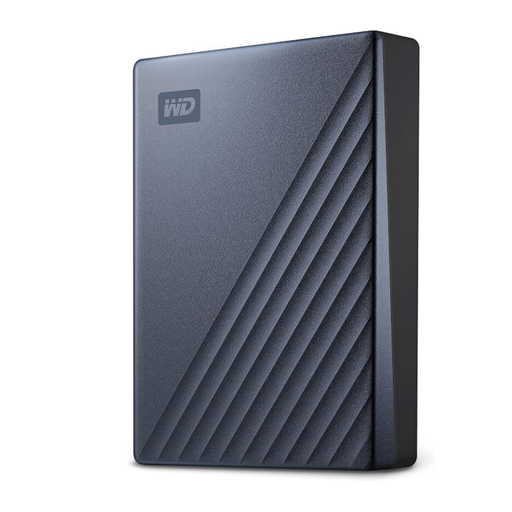
Western Digital My Passport Ultra 5TB portable hard drive in blue

Western Digital My Passport Ultra 5TB HDD, blue

This portable hard drive suits a capacity-led archive of completed projects, assets and renders rather than a workflow that calls for SSD-class active-project access.

Check the intended computer’s file-system requirements before loading projects, and keep another backup copy separate from the drive.

View on Joybuy

Frequently asked questions

Should I use an SSD or HDD for animation projects?

Use an SSD when you regularly access active projects from the external drive; use an HDD mainly for completed-project archives and backup copies. Check capacity for your files and the workstation interface before choosing a faster-rated SSD.

Will a USB-C SSD reach its advertised speed on my workstation?

Not necessarily: USB-C identifies the connector, not the supported data mode. Kingston says the XS2000 needs USB 3.2 Gen 2x2 for optimum performance and will not reach its advertised maximum on a Mac because macOS does not use that protocol.

Which format should I use to share projects between Mac and Windows?

For a disk over 32GB shared with Windows, Apple identifies ExFAT as a compatible format. Copy existing files elsewhere before changing format because formatting erases them; for external storage used solely with Final Cut Pro, Motion or Compressor on a Mac, Apple recommends APFS.

Can a Time Machine drive also hold a Final Cut Pro library?

Not on the same storage device as configured for Time Machine backups, according to Apple. Plan separate storage for the Final Cut Pro library and the Time Machine backup.

How should I back up animation projects stored on an external drive?

Keep another copy and leave at least one backup disconnected when it is not in use. The UK National Cyber Security Centre advises connecting backup storage only when necessary; also check that important project files can be restored.