Archive-first studio manager
If one person oversees periodic backups of completed footage, a desk-based drive may be a practical destination. Size it for the library and its expected growth, and keep another independent copy.


A desktop external hard drive can serve as a desk-based backup destination, while a portable SSD suits a copy that editors regularly move or transfer. If several people need controlled access to the same library, choose shared storage with account permissions and back it up to a separate destination. None of these devices is a complete backup plan on its own; keep an independent copy and test that you can restore it.
If one person oversees periodic backups of completed footage, a desk-based drive may be a practical destination. Size it for the library and its expected growth, and keep another independent copy.
If you move selected footage between work locations or need a portable recovery copy, an external SSD is worth considering. Check its usable capacity and the workstation connection before choosing by its advertised speed.
If several editors need different access rights to one library, centrally managed shared storage is more suitable than passing around a USB drive. Synology documents user and group permissions for shared folders; the shared storage still needs its own backup.
Decide whether the device is primarily an archive destination, a portable copy or a library that several people must access. These roles can complement one another, but each calls for different checks.
Choose when: One operator needs a desk-based destination for periodic footage backups.
Trade-off: An attached drive does not provide a managed shared library or protect the only copy from loss.
Choose when: Editors regularly move a copy or transfer selected projects between locations.
Trade-off: Advertised transfer rates depend on the host connection, and the portable drive remains just one copy.
Choose when: Several people need centrally managed access with different permissions.
Trade-off: Network setup and administration are additional work, and the library needs a separate backup destination.
| Concern | Buying checks | Who this matters to |
|---|---|---|
| Usable archive capacity | Allow for the current library, expected growth and retention period. Compare usable space rather than relying on the labelled capacity alone. | If completed footage keeps accumulating, I need room for the archive without replacing its destination too soon; around 33% of consumers put archive capacity first. |
| Portable transfers | Check the workstation’s USB or Thunderbolt specification and the supplied cable. Make sure the drive holds the footage you intend to move. | When projects travel between edit locations, I want a copy I can carry and transfer using my workstation; around 25% of consumers prioritise portable transfers. |
| Shared access and recovery | Set the required user or group permissions, then plan a separate backup destination and test restoration. | With several editors using the library, I need to control who can change files and recover an earlier copy if necessary; around 42% of consumers put shared access and recoverability first. |
One attached drive is still one device. The UK Department for Education’s 3-2-1 guidance calls for separate copies, including one off-site.
Use the drive as one destination, maintain an independent copy and periodically check that files restore.
RAID can help keep storage available after certain drive failures, but Synology states that RAID and Synology Hybrid RAID are not backup solutions.
Keep a recoverable copy on a separate destination rather than relying on mirrored or redundant drives alone.
Manufacturer speed figures depend on the supported interface and host connection; a connector’s shape alone does not establish the available transfer rate.
Check the workstation’s port specification and the supplied cable against the drive’s requirements.
A drive connected to one workstation does not inherently provide the managed user and group permissions available in a shared-folder system.
If editors need different access rights, choose shared storage with appropriate accounts and keep its backup separate.
These brands illustrate different storage roles, not a shortlist of products available for every studio.
Its Expansion Desktop range is relevant to a desk-based external hard-drive backup or archive.
Its X10 Pro is an example of a portable SSD for moving selected footage or keeping a portable copy.
Its shared-storage software is relevant where editors need managed access to a central library.
Its portable and configurable Thunderbolt storage ranges are relevant to studios assessing specialist media workflows.
These products cover network storage for a shared library and portable drives for carrying a separate copy. Choose the storage role first, then check capacity, connections and the backup arrangement for your studio.
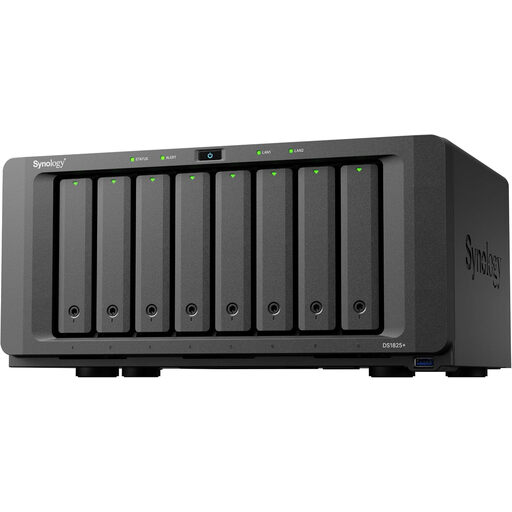 No image available
Consider this NAS if the studio needs a centrally stored library rather than a drive passed between workstations.
The listed variant has eight bays and is diskless. Check compatible drives, configured usable capacity, network requirements and permissions; arrange and test a separate backup.
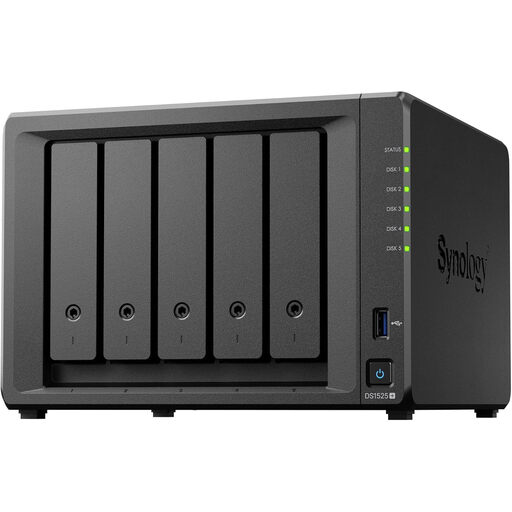 No image available
Consider this NAS for a shared studio library if a managed network-storage setup suits the team’s access needs.
The listed variant has five bays and is diskless. Confirm the drives and usable capacity after configuration, the studio’s network connection and a separate, recoverable backup.
 No image available
This portable SSD is a candidate for carrying selected footage or an additional recovery copy between locations.
The listed variant is 1 TB and specifies USB 3.2 Gen 2. Check the workstation connection and whether its usable capacity covers the files you intend to carry; keep another independent copy.
 No image available
This portable SSD may suit an editor who needs to move a selected set of projects or maintain an additional copy.
The listed capacity is 2 TB. If transfer time matters, confirm the host interface and write-speed specification before choosing it; do not make it the studio’s only backup.
 No image available
This portable hard drive is a candidate when the studio wants to carry a larger labelled capacity than the portable SSD options shown here.
The listed capacity is 5 TB. Check usable space against library growth and retention, and assess the connection against any frequent-transfer needs. It does not replace managed shared storage or an independent backup.
No: it can be one backup destination, but not the only recoverable copy. The UK Department for Education’s 3-2-1 guidance calls for copies on separate devices, including an off-site copy, and recommends testing restores.
No. Synology states that RAID and Synology Hybrid RAID are not backup solutions. Use a separate destination from which the studio can restore files, even if the primary storage has drive redundancy.
They can access a drive shared through its connected computer, but the drive itself does not inherently provide managed user and group permissions. If different editors need controlled rights to the library, consider shared storage with individual accounts and back it up independently.
Apply appropriate security to a library containing personal data. GOV.UK describes protection against unauthorised access, loss, destruction and damage as part of handling personal data; assess who needs access and how the studio will recover a lost or changed file.
The reported capacity can differ because operating systems may use a different reporting standard from the decimal capacity on the label, as Seagate explains in its Expansion Desktop manual. Formatting also uses space, so plan around usable capacity and leave room for future footage.