
24/7 Customer Support

Free returns

Same-day & Next-day Delivery

Quality Guaranteed

Unlock Your Welcome Offers: FREE Delivery | Up to 80% OFF | Free 30-day JoyPlus trial
Download the APP
Navigating the world of art supplies can be a challenge, especially when faced with a brand as reputable and varied as Faber-Castell. Whether you are an art student looking for a reliable set, a hobbyist ready to upgrade or a semi-professional seeking specific qualities, choosing the right Faber-Castell coloured pencils is crucial. With options ranging from the classic student sets to the more advanced Goldfaber and versatile watercolour ranges, it is easy to feel overwhelmed.
This guide is designed to cut through the clutter. As a Joybuy Product Recommendation Officer, my role is to provide clear, practical information to help you compare your options. We will look at the key features of different Faber-Castell lines, helping you find the perfect drawing pencils set for your artistic needs and budget.
Before diving into specific products, understanding a few key factors will help you make a more informed decision. Consider these points as you browse.
The core of any coloured pencil is its lead. The quality determines the colour vibrancy, how smoothly it applies to paper and how well it lasts. For sketches and practice, a standard lead is often sufficient. However, for finished pieces you intend to display or sell, look for pencils with good lightfastness. This rating indicates how resistant the pigments are to fading when exposed to light, ensuring your artwork remains vibrant over time. Artist coloured pencils typically offer higher pigment concentration and better lightfastness ratings than student-grade alternatives.
There is nothing more frustrating than a pencil lead that constantly snaps during sharpening or use. Faber-Castell is known for its Secural Bonding (SV) process, which involves gluing the entire length of the lead to the wooden casing. This makes for exceptionally break-resistant pencils, reducing waste and ensuring a consistent drawing experience. A pencil with a robust core and quality wood casing is a dependable tool for both detailed work and broader strokes.
Your intended artistic style plays a significant role in your choice. Standard coloured pencils are wax or oil-based and are ideal for traditional drawing techniques like layering, blending and hatching. In contrast, Faber-Castell watercolour pencils contain a water-soluble binder. They can be used dry, just like a standard pencil, but with the application of a wet brush, the pigment dissolves, creating fluid watercolour effects. This dual functionality is perfect for mixed-media projects or for artists who enjoy both drawing and painting.
Based on their features, intended use and overall value, here are our recommendations from the Faber-Castell range.
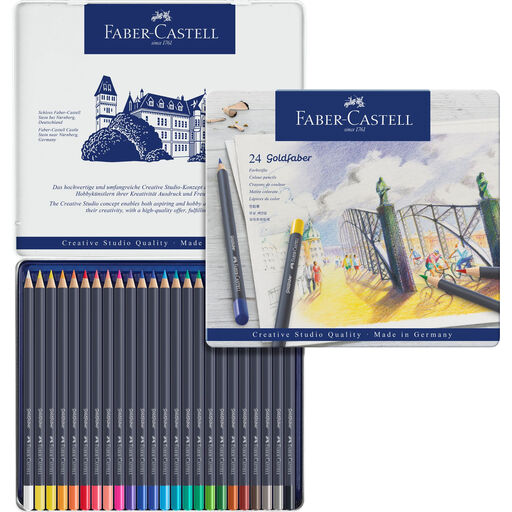
Why It Stands Out
The Faber-Castell Goldfaber range strikes an excellent balance between student and professional quality. These pencils feature a highly pigmented 3.3 mm lead that delivers outstanding colour brilliance with minimal effort. The formulation is designed for excellent lightfastness, making them suitable for artwork you wish to preserve. Furthermore, the lead is both smudge-resistant and water-resistant, ensuring clean lines and preventing accidental blending in detailed compositions.
Pros
Who is it for? This set is ideal for ambitious art students, hobbyists and semi-professionals seeking a set of professional colouring pencils that offer superior performance without the premium price tag of top-tier artist ranges. They are versatile enough for illustration, layering and expressive sketching.

Why It Stands Out
The Classic range is a dependable workhorse for everyday creativity. These pencils deliver brilliant, vivid colours in a traditional hexagonal barrel that is comfortable to hold. Their standout feature is the special secural bonding (SV) process, which provides high break-resistance, making them a durable choice for classrooms and home studios alike. The wood is also sourced from certified sustainable forestry, reflecting an environmentally conscious approach.
Pros
Who is it for? This drawing pencils set is perfectly suited for beginners, young artists and hobbyists who need a reliable, vibrant and durable set for drawing, colouring and school projects.

Why It Stands Out
These pencils offer the best of both worlds: drawing and painting. The lead is fully water-soluble, allowing you to lay down colour like a standard pencil and then transform it into a watercolour wash with a wet brush (one is conveniently included). This opens up a world of creative techniques, from smooth gradients to layered washes. Like the standard Classic pencils, they feature SV bonding for break-resistance and are made from sustainable wood.
Pros
Who is it for? These are an excellent choice for artists of all levels who enjoy experimenting with mixed media. They are particularly useful for illustrators, crafters and anyone who wants the creative flexibility to switch between drawing and painting without needing two separate sets of supplies.
While these three sets cover a wide range of needs, Faber-Castell offers an even broader selection. If you are looking for a different set size, a specific colour palette or other types of drawing tools, we invite you to explore our full collection.
Discover more options in our artists pencils category.
The main difference lies in the lead quality and intended user. The Classic range is designed for students and hobbyists, offering vibrant colours and excellent durability for general use. The Goldfaber range is a step up, aimed at semi-professionals and serious students. It features a higher pigment concentration, a softer laydown and better lightfastness, making it more suitable for finished artwork.
Faber-Castell produces several lines of professional colouring pencils, with the Polychromos range being their flagship artist-grade product (not featured here). The Goldfaber pencils serve as an excellent entry point into professional-quality work, offering many of the features artists look for, such as high pigmentation and good lightfastness, at a more accessible price point. Many professionals use Goldfaber for sketching, concept work or as a complementary set.
There are several ways to use them. You can draw directly onto dry paper and then go over your drawing with a wet brush to dissolve the pigment and create a watercolour effect. Alternatively, you can wet the paper first and then draw on it for intense, soft-edged lines. You can also lift pigment directly from the pencil tip with a wet brush to use it like a traditional pan watercolour.