Delicate-coat owners
You want to remove bobbles from fine wool, cashmere blends or thin coat panels without treating speed as more important than careful handling.


For a fine wool or cashmere-blend coat, consider an electric fabric shaver with a protective cap or shaving buffer, and test an inconspicuous area before treating a visible panel. Rechargeable power is more convenient for repeated sessions, while an AA-powered model may suit occasional use if replacing batteries is acceptable. A manual comb is another option for suitable wool and cashmere knitwear, but it has fabric exclusions of its own.
You want to remove bobbles from fine wool, cashmere blends or thin coat panels without treating speed as more important than careful handling.
You expect to de-pill several garments or household textiles, so charging, emptying the lint chamber and cleaning the head affect your choice.
You want a cordless tool for occasional use and are comfortable replacing AA batteries rather than keeping another device charged.
Start with the coat fabric and any trims: a protective feature does not make every part of a coat suitable for shaving. Then choose between rechargeable and AA power according to how often you expect to use the tool; consider a manual comb only for fabrics its maker recommends.
| Concern | What to check | Who this matters to |
|---|---|---|
| Delicate fabric and coat details | Check the care label and whether the model has a protective cap or buffer. Test a discreet area; keep the head away from zips, buttons, loose threads and embroidery. | If my coat has fine fabric or vulnerable details, I want to avoid catching them while removing bobbles. Around 42% of consumers may put fabric protection first. |
| Repeated use and cleaning | Compare the maker’s stated runtime and charging method, then check how the lint chamber opens and which cleaning tools are included. | When I refresh several garments, I want a tool I can power and empty without interrupting every session. Around 33% of consumers may prioritise repeated-use convenience. |
| Occasional-use simplicity | Confirm the battery type and whether cells are included; consider the need to replace them during the tool’s life. | If I only tackle coat bobbles occasionally, I would rather replace batteries when needed than keep a device charged. Around 25% of consumers may make simplicity their main concern. |
Philips advises keeping its fabric shavers away from zips, buttons, loose threads and embroidery, even when a model has a cap or buffer.
Lay the coat flat, work gently on plain fabric panels and remove lint around trims by hand.
The Laundress describes its Sweater Comb for suitable wool and cashmere knitwear and outerwear, but does not recommend it for delicate synthetics or knotty yarns or fibres.
Check the coat’s fibre and construction, then test a small inconspicuous area if suitability is uncertain.
AA-powered shavers need replacement batteries; rechargeable models need charging. Either type also needs its collected lint emptied.
For regular sessions, check charging, stated runtime and cleaning access. For occasional use, check the required batteries and what comes in the box.
Philips lists both AA-powered and USB-rechargeable fabric shavers relevant to different coat-care routines.
Its Revive 27660 is a rechargeable option for people planning repeated garment or home-textile care.
Its Sweater Comb offers a manual approach for suitable wool and cashmere knitwear and outerwear.
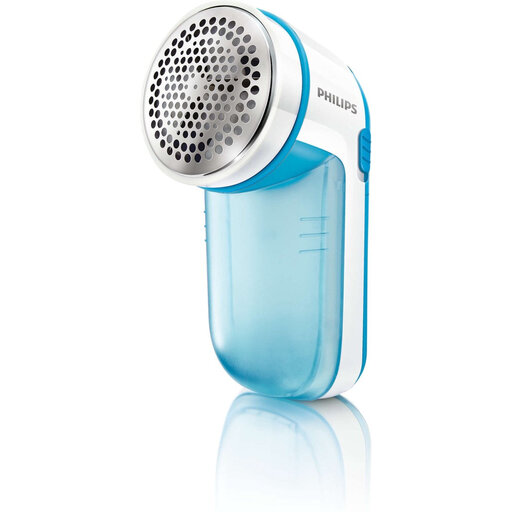
This AA-powered fabric shaver is a choice to examine if you remove coat bobbles occasionally. Check the requirements of your particular coat before using any cutting-head tool on it.
 No image available
Consider this model for occasional coat de-pilling if replacing AA batteries suits your routine. Check that the protective cap and batteries you need are included with this GC026/00 listing; do not assume accessories specified for the GC026/80 are identical. Lay the coat flat, test a discreet area and avoid zips, buttons, loose threads and embroidery.
Lay the clean, dry coat flat, smooth the panel and move the shaver gently over a discreet test area before continuing. Philips advises avoiding zips, buttons, loose threads and embroidery; use a protective attachment where the model supplies one and the garment is suitable.
Rechargeable power suits repeated sessions if you are happy to keep the device charged; AA power suits occasional use if replacing cells is acceptable. Philips states up to 90 minutes of runtime for the GCA2100/20, while Russell Hobbs states up to 90 minutes for the Revive 27660; those figures are manufacturer specifications, not directly comparable results from a coat-use test.
Empty the collected lint and clean the head in line with the model’s instructions. If a cleaning brush is supplied, use it as directed rather than leaving loose fibres around the cutting area.
Contact the retailer and explain the fault rather than relying solely on a manufacturer warranty. GOV.UK says retailers must offer a refund when goods are faulty, not as described or do not do what they are supposed to do; the remedy available in an individual case depends on the circumstances and timing.