For regular touch-ups on a knitted scarf that is suitable for shaving, an electric fabric shaver can reduce the effort of removing pills; a manual tool makes more sense for small, occasional jobs if you accept more strokes. Neither choice makes a fragile scarf safe to shave: check its care label and construction, test a hidden area and use a light touch. Russell Hobbs specifically warns that its electric shaver may damage angora and textured or raised knits.
Who is choosing?
Owners of delicate or textured scarves
If your scarf has a loose, raised or precious knit, preventing snags matters more than clearing every pill quickly. Check its care label and test a hidden area; Russell Hobbs warns that its electric shaver may damage angora and textured or raised knits.
Frequent knitwear refreshers
If you regularly remove pills from several scarves or other knitwear, an electric tool may save manual effort. Good Housekeeping UK recommends electric shavers for regular or larger jobs, provided the fabric is suitable for shaving.
Occasional touch-up users
If you only need to tidy a small area now and then, a compact manual tool avoids charging and replacement batteries. Good Housekeeping UK considers manual tools sufficient for small one-off jobs, though they require more effort.
What matters when choosing?
Decide whether your scarf is suitable for shaving before comparing power options. Then match the tool to how much fabric you expect to refresh and how often you will use it.
| Concern | What to check | Who this matters to |
|---|
| Protecting delicate knits |
Check the scarf’s care label and construction, then the exact tool’s guidance on delicate fabrics and protective attachments. |
If my scarf has a raised texture or loose threads, I want to avoid catching the knit even if that means leaving some pills alone. Roughly 42% of consumers put protecting the scarf first. |
| Repeated pill removal |
Compare the power type and lint-collector access; treat stated runtime as model-specific rather than a measure of fabric safety. |
When several scarves or jumpers need attention, I would rather spend less effort on each item while still checking that its fabric is suitable. About 33% of consumers prioritise easier repeated use. |
| Occasional touch-ups |
Choose between a battery-free manual tool, replaceable batteries and USB charging according to where you will use and store it. |
For a small patch of bobbles now and then, I can accept extra strokes if the tool is simple to put away. Around 25% of consumers make low-upkeep touch-ups their primary concern. |
Mistakes to avoid
-
Assuming a protective cap makes every scarf safe to shave
A cap or buffer is a feature of a particular model, not permission to shave a scarf with pulls, a loose construction or a raised texture. Russell Hobbs warns that angora and textured or raised knits may be damaged by its electric shaver.
Follow the scarf’s care label, inspect it for vulnerable areas and test an unobtrusive spot. Work on a flat surface with light strokes, or seek textile-care advice if you are unsure about the knit.
-
Choosing by runtime or blade speed alone
Those figures describe aspects of convenience; they do not establish whether a delicate scarf can withstand shaving.
Check fabric-suitability guidance and protective features before deciding whether head size, power type or runtime meets your routine.
-
Overlooking power and cleaning
An AA-powered model needs replacement batteries, while a rechargeable one needs charging access. Collected pills also need to be emptied from an electric shaver.
Check the exact model’s power requirements and included charging accessories. Follow its instructions for emptying and cleaning the lint collector; Russell Hobbs advises cleaning its Revive shaver after each use and not submerging it in water.
Keeping an AA-powered shaver ready means having replacement batteries available.
Brands to consider for scarf care
Philips
Philips offers distinct AA-powered and USB-rechargeable fabric-shaver models. Check the complete model number before relying on a particular protective feature.
- Philips specifies a height-adjustment cap for the GC026/80 and a 1 mm shaving buffer for the GCA2100/20.
- Neither feature establishes that a raised, loose or damaged scarf is suitable for shaving; follow the scarf’s care label and test first.
Russell Hobbs
The rechargeable Revive Fabric Shaver is an option for people who prefer USB-C charging and a travel lock.
- Russell Hobbs specifies a six-blade head and up to 90 minutes of use for the Revive model.
- The manufacturer warns that angora and textured or raised knits may be damaged. It advises testing a hidden area and using light strokes; its USB-C cord does not include a mains adapter.
Gleener
Gleener’s Compact 4-in-1 is a battery-free manual option with interchangeable fabric edges and a lint brush.
- It avoids both charging and replacement batteries for occasional touch-ups.
- Gleener positions the tool for delicate knits, but that claim does not replace a hidden-area test. Manual removal also takes more effort for larger or repeated jobs, according to Good Housekeeping UK’s fabric-care guidance.
Fabric shavers on Joybuy
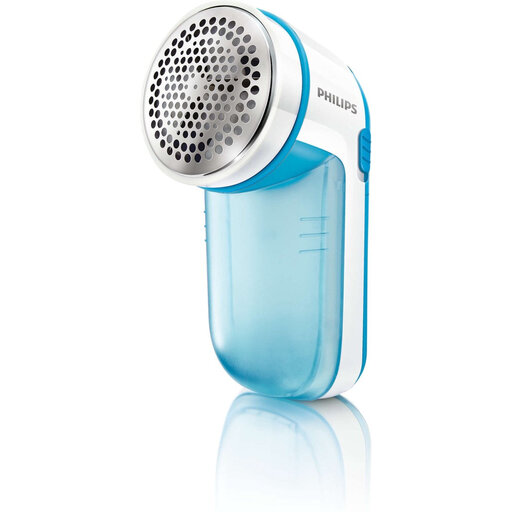
This AA-powered electric fabric shaver is a choice to consider for occasional scarf touch-ups. Check the GC026/00 instructions and your scarf’s care label before using it on a delicate or textured knit.
 No image available
Philips GC026/00 Fabric Shaver, Blue
Consider this electric shaver for occasional pill removal from a scarf that is suitable for shaving. Before use, check the GC026/00 instructions against the scarf’s care label and test an unobtrusive area; do not assume guidance for another GC026 variant applies to this one.
Joybuy
Questions about scarf care
Can I use a fabric shaver on every knitted scarf?
No: check the scarf’s care label and construction before shaving it. Russell Hobbs warns that its electric shaver may damage angora and textured or raised knits. Avoid working over pulls, loose threads, thin areas and decorations, and test an inconspicuous spot first.
How should I shave pills from a suitable scarf?
Lay the scarf flat and move the tool lightly over the surface without pressing or scraping. Alan Paine’s knitwear-care guidance recommends a flat surface and a light touch; stop if the tool catches the fabric.
Should I choose AA batteries, USB charging or a manual tool?
Choose according to how often and where you expect to use the tool. Philips specifies two AA batteries for its GC026/80; rechargeable models avoid replacing those batteries but need charging access. For small, occasional jobs, a manual tool avoids both power requirements if you are comfortable making more passes.
How do I clean an electric fabric shaver?
Switch it off and follow the exact model’s instructions for emptying its lint collector and cleaning the cutter. For the Revive model, Russell Hobbs advises cleaning after each use, handling the cutter carefully and not submerging the device in water.


