
24/7 Customer Support

Free returns

Same-day & Next-day Delivery

Quality Guaranteed

Unlock Your Welcome Offers: FREE Delivery | Up to 80% OFF | Free 30-day JoyPlus trial
Download the APP
Fabric storage cubes can make wardrobes, shelves and children’s rooms easier to manage without taking up permanent floor space. However, attractive photographs and low prices do not always reveal whether a set will fit your shelving, hold its shape or remain practical after regular use.
Before buying fabric storage cubes, check the construction, measurements and care instructions. The right choice depends on whether you need clothes storage boxes, cube shelf organisers, wardrobe storage boxes or flexible bins for toys and household items.
A cube described as “standard size” may not fit your furniture. Many UK cube shelving units have compartments around 30–32 cm wide, while some fabric organisers measure 33 cm or more. A box that is slightly too large may be difficult to pull out, leave the shelf doors unable to close or press against the sides.
Measure the internal width, depth and height of each compartment. Allow a small amount of clearance so the handles remain usable.
Non-woven fabric organisers often use cardboard panels to create structure. The fabric weight, such as 80 g/m², describes the outer material rather than the total amount of weight a box can safely hold. The more useful figure is the manufacturer’s stated capacity per cube.
Avoid placing books, shoes or dense household items into a box unless its load rating supports them. Clothing, bedding and soft toys are generally more suitable for lightweight fabric storage bins.
Foldable storage boxes may arrive with a “new” odour, particularly when packed closely for delivery. Product instructions may recommend airing them in a well-ventilated place before use. Many non-woven fabric organisers are suitable for wiping but not machine washing.
Check whether the product can be spot-cleaned with a damp cloth, and avoid storing it in a persistently damp cupboard. Keep fabric boxes away from open flames, sharp objects and excessive loads.
For cube shelving, compare the product’s external dimensions with the shelf’s internal opening. Common sizes include:
Do not rely on the number of cubes alone. A 6-pack storage cubes set may offer good category separation, but only if all six fit your intended space.
Look for a combination of fabric and a firm internal panel. Cardboard-supported designs usually hold a more consistent cube shape than fabric-only baskets, while still folding flat when the base panel is removed or folded.
For everyday use, inspect whether the product includes:
Non-woven fabric organisers are often light and economical. Oxford fabric or cotton-polyester designs may be more suitable for larger clothes storage boxes, but the product’s stated capacity and dimensions remain more important than the material name alone.
A cube for jumpers needs more usable volume than one for cables or accessories. Use smaller cube organisers with handles for underwear, craft supplies and children’s items. Larger folding storage boxes can hold coats, towels, spare bedding or seasonal garments.
Avoid treating a fabric cube as a rigid storage crate. It is designed for organisation and accessibility rather than carrying very heavy or sharp contents.

Why This Fits Their Persona: The compact six-piece set suits renters, students and smaller UK bedrooms where cupboards or shelving have limited depth. The beige finish can be used for clothes, accessories or household sorting.
Its listed 10.5 x 10.5 x 11-inch dimensions make it easier to compare with compact cubbies before ordering. The stated 8.5-litre capacity per container also helps set realistic expectations.
Six containers, integrated handles and a foldable design for storage when not in use.
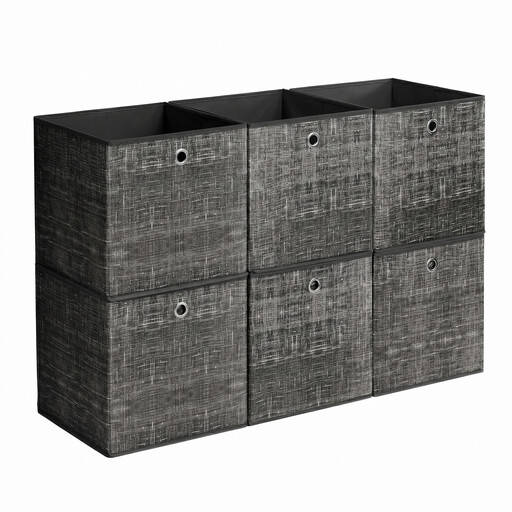
Why This Fits Their Persona: A suitable option for homeowners who want coordinated shelf storage baskets in a living room, study or bedroom. The rustic brown and black combination provides a defined visual look across open shelving.
The dimensions are clearly listed as 33 x 33 x 33 cm, with guidance to use compartments of 34 x 34 x 34 cm or larger. This reduces the risk of buying cubes that are too tight for the shelf.
80 g/m² non-woven fabric with cardboard construction; each box has a stated 5 kg maximum capacity.
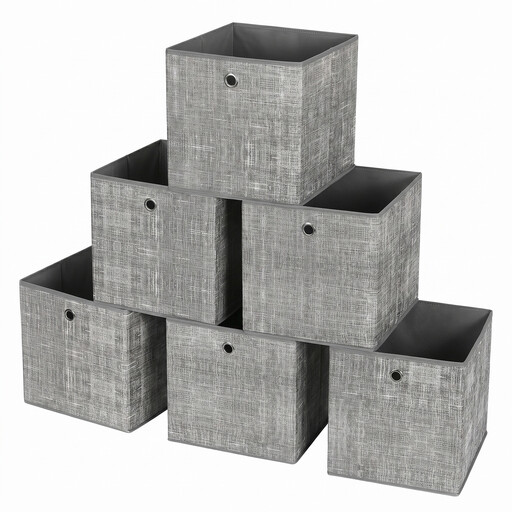
Why This Fits Their Persona: Families can use the six cubes to separate toys, books, clothes and everyday items across several rooms. The standard cubic format is practical for compatible cube storage units.
The product states a 5 kg maximum static load per box, so shoppers can avoid treating the fabric cubes like heavy-duty crates. The stated 30 cm dimensions support straightforward shelf comparison.
Cardboard and 80 g/m² non-woven fabric construction, base panels for setup and handles for retrieval.
For underwear, socks and smaller garments, a dedicated undergarments storage range may provide more suitable compartments than open fabric cubes.
We have compiled a complete, real-time list of products that fully satisfy these strict selection criteria and UK safety regulations.
Yes. They are particularly useful for folded T-shirts, jumpers, towels, underwear and seasonal garments. Check the internal size and capacity first, as bulky coats or heavy shoes may require larger wardrobe storage boxes with stronger construction.
Some do, but measurements vary. A 30 cm cube may fit a compartment measuring 30.5 cm or more, while a 33 cm organiser generally needs a larger opening. Measure the internal shelf dimensions rather than relying on the word “standard”.
Lifespan depends on load, handling, humidity and how often the boxes are removed. Keeping within the stated weight limit, avoiding sharp objects and storing them in a dry area can help maintain their shape and fabric finish. Foldable designs can also be stored flat when not required, reducing cupboard clutter.