Hosts seeking a Fairtrade-labelled chai
Check the claim on the exact chai pack rather than treating every ethical-sourcing statement as the FAIRTRADE Mark. The Fairtrade Foundation distinguishes its classic mark from other certification schemes.


If the chai itself needs to be sold as Fairtrade, Clipper Tea Shop describes its Organic Indian Chai Black Tea as Organic & Fairtrade. It contains black tea, so consider a separate caffeine-free option for guests who want one. Pukka Vanilla Chai is described as naturally caffeine-free, but Pukka uses Fair for Life certification, which is distinct from the FAIRTRADE Mark.
Check the claim on the exact chai pack rather than treating every ethical-sourcing statement as the FAIRTRADE Mark. The Fairtrade Foundation distinguishes its classic mark from other certification schemes.
A black-tea chai and a caffeine-free herbal chai offer guests a choice without assuming that every spiced blend has the same tea base.
Check guidance for the particular blend. Pukka describes Original Chai as suitable with or without milk, while teapigs describes its black chai as suitable for a milkier serve.
Decide what certification the brunch calls for, then choose the tea base and ingredients that suit the guests and the way you plan to serve it.
Choose when: The chai must have an explicit Fairtrade claim; Clipper Tea Shop describes its Organic Indian Chai Black Tea as Organic & Fairtrade.
Bear in mind: It contains black tea, so it is not a caffeine-free serving.
Choose when: A caffeine-free chai is useful and Fair for Life meets the host’s certification requirement; Tesco describes Pukka Vanilla Chai as naturally caffeine-free.
Bear in mind: Pukka’s Fair for Life certification is not the FAIRTRADE Mark, and Vanilla Chai contains liquorice root.
Choose when: A particular flavour or format matters more than an established Fairtrade claim for the chai; Twinings and teapigs list black-tea chai options.
Bear in mind: Check the exact pack before describing either brand’s particular chai as Fairtrade.
| Priority | What to check | Your needs |
|---|---|---|
| Certification | Read the exact pack’s certification wording and mark. The Fairtrade Foundation says its classic black-background mark covers ingredients that can be Fairtrade-certified; Pukka identifies Fair for Life as a different scheme. | I want the chai itself to be sold as Fairtrade, rather than relying on a general ethical-sourcing claim. |
| Caffeine | Check whether the blend contains black tea or is described as caffeine-free. Clipper Indian Chai and Pukka Original Chai contain black tea; Tesco describes Pukka Vanilla Chai as naturally caffeine-free. | Some guests may prefer black-tea chai, while others would welcome a caffeine-free choice. |
| Milk serving | Look for guidance on the particular blend. Pukka says Original Chai works with or without milk, and teapigs describes its chai as suitable with plenty of milk. | If I plan to put milk on the table, I want to know which chai the maker describes for that style of serving. |
| Ingredients | Compare the current ingredient lists. Clipper lists cinnamon, orange peel, cloves and fennel alongside black tea; Pukka Vanilla Chai lists liquorice root among its ingredients. | I would like guests to see what is in each blend, particularly when their ingredient preferences differ. |
A chai can carry a named certification without carrying the FAIRTRADE Mark. Pukka identifies its teas as Fair for Life certified.
Decide whether the brunch calls for an explicit Fairtrade claim or whether another named scheme is acceptable, then check the exact pack.
Clipper Indian Chai, Pukka Original Chai and teapigs Chai contain black tea.
If guests want a choice, label the black-tea chai clearly and consider a separately labelled caffeine-free herbal blend such as Pukka Vanilla Chai.
Pukka Original Chai and Vanilla Chai list liquorice root, which may matter to guests checking ingredients.
Keep the packs available so guests can read the current ingredient lists before choosing a drink.
Availability and pack information can change between planning and serving brunch.
Check availability before shopping, then read the certification wording and ingredients on the pack received.
These references cover different chai blends and shopping alternatives; a brand’s inclusion does not establish Fairtrade certification for every product it sells.
Clipper Tea Shop describes its 20-bag Organic Indian Chai Black Tea as Organic & Fairtrade.
Pukka offers black-tea Original Chai and a Vanilla Chai herbal infusion described as naturally caffeine-free. Pukka says its teas are Fair for Life certified.
Twinings lists Classic Chai and Vanilla Chai and describes black-tea chai as typically served with milk.
teapigs lists a black-tea chai with cinnamon, ginger, cardamom and vanilla.
Tesco lists chai products from several brands alongside its own Tesco Finest range.
Sainsbury's describes its Red Label tea bags as 100% Fairtrade black tea.
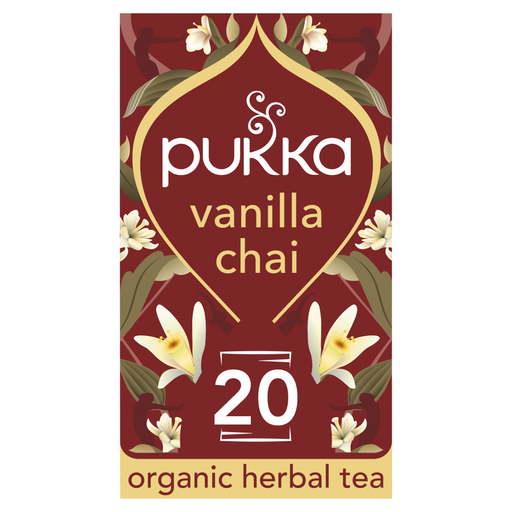
This Pukka option is a caffeine-free herbal chai for guests who want an alternative to black-tea chai. Its Fair for Life certification is distinct from the FAIRTRADE Mark, so check the pack if Fairtrade certification is required.
 No image available
A herbal chai option for guests who prefer a caffeine-free drink. The listed ingredients include cinnamon, ginger, liquorice root, fennel, cardamom and vanilla; check the pack’s certification wording and serving guidance if those affect your brunch plans.
Read the claim and mark on the exact pack. The Fairtrade Foundation says its classic black-background FAIRTRADE Mark indicates that ingredients capable of Fairtrade certification are Fairtrade-certified; Pukka’s Fair for Life certification is a different scheme.
Clipper Tea Shop describes its Organic Indian Chai Black Tea as Organic & Fairtrade. It contains black tea with cinnamon, orange peel, cloves and fennel, so it is a caffeinated chai rather than an option for guests avoiding caffeine.
A separate caffeine-free option gives guests a choice if caffeine preferences differ. Tesco describes Pukka Vanilla Chai as naturally caffeine-free, whereas Clipper Indian Chai and Pukka Original Chai contain black tea.
Yes, but check the blend you choose. Pukka says Original Chai can be served with or without milk, and teapigs describes its black chai as suitable with plenty of milk; that guidance does not automatically apply to every chai variant.
Chai blends use different tea bases and spices, and pack information can change. Pukka Original Chai and Vanilla Chai list liquorice root, so keeping the current packs available lets guests check ingredients for themselves.