Hosts seeking Fairtrade chai
If Fairtrade certification is part of the brief for a cream tea, look for the claim on the exact chai rather than relying on a brand's wider ethical-sourcing message.


If Fairtrade certification is essential for your cream tea, Clipper's UK listing explicitly identifies its Organic & Fairtrade Indian Chai as Fairtrade; check that claim on the pack you buy. Pukka describes its teas as Fair for Life certified, which is a different standard. Once the certification meets your requirement, consider the blend's spices, whether you plan to add milk and whether guests want to avoid caffeine.
If Fairtrade certification is part of the brief for a cream tea, look for the claim on the exact chai rather than relying on a brand's wider ethical-sourcing message.
A black-tea chai may be the style you want to serve with milk. Check the blend's ingredients and brewing directions: teapigs describes its chai as suitable with plenty of milk, while Twinings leaves milk optional for Classic Chai.
A clearly labelled caffeine-free herbal chai offers a different route from black-tea chai. Pukka describes its Spiced Vanilla Chai as caffeine-free; check the name and details of the particular pack before serving it.
Start with the certification required for the occasion, then narrow the choice by tea base, serving method and ingredients.
| Priority | What to check | Your needs |
|---|---|---|
| Certification | Look for a Fairtrade claim on the exact product or pack if that certification is required. Clipper's UK listing calls its Organic Indian Chai Fairtrade; Pukka describes its teas under the different Fair for Life standard. | I want the chai served at my cream tea to meet a specific Fairtrade requirement, rather than a broader ethical-sourcing preference. |
| Tea base | Check whether the blend contains black tea or is a herbal infusion. If caffeine avoidance matters, look for an explicit caffeine-free statement on the chosen pack. | Some guests want a black-tea chai; others would prefer to avoid caffeine during an afternoon gathering. |
| Spices and milk | Compare the named spices and the maker's brewing directions. Clipper lists cinnamon, orange peel, cloves and fennel; teapigs describes its Assam-based chai as suitable with plenty of milk, and Twinings makes milk optional for Classic Chai. | I'm serving chai alongside scones and clotted cream and want to choose a spice blend and milk preparation my guests will enjoy. |
| Guest ingredients | Read the current ingredients and allergen information for each pack, including any additions you plan to serve with the tea. | When serving several guests, I need to check the particular blend against their ingredient restrictions rather than assume all chai recipes are alike. |
Pukka's Fair for Life certification and a brand donation scheme are not Fairtrade claims for a particular chai. That distinction matters if Fairtrade is a firm requirement for the event.
Check the exact product page and pack for the certification you require. Clipper's UK listing explicitly calls its Organic Indian Chai Fairtrade.
Black-tea chai and caffeine-free herbal chai offer different tea bases, even when both contain familiar chai spices. Milk directions also vary by blend.
Check the tea base, caffeine statement and brewing instructions before deciding what to serve.
The listed ingredients differ across Clipper, Twinings and teapigs chai, so a familiar product name cannot stand in for an ingredient check.
Read the current pack's ingredients and allergen information, particularly when guests have allergies, intolerances or ingredient restrictions.
Clipper's UK shop lists Organic & Fairtrade Indian Chai in a 20-bag format, making the exact product claim relevant when Fairtrade certification is required.
Pukka says its teas are Fair for Life certified and that the proportion of certified herbs is shown on pack.
Twinings Classic Chai is a black-tea blend with cloves and cardamom.
teapigs describes its Assam black-tea chai as strong and suitable with plenty of milk.
This Joybuy option is a Pukka herbal vanilla chai to consider when Fairtrade certification is not a requirement for the cream tea.
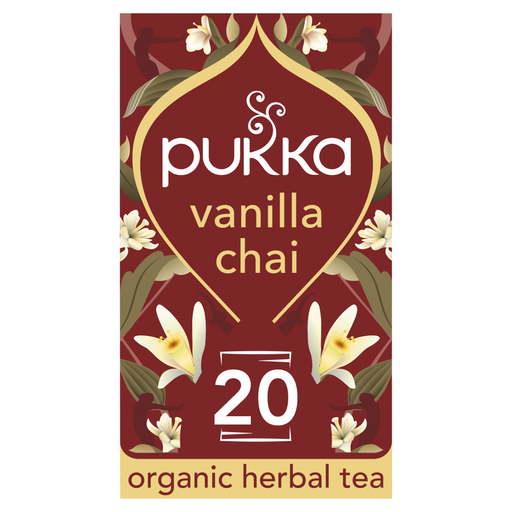 Image unavailable
A herbal chai option for an afternoon tea when you are not looking for a black-tea blend. The listed pack contains 20 sachets and weighs 40g. Pukka says its teas are Fair for Life certified, which is distinct from Fairtrade. Check this pack's caffeine information and preparation directions if either affects what you plan to serve.
Check the exact pack or product listing for its Fairtrade claim or Mark. An ethical-sourcing message or another certification is not proof that the particular chai is Fairtrade-certified. Clipper's UK listing explicitly identifies its Organic Indian Chai as Fairtrade.
Pukka describes its teas as Fair for Life certified, not as carrying the same Fairtrade certification claim. Pukka says the proportion of certified herbs appears on pack, so check the particular product if Fair for Life meets your requirements.
teapigs describes its Assam-based chai as suitable with plenty of milk, while Twinings leaves milk optional for Classic Chai. If Fairtrade certification takes priority, Clipper's Organic & Fairtrade Indian Chai has an explicit product-level claim; check its preparation directions and whether its listed spices suit your guests.
Yes: Pukka describes its Spiced Vanilla Chai as a caffeine-free herbal blend. Check the precise product name and caffeine statement on the pack you buy, rather than assuming every vanilla chai has the same tea base.
Read the current ingredients and allergen information for the chosen chai and anything served with it. Chai blends use different spices and tea bases, so check each pack against guests' ingredient restrictions rather than relying on the word ‘chai’.