What should you check?
Start with the Fairtrade claim, then check the recipe’s chocolate requirements and the pack’s ingredient and allergen information.
| Priority | What to check | Your needs |
|---|
| Fairtrade claim |
Read the mark on the exact pack and whether its wording covers eligible ingredients or names a sourced ingredient. Check any mass-balance statement rather than assuming physical separation. |
I want the product’s Fairtrade claim to match what I mean by Fairtrade, not merely a general cocoa-sourcing statement. The Fairtrade Foundation explains the scope of the classic Fairtrade Mark. |
| Cocoa percentage |
Match the percentage and quantities in the recipe. Good Food’s salted caramel brownies specify a combination of 70% and 50% chocolate. |
For a recipe that names two cocoa percentages, I would check both before replacing them with a single dark bar. |
| Bar format |
Check whether the recipe calls for cooking chocolate, plain chocolate or a bar with inclusions. A cooking label does not replace the need to check cocoa percentage. |
If the chocolate is going into batter or ganache, I want its ingredients to fit the recipe. For pieces intended to remain in a bake, a bar with inclusions may serve a different purpose. |
| Dietary fit |
Read the current ingredients and precautionary allergen statement for the exact variant. Do not assume that dark chocolate, Fairtrade certification or brand-level vegan wording settles an allergy question. |
When baking for someone who avoids an ingredient, I need to check the bar before it goes into a shared batch. |
Brand references for this decision
These brands illustrate different product and sourcing claims; a brand’s inclusion here does not establish a Fairtrade claim for every bar it makes.
Green & Black’s
A reference for bakers seeking chocolate expressly sold for cooking.
- Waitrose & Partners lists its Organic Cooking Dark Chocolate as Fairtrade, organic and 70% cocoa.
- That cooking bar’s possible milk and tree-nut warnings need checking against the current pack.
Divine
A reference for a plain 70% Fairtrade dark bar rather than a filled snack bar.
- Divine describes its 90g 70% Dark Chocolate bar as made with Fairtrade ingredients.
- Its stated possible gluten, milk and nut presence matters when baking for someone with an allergy.
Tony’s Chocolonely
A reference for a larger, 180g plain dark bar.
- Tony’s UK describes its 70% Extra Dark bar as containing Fairtrade cocoa and sugar.
- The brand also lists possible gluten, egg, milk and nuts for that bar; check its current label.
Hu
A range to examine when a recipe calls for dark chocolate and dietary wording is important.
- Hu’s UK site presents its range as Fairtrade and publishes baking recipes using its chocolate.
- Check the ingredients and allergen wording of the particular bar rather than applying a range-wide description to every variant.
Cadbury
A familiar milk-chocolate option when a recipe calls for that flavour, subject to its own ingredient requirements.
- Cocoa Life describes the cocoa sourcing programme used for Cadbury Dairy Milk.
- A Cocoa Life statement does not itself establish a Fairtrade claim for an individual bar.
Mars Wrigley brands: Galaxy, Mars, Snickers and Twix
Filled and milk-chocolate bars to consider when a recipe calls for their particular ingredients or texture.
- Galaxy and Mars describe cocoa-sourcing approaches for specified products or production volumes.
- Those descriptions do not establish a Fairtrade claim for a particular bar; fillings also require a separate recipe and allergen check.
KitKat
A wafer bar for recipes that specifically call for wafer pieces.
- KitKat describes Rainforest Alliance-certified cocoa mass in its UK and Ireland bars.
- That is not, by itself, a Fairtrade product claim or a reason to substitute a wafer bar for plain melting chocolate.
Joybuy chocolate bars for home baking
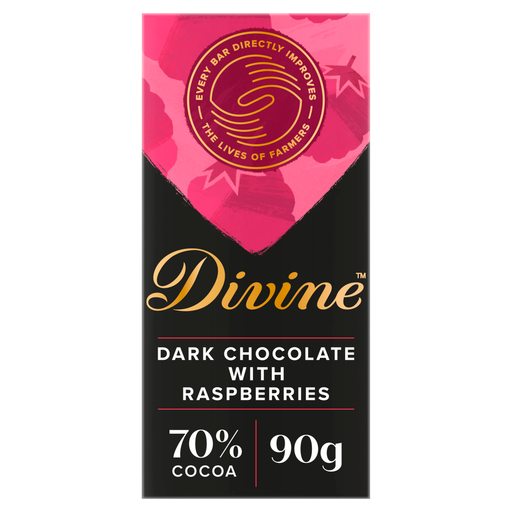
These options are dark bars to assess against your recipe and Fairtrade requirement. The two Green & Black’s bars have different cocoa percentages; the Divine bar contains raspberries rather than being a plain dark bar. None should be confused with Green & Black’s separate cooking-chocolate product discussed above.
 No image available
Green & Black’s Dark Chocolate 70% 90g
A plain dark-bar option to check for recipes specifying 70% cocoa; it is not the separate Green & Black’s cooking bar. Check the current pack’s Fairtrade wording and its possible almond, hazelnut and milk warnings.
View on Joybuy
 No image available
Green & Black’s Dark Chocolate 85% 90g
Consider this bar where the recipe calls for 85% cocoa, rather than substituting it without adjustment for a stated 70% or 50% chocolate. Check the current pack’s Fairtrade wording and its possible almond, hazelnut and milk warnings.
View on Joybuy
 No image available
Divine 70% Dark Chocolate with Raspberries 90g
The raspberry pieces make this a different choice from plain 70% chocolate; use it where that addition fits the recipe. If avoiding milk, check the current ingredients rather than relying on vegan-friendly wording, and read the allergen statement before use.
View on Joybuy
Questions about baking chocolate
How do I identify Fairtrade chocolate for baking?
Check the exact bar’s Fairtrade mark and read which ingredients its claim covers. The Fairtrade Foundation says the classic Fairtrade Mark covers ingredients that can be Fairtrade-certified; a claim naming a sourced ingredient has a narrower stated scope. A general responsible-sourcing statement is not a substitute for checking the product’s Fairtrade wording.
Does a mass-balance claim mean the ingredients in my bar were kept separate?
No physical separation is established by a mass-balance claim alone. Where a bar states that Fairtrade ingredients are handled through mass balance, read that as a sourcing claim rather than proof that every part of the individual bar remained segregated through processing.
Should I use 70% chocolate for brownies?
Use 70% chocolate when it fits the recipe’s specified cocoa percentages and quantities. Good Food’s salted caramel brownie recipe calls for both 70% and 50% chocolate, so replacing its full chocolate quantity with a single 70% bar would change the stated mix.
Can a filled snack bar replace plain dark baking chocolate?
Use a filled bar when the recipe is designed for its inclusions, not as an automatic one-for-one replacement for plain chocolate. For example, SNICKERS UK lists peanuts, milk ingredients and egg white in its 40g bar; those ingredients matter to both the bake and anyone checking allergens.
What should I check before baking for someone with an allergy?
Read the current pack’s full ingredients and precautionary allergen statement for the exact variant before using it. A dark, Fairtrade or vegan description does not override a milk, nut or other relevant warning on that bar.


