What should you check before ordering?
Start with the claim you need the pack to make, then choose a serving format and check the precise flavour and event setting.
| Priority | What to check | Your needs |
|---|
| Fairtrade claim |
Look at the exact wrapper. According to the Fairtrade Foundation, the classic black-background FAIRTRADE Mark covers all certifiable ingredients; the white Fairtrade Sourced Ingredient mark identifies the ingredient sourced on Fairtrade terms. Do not substitute a general cocoa-sourcing claim for either mark. |
If Fairtrade is a condition of buying, I need to know whether the whole bar’s certifiable ingredients qualify or whether the claim applies to a named ingredient such as cocoa. |
| Serving format |
Confirm the bar weight, case count and whether each portion has its own wrapper. A UK trade listing gives a Divine case as 30 × 35 g; Divine also lists a 90 g milk bar, while Tony’s Chocolonely lists 180 g bars. |
For handouts, I want to confirm that each guest can take a wrapped bar. For a staffed sharing table, I can plan how to divide and serve larger bars. |
| Allergens |
Read the current ingredients and precautionary statements for every flavour and pack being served. Keep that information available at the table rather than relying on another flavour’s label. |
Guests may need to check milk, gluten, nuts or other ingredients before accepting a piece; a Fairtrade claim does not answer an allergen question. |
| School-food setting |
Determine whether the event’s food falls under England’s school-food standards. The Department for Education’s school-food guidance, dated November 2025, says chocolate and confectionery must not be served under those standards across the school day. |
If I am organising a school-connected event in England, I need to establish which food provision rules apply before putting chocolate on the menu. |
Brand references
A brand’s wider sourcing programme and the certification shown on a particular wrapper are separate things to check.
Divine
A Fairtrade milk-chocolate route with both a listed 90 g bar and a 30 × 35 g case.
- Divine says its 45% Milk Chocolate uses ingredients bought on Fairtrade terms wherever possible.
- That bar contains milk and may contain gluten and nuts; check the chosen pack’s label and case details.
Tony’s Chocolonely
A range of 180 g bars that the brand’s UK site identifies as Fairtrade-certified.
- The listed large-bar range includes milk and dark chocolate options for a sharing table.
- A large bar is not an individually portioned handout; check the exact flavour’s mark and allergens.
Cadbury
A Mondelez brand associated with its Cocoa Life programme.
- Cocoa Life’s account of Mondelez’s Fairtrade partnership does not establish a Fairtrade claim for a particular Cadbury bar. Check that bar’s pack if Fairtrade is required.
Galaxy
Galaxy names products including Smooth Milk and Ripple in its responsible-cocoa programme.
- Galaxy explains that its sourcing uses mass balance, so certified cocoa need not be in a particular finished bar. This is not proof of a Fairtrade claim.
Mars
Mars bars are among the products Mars includes in its European responsible-cocoa programme.
- Mars describes equivalent-volume purchasing and mass balance; check an individual wrapper rather than treating the programme as Fairtrade certification of that bar.
Snickers
Snickers is included in Mars’s European responsible-cocoa programme.
- The programme’s equivalent-volume, mass-balance approach does not establish that a particular Snickers bar carries a Fairtrade claim.
Twix
Twix is included in Mars’s European responsible-cocoa programme.
- Mars’s mass-balance explanation is not a substitute for checking the exact Twix pack when Fairtrade is mandatory.
KitKat
Nestlé UK identifies Rainforest Alliance as KitKat’s cocoa-certification partner.
- That cocoa-certification information does not establish a Fairtrade claim for a particular KitKat pack.
Chocolate bars on Joybuy
These are large Tony’s Chocolonely bars and a Green & Black’s dark bar to consider for planned sharing. If your purchase requires a particular Fairtrade mark, check the exact wrapper and its claim before ordering.
 No image available
Tony’s Chocolonely Milk Chocolate Caramel Sea Salt 180 g
The 180 g format can be divided at a sharing table. Confirm the Fairtrade mark and check the current caramel-and-sea-salt bar’s allergen label before serving.
 No image available
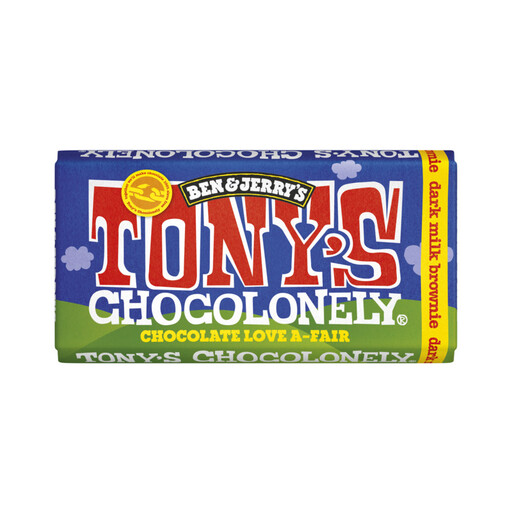
Tony’s Chocolonely Ben & Jerry’s Dark Milk Chocolate Fudge Brownie 180 g
This 180 g dark milk chocolate bar is an option when you plan to divide portions. Check its exact Fairtrade mark and current allergen statement, particularly if guests need to avoid wheat, milk or soya.
 No image available
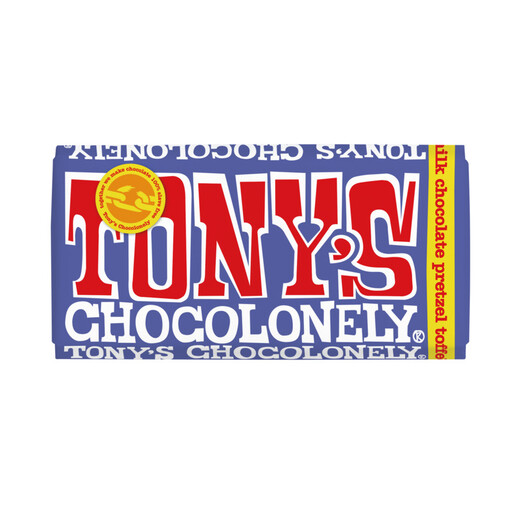
Tony’s Chocolonely Milk Chocolate Pretzel & Toffee 180 g
The 180 g pretzel-and-toffee bar suits a planned sharing format rather than an assumed one-bar-per-guest handout. Check the wrapper’s Fairtrade mark and allergen wording for the precise flavour.
 No image available
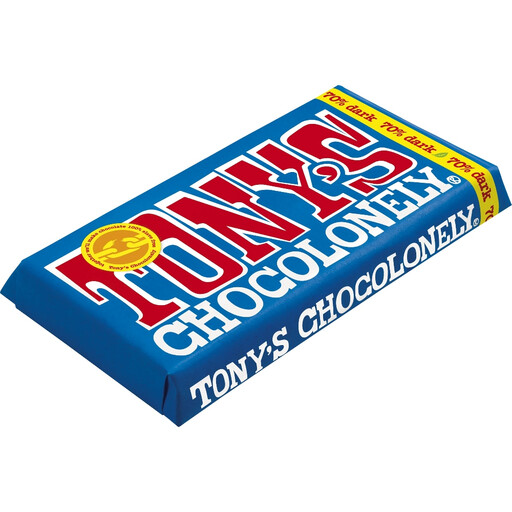
Tony’s Dark Chocolate 180 g
Consider this 180 g dark bar if you can serve pieces from a larger pack. Confirm the exact Fairtrade mark and read its current ingredient and precautionary allergen statements before putting it out for guests.
 No image available
Green & Black’s Dark Chocolate 85% 90 g
This 90 g dark bar offers a smaller sharing format than the 180 g bars above. Check the precise wrapper to establish the scope of its Fairtrade claim, and read its precautionary allergen statements before serving.
Frequently asked questions
How can I tell what a chocolate bar’s Fairtrade mark covers?
Check the actual wrapper. The Fairtrade Foundation says the classic black-background FAIRTRADE Mark means all ingredients that can be Fairtrade-certified are certified, while the white Fairtrade Sourced Ingredient mark identifies the ingredient sourced on Fairtrade terms. The latter does not say that every certifiable ingredient qualifies.
Do KitKat, Galaxy, Mars, Snickers or Twix cocoa claims make the bars Fairtrade?
Not on the basis of those claims alone. Nestlé UK identifies Rainforest Alliance as KitKat’s cocoa-certification partner; Mars describes a mass-balance responsible-cocoa programme covering Galaxy, Mars, Snickers and Twix in Europe. If Fairtrade is required, look for the applicable claim on the exact bar’s pack.
Can chocolate be served at a school-connected street party?
First establish whether the food is supplied under England’s school-food standards. The Department for Education’s school-food guidance, dated November 2025, says chocolate and confectionery must not be served under those standards across the whole school day, regardless of a Fairtrade claim. Do not extend that rule automatically to an independent street party or to other UK nations.
What allergen information should I keep at the serving table?
Keep the current ingredient and allergen information for every flavour you serve, preferably with its packaging. Divine’s 45% Milk Chocolate, for example, lists milk and warns that it may contain gluten and nuts; another flavour or pack needs its own check.
Should I choose sharing bars or individually wrapped bars?
Choose by how you will hand out the chocolate: larger bars require a plan for dividing and serving pieces, while one-per-person distribution requires you to confirm individual wrapping on the exact pack. Divine lists a 90 g milk bar, a UK trade listing identifies a 30 × 35 g Divine case, and Tony’s Chocolonely lists 180 g bars; confirm the case contents before treating it as a ready-to-hand-out option.


