Fairtrade-first shoppers
If product-level certification matters to you, check the mark on the current wrapper or listing rather than relying on a brand’s wider cocoa-sourcing programme.


Start with the Fairtrade Mark on the exact bar: the Fairtrade Foundation says the standard mark covers ingredients that can be Fairtrade-certified, while the Fairtrade Sourced Ingredient mark covers the named ingredient. A 35g to 50g bar is an individually sized option for a mid-morning break; a 180g bar calls for sharing or choosing your own portion. Then compare the flavour, ingredients, allergens and nutrition label of the products you are considering.
If product-level certification matters to you, check the mark on the current wrapper or listing rather than relying on a brand’s wider cocoa-sourcing programme.
A 35g to 50g bar offers an individual format. A 180g bar makes more sense if you intend to share it or choose a portion from it.
Fairtrade status does not settle flavour, vegan suitability, allergens or nutrition. Compare those details on the exact bars you might buy.
Identify the Fairtrade claim first, then choose a pack size and compare the product details that matter for your break.
| Priority | What to check | Your needs |
|---|---|---|
| Fairtrade claim | Look for the mark on the exact product. The Fairtrade Foundation distinguishes the standard Fairtrade Mark, which covers ingredients that can be certified, from the white Fairtrade Sourced Ingredient mark, which identifies a named ingredient such as cocoa. | I want to know what the claim covers, not just whether the brand has an ethical-sourcing programme. |
| Bar size | Compare the pack weight with the amount you plan to eat. Divine lists 35g bars, while Tony’s Chocolonely lists small 47g and 50g bars alongside 180g bars. | For a break on my own, I may prefer one small bar. If I choose 180g, I’ll share it or decide on a portion. |
| Flavour and ingredients | Choose between milk and dark chocolate by the exact product’s ingredients and cocoa description. Divine describes its 35g 70% dark bar as vegan; check each pack’s current allergen statement separately. | A darker cocoa flavour might appeal to me, but I still need the ingredients and allergens to fit my requirements. |
| Declared sugars | Compare the same nutrition measure. Divine declares 56.6g sugars per 100g for its 35g milk bar and 28.9g per 100g for its 35g 70% dark bar; these figures do not describe every milk or dark bar. | If sugars matter to my choice, I want to compare the two labels on a like-for-like per-100g basis rather than judge by chocolate type alone. |
A company’s sourcing programme or Fairtrade partnership does not tell you which Fairtrade claim applies to a particular bar.
Check the current wrapper or listing for the Fairtrade Mark. If it is a Fairtrade Sourced Ingredient mark, read which ingredient it names.
A larger bar can be shared or portioned, but its full pack weight is not equivalent to a 35g or 50g individual bar.
Compare pack sizes before buying and use the chosen product’s own nutrition panel for any portion comparison.
Divine declares its 35g 70% dark bar vegan and lists fewer sugars per 100g than its 35g milk bar. Neither detail establishes the allergens or nutrition of a different dark bar.
Read the ingredients, allergen statement and nutrition table on the exact product you intend to buy.
For state-funded schools in England, the Requirements for School Food Regulations 2014 classify chocolate as confectionery. School-food rules need a separate check from an everyday personal snack choice.
If buying for school catering, establish which UK nation’s rules apply and consult its current school-food requirements. The Department for Education’s school-food guidance concerns England.
These brand examples help distinguish product claims and formats; check the current bar rather than assuming every product from a brand has the same mark or ingredients.
Divine lists 35g milk and 70% dark chocolate bars made with Fairtrade ingredients.
Tony’s UK milk-chocolate collection lists small 47g and 50g bars as well as 180g bars.
Cocoa Life and Mondelēz International associate Green & Black’s with their Fairtrade partnership.
Cadbury says Dairy Milk cocoa is sourced through its Cocoa Life programme, which has a Fairtrade partnership.
These Tony’s Chocolonely options are 180g bars for sharing or choosing your own portion, rather than individually sized 35g to 50g bars. If the Fairtrade claim is decisive, check the marking on the exact current pack before buying.
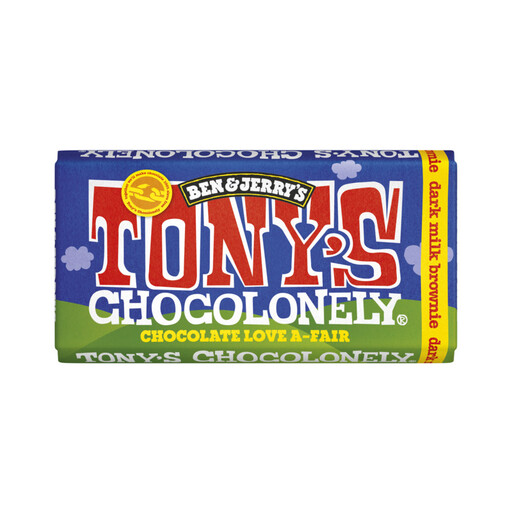 No image available
The 180g format suits sharing or choosing a portion for a break rather than treating the whole bar as an individual snack. Check the current pack’s Fairtrade marking, ingredients and allergens.
 No image available
This 180g milk-chocolate bar with caramel and sea salt is a larger format to share or portion. Check which Fairtrade Mark appears on the current pack, along with its ingredients and allergens.
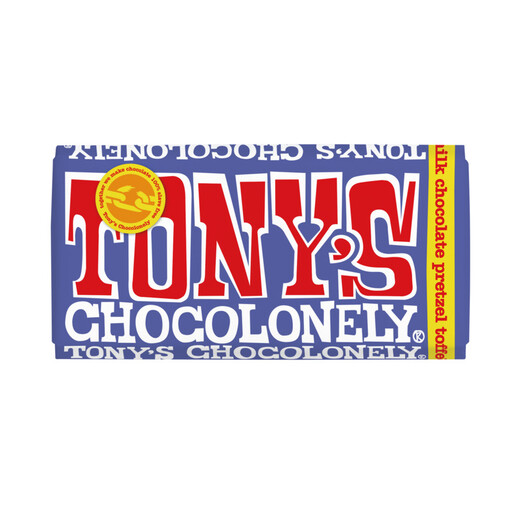 No image available
The 180g milk-chocolate bar with pretzel and toffee is another sharing or self-portioning option. Read the current pack to establish the scope of its Fairtrade claim and check its allergen statement.
Check the mark on the current wrapper or product listing. The Fairtrade Foundation says its standard mark covers ingredients that can be Fairtrade-certified; the white Fairtrade Sourced Ingredient mark applies to the named ingredient, such as cocoa.
No. A brand’s partnership or cocoa-sourcing programme does not establish which mark applies to an individual bar. For example, Cadbury describes Cocoa Life and its Fairtrade partnership, but a shopper requiring product-level certification should check the exact Dairy Milk pack.
Choose the size that fits the amount you plan to eat. Divine lists 35g bars and Tony’s Chocolonely lists small 47g and 50g bars; compare each product’s ingredients, allergens and nutrition label as well as its weight.
Divine declares 28.9g sugars per 100g for its 35g 70% dark bar, compared with 56.6g per 100g for its 35g milk bar. That comparison applies to those two products on the same per-100g label basis, not to dark and milk chocolate generally.
Check the school-food rules for the UK nation and setting concerned before supplying it. In England, the Requirements for School Food Regulations 2014 include chocolate in the definition of confectionery, and the Department for Education publishes guidance for food provided in state-funded schools. Do not assume England’s rules apply across the UK.