Sellers highlighting Fairtrade cocoa
If you intend to describe biscuits as using Fairtrade cocoa, you need a statement for the exact product. A familiar brand name alone does not establish how its cocoa was sourced.


If Fairtrade sourcing is part of your car boot sale refreshment offer, choose a chocolate digestive whose exact pack identifies Fairtrade cocoa: Waitrose & Partners and Central Co-op Food make that claim for the products discussed here. The claim concerns cocoa, not necessarily every ingredient. Keep the original packaging available for ingredient and allergen checks, and ask your local authority whether your food-selling activity requires registration.
If you intend to describe biscuits as using Fairtrade cocoa, you need a statement for the exact product. A familiar brand name alone does not establish how its cocoa was sourced.
Keep the current retail pack available so customers can inspect its ingredients and allergen information. A biscuit described as free from cereals containing gluten can still contain other allergens.
If you plan to sell or serve biscuits at a car boot sale, the nature and frequency of your activity affect whether food-business registration is required. Your local authority can advise on your circumstances.
Decide whether an explicit Fairtrade cocoa claim is essential, then check the pack information you will need when offering the biscuits to customers.
| Priority | What to check | Your needs |
|---|---|---|
| Fairtrade claim | Check the exact pack for a Fairtrade cocoa statement or an applicable Fairtrade mark. Identify which ingredient the claim covers. | I want to describe the cocoa sourcing accurately, rather than assume a chocolate digestive is Fairtrade because of its brand. |
| Mass balance | Read any mass-balance wording. The Fairtrade Foundation explains that the corresponding quantity of Fairtrade ingredient must be purchased, although certified and non-certified cocoa may be mixed during processing. | If I mention Fairtrade cocoa at the stall, I want customers to understand the claim without suggesting that every biscuit contains physically segregated cocoa. |
| Ingredients and allergens | Keep the current pack available and check its full ingredients list, emphasised allergens and precautionary warnings. Check a free-from product for other allergens too. | Customers may ask what is in each variety; I need its original label to hand rather than relying on the product name. |
| Food-selling activity | Ask the relevant local authority whether your activity requires registration. GOV.UK guidance covers food sales from temporary premises and notes that very limited, infrequent activity may be treated differently. | Before trading, I want to know which requirements apply to the way and frequency with which I offer refreshments. |
A Fairtrade claim may cover a named ingredient rather than the whole biscuit. The reviewed Tesco Groceries listing for McVitie's Milk Chocolate Digestives does not state a Fairtrade cocoa claim.
Check the exact pack or current product information before describing a biscuit as using Fairtrade cocoa.
The Fairtrade Foundation explains that certified and non-certified cocoa may be mixed during processing under mass balance.
Where the pack uses that wording, describe its cocoa as Fairtrade sourced on a mass-balance basis rather than claiming the cocoa in each biscuit was kept separate.
Co-op Free From Chocolate Digestives are described as free from cereals containing gluten, but the product information lists milk, oats and soya and warns that they may contain nuts.
Let customers inspect the current pack and its complete allergen declaration.
Without the pack, customers cannot readily inspect the manufacturer's ingredient and allergen information for the biscuits you are offering.
Keep packaging available, distinguish between varieties and check any applicable food-business requirements with your local authority.
These references concern the named product listings, not every digestive made by each brand.
The milk and dark chocolate digestive listings from Waitrose & Partners both state “Fairtrade sourced cocoa - mass balance”.
Central Co-op Food describes its Free From Chocolate Digestives as using cocoa sourced, traded and audited as Fairtrade, with mass-balance wording.
The reviewed Tesco Groceries listing identifies McVitie's Milk Chocolate Digestives 266g as a chocolate digestive, but does not state a Fairtrade cocoa claim.
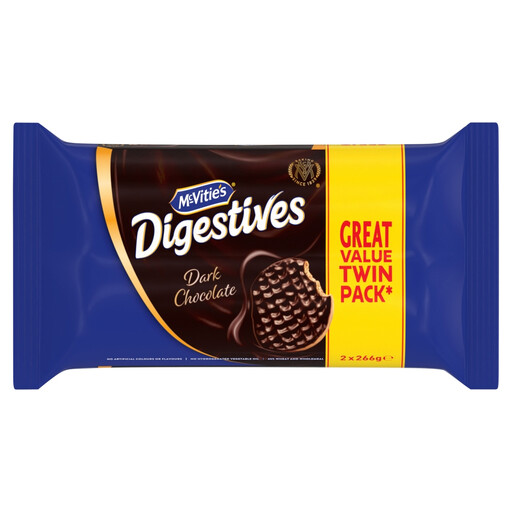
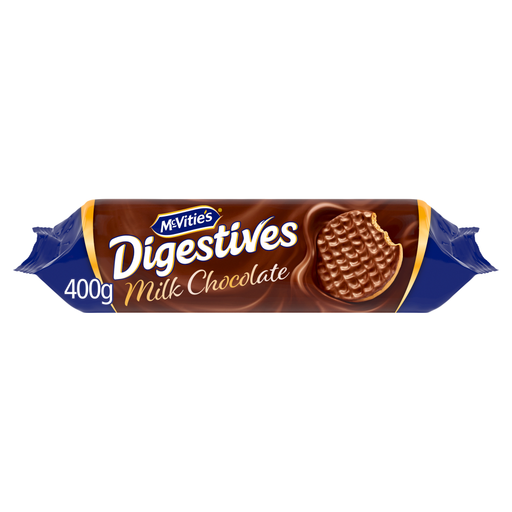
These McVitie's milk and dark chocolate digestives offer two pack formats for a car boot sale stall. Check each exact pack before making any Fairtrade cocoa claim, and retain its ingredient and allergen information for customers.
 No image available
The twin-pack format offers two packs of dark chocolate digestives for the stall. Its product description lists wheat, milk and soya; keep the original packaging available and confirm any cocoa-sourcing claim on the exact pack before using it.
 No image available
This 400g pack offers a milk chocolate digestive for the stall. Its product description lists milk, soya and wheat; retain the pack for customer checks and confirm any Fairtrade cocoa statement on that pack before displaying one.
No. The Fairtrade Foundation explains that certified and non-certified cocoa can be mixed during processing under mass balance, while the corresponding quantity of Fairtrade cocoa must be purchased. Describe the sourcing claim as it appears on the pack.
Only make a Fairtrade claim that the exact product supports. Waitrose & Partners states that its named Essential milk and dark chocolate digestives use Fairtrade sourced cocoa, and Central Co-op Food makes a Fairtrade cocoa statement for its named Free From product. The reviewed Tesco Groceries listing for McVitie's Milk Chocolate Digestives does not state that claim.
Registration depends on your activity, so ask the relevant local authority before trading. GOV.UK guidance says selling or handling food from temporary premises may constitute a food business, while the local authority may decide that very limited and infrequent activity does not require registration.
Keep the current packaging available so customers can read the food name, ingredients and allergen information for the particular variety. GOV.UK guidance for community and charity events recommends retaining packaging; a free-from description is not a substitute for checking the full label.