What to check before choosing
Start with the allergen you need to avoid and the exact bar you intend to buy. Then compare what its Fairtrade claim covers and which cocoa percentage you prefer.
| Priority |
What to check |
Your needs |
| Allergen wording |
Read the current ingredients, ‘may contain’ statement and any ‘not suitable for’ wording on the exact bar. The Food Standards Agency explains that precautionary wording signals possible unintended allergen presence through cross-contact. |
I need to distinguish an ingredient in the recipe from a warning about possible cross-contact, and avoid wording that conflicts with my allergy requirements. |
| Fairtrade claim |
Identify the mark and any named Fairtrade ingredient or mass-balance statement. The Fairtrade Foundation says its classic black-background mark covers all ingredients that can be Fairtrade-certified; its Fairtrade Sourced Ingredient mark identifies a specified sourced ingredient. A mass-balance claim does not establish physical separation in an individual bar. |
I want to know whether the claim covers all certifiable ingredients or a named ingredient, without treating sourcing information as an allergen clearance. |
| Cocoa and recipe |
Compare the stated cocoa percentage and the ingredients of the exact plain, filled or flavoured variant. Neither a higher percentage nor a shorter ingredient list overrides an allergen warning. |
I’m choosing a cocoa percentage to suit my taste, but I still need to assess this particular recipe and its precautionary wording. |
Brand references
These examples concern specific dark-chocolate bars, not every product made by each brand. Check the current pack before applying a bar’s allergen information to a purchase.
Divine
Divine describes its 70% dark bar as made with Fairtrade ingredients.
- The 90g bar is described as vegan and made without palm oil or soya in its recipe.
- Its label states ‘MAY CONTAIN: Gluten, Milk, Nuts’.
Green & Black's
Ocado lists the Organic 85% dark bar as Fairtrade and describes mass balance for its Fairtrade cocoa, sugar and vanilla.
- The listed bar is organic and contains 85% cocoa.
- Its listed warning says it may contain nuts and milk.
M&S
M&S describes its 75% and 85% dark bars as using Fairtrade cocoa.
- The two cocoa percentages offer a choice between the listed bars.
- M&S marks both as not suitable for people with milk, nut or peanut allergies and advises shoppers to read the product label rather than rely solely on online information.
Montezuma's
Absolute Black is a 100% cocoa comparator for recipe preferences, rather than an established Fairtrade-certified choice here.
- Montezuma's describes this bar as made without milk, gluten or soya in the recipe.
- It says the bar may contain traces of milk, nuts and peanuts.
Lindt
Lindt Excellence 99% is a high-cocoa dark-bar comparator, not an established Fairtrade choice here.
- Lindt describes the 99% bar as made to a vegan recipe.
- Lindt states that it is not suitable for people with a milk allergy and that it may contain nuts, milk, soya and sesame seeds.
Dark chocolate options on Joybuy
These two dark bars offer different cocoa percentages and Fairtrade sourcing information. For either one, compare the current pack’s claim and allergen wording with your own requirements before buying.
 No image available
Green & Black's Dark Chocolate 85% 90g
Consider this 85% cocoa bar if its current label fits your allergen requirements. Product information for Green & Black's Organic 85% describes Fairtrade cocoa, sugar and vanilla under mass balance and warns that the bar may contain nuts and milk; mass balance does not establish physical separation of certified ingredients in an individual bar. Check the pack’s exact Fairtrade mark and allergen wording before buying.
Joybuy
 No image available
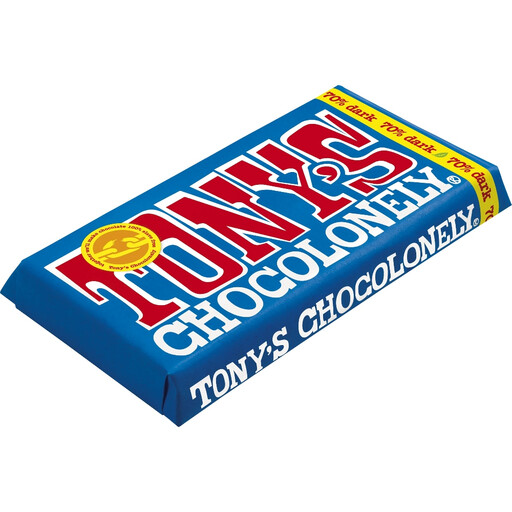
Tony's Dark Chocolate 180g
Tony's listing describes Fairtrade sourcing for cocoa, sugar and cocoa butter; check the current pack to see the precise claim. For an allergy-sensitive purchase, check its ingredients for soya and its precautionary wording for gluten-containing cereals, eggs, milk, nuts and peanuts. Do not choose the bar if its current wording conflicts with an allergen you need to avoid.
Joybuy
Questions about labels and allergens
Does vegan dark chocolate clear a bar for a milk allergy?
No. Vegan describes the recipe, not every possible cross-contact warning. Divine’s vegan 70% bar says it may contain milk, and Lindt says its vegan-recipe 99% bar is not suitable for people with a milk allergy because it is made in a facility that uses milk.
What does ‘may contain’ mean on a UK food label?
It is a precautionary warning that an allergen may be unintentionally present. The Food Standards Agency explains that this can arise through cross-contamination; check the warning against the specific allergen you need to avoid rather than treating an ingredient list alone as clearance.
Do the Fairtrade marks cover the same ingredients?
No. The Fairtrade Foundation says its classic black-background mark indicates that all ingredients that can be Fairtrade-certified are certified. Its Fairtrade Sourced Ingredient mark identifies a specified Fairtrade-sourced ingredient, so check which ingredient the claim names.
Can I use online allergen information to choose a bar?
Use it to narrow your options, then read the current pack before buying. M&S advises shoppers that product information can change and that its online ingredients and allergen details should not replace the product label.


