What should you check before buying?
Start with the ethical claim if it determines your choice, then compare the recipe requirements and the current pack label.
| Priority |
What to check |
Your needs |
| Fairtrade claim |
Check the exact product’s mark and wording. According to the Fairtrade Foundation, the classic mark covers all ingredients that can be Fairtrade-certified; the Fairtrade Sourced Ingredient Mark identifies a named Fairtrade-sourced ingredient. |
I want to know whether the claim covers every certifiable ingredient or cocoa alone. |
| Cocoa percentage |
Compare the stated cocoa percentage with the recipe. Divine lists a 70% dark bar, while M&S lists a separate 75% single-origin bar; the percentage does not, by itself, describe the finished bake’s flavour. |
For this bake, I want to stay close to the chocolate specified in the recipe rather than change its flavour without planning to. |
| Chocolate format |
Check the form and stated uses. Lindt describes its 70% cooking bar for cakes, tarts, brownies and cookies; Montezuma's describes buttons and couverture for baking or melting. Check Fairtrade claims separately. |
Chopping a bar is fine for an occasional cake, but for this recipe I may prefer pieces that are ready to portion. |
| Allergen information |
Read the current pack’s ingredients, may-contain statements and suitability wording. Lindt states that its 70% cooking bar is not suitable for people with a milk allergy. |
If I am baking for someone with an allergy, I need to assess the chocolate’s own label before using it. |
Which brands offer relevant options?
These examples illustrate different product claims and baking formats; a brand’s approach does not establish the claims on every bar it makes.
Divine
Divine’s plain 70% dark bar has a product-specific Fairtrade ingredient claim. It is distinct from flavoured Divine variants.
- Divine lists Fairtrade cocoa mass, sugar, cocoa butter and vanilla for its plain 70% bar.
- It is presented as a bar rather than a dedicated cooking chocolate, and its allergen information includes may-contain warnings for gluten, milk and nuts.
M&S
M&S describes its 75% single-origin dark bar as sourced from Fairtrade cocoa farms. It also sells a separate 70% dark chocolate intended for baking.
- The 75% bar lists cocoa mass, cane sugar and cocoa butter.
- Check the claim on the specific product: the separate 70% baking chocolate’s stated baking use does not establish the same Fairtrade claim.
Lindt
Lindt describes its 70% cooking bar for cakes, tarts, brownies and cookies. Its company sourcing programme is a separate claim from Fairtrade certification.
- The cooking bar states 70% cocoa and has explicitly stated baking uses.
- Do not treat Lindt’s Farming Program claim as a Fairtrade mark on this bar; Lindt also states that the bar is unsuitable for people with a milk allergy.
Montezuma's
Montezuma's describes organic buttons as suitable for baking and its couverture range as chocolate for baking and melting.
- Button and couverture formats offer alternatives to chopping a bar.
- An organic or baking description does not establish Fairtrade certification; check the exact pack if that claim matters to you.
Hotel Chocolat
Hotel Chocolat describes a cacao-farming initiative connected to its Better Way Bar range.
- The company identifies the range to which its farming-support claim relates.
- That range-specific company claim does not establish Fairtrade certification or baking suitability for another Hotel Chocolat dark chocolate.
Green & Black's
Morrisons lists Green & Black's Organic dark bars at 70% and 85% cocoa.
- The listed cocoa percentages give bakers distinct bars to compare with a recipe.
- Check the individual pack for its Fairtrade claim and baking suitability rather than inferring either from the brand or organic description.
Dark chocolate options on Joybuy
These options include a 70% cooking bar and two 70% dark bars, one with raspberries. If Fairtrade certification determines your choice, check the claim and its scope on the exact pack.
 No image available
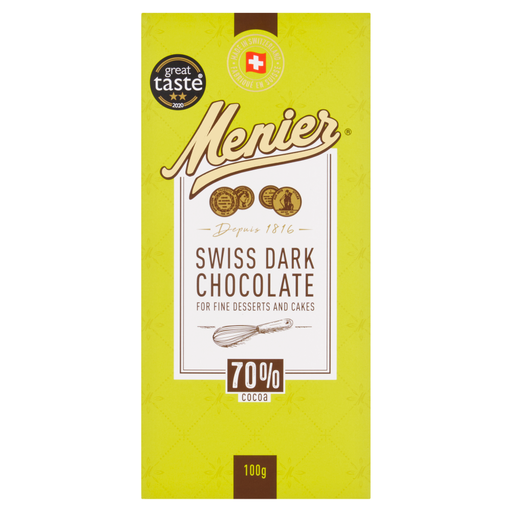
Menier Dark Cooking Chocolate 70% Cocoa 100g
A cooking-chocolate format to consider when the recipe calls for 70% dark chocolate. The listing identifies milk as an ingredient and warns of possible gluten, egg and tree-nut presence; check the current pack for an allergy-sensitive bake. A separate sourcing claim should not be read as Fairtrade certification.
View on Joybuy
 No image available
Green & Black's Dark Chocolate 70% 90g
A 70% dark bar to consider when a recipe does not require a dedicated cooking format. Check whether the bar form suits the preparation, and read the exact pack for the scope of any Fairtrade claim. Its listing warns that it may contain almonds, hazelnuts and milk.
View on Joybuy
 No image available
Divine 70% Dark Chocolate with Raspberries 90g
A raspberry-containing 70% bar for a recipe where fruit pieces are wanted, rather than a substitute for plain chocolate. The Fairtrade information for Divine’s plain 70% bar should not be assumed to describe this variant. Milk appears in this variant’s ingredient and allergen information despite vegan-friendly wording; check the current pack before an allergy-sensitive bake.
View on Joybuy
Frequently asked questions
What do the two Fairtrade marks mean on chocolate?
According to the Fairtrade Foundation, the classic Fairtrade Mark means all ingredients that can be Fairtrade-certified are certified. The Fairtrade Sourced Ingredient Mark means the named ingredient, such as cocoa, is Fairtrade-sourced. Read the wording beside the mark to see which claim the chocolate makes.
Should I use 70% dark chocolate for baking?
Use 70% when it matches the recipe or the result you intend. Lindt specifies cakes, tarts, brownies and cookies as uses for its 70% cooking bar, but that does not mean every recipe calls for the same percentage. Check the recipe before replacing its stated chocolate with a 75% bar.
Does responsible sourcing mean a chocolate is Fairtrade-certified?
No: a general responsible-sourcing or sustainability statement does not establish a product-specific Fairtrade claim. Lindt describes its cocoa sourcing programme, while Hotel Chocolat describes an initiative connected to its Better Way Bar range. Check the Fairtrade mark or wording on the chocolate you intend to use.
Is vegan dark chocolate suitable for someone with a milk allergy?
Not automatically. Divine’s plain 70% bar carries a may-contain milk warning, and Lindt says its 70% cooking bar is unsuitable for people with a milk allergy. Read the current pack’s ingredients, cross-contact warnings and suitability wording before using either in an allergy-sensitive bake.
How should I store dark chocolate before baking?
Follow the directions on the pack you buy. For its dark baking chocolate, M&S specifies a cool, dry place away from sunlight; check the chosen product’s own storage instructions rather than applying those directions to every bar.


