For a Fairtrade-led cake, check the exact chocolate’s Fairtrade Mark: the classic mark covers all ingredients that can be Fairtrade-certified, while the Fairtrade Sourced Ingredient Mark identifies a named ingredient. Then choose a plain bar with the cocoa percentage your recipe calls for and check the current pack for allergens. Chocolate sold for baking is not automatically Fairtrade-certified.
Who is this choice for?
Bakers seeking Fairtrade credentials
If Fairtrade status matters to your cake ingredients, check the mark on the exact bar rather than relying on general ethical-sourcing language. The Fairtrade Foundation distinguishes between its classic mark, which covers all certifiable ingredients, and its Sourced Ingredient Mark, which names the ingredient covered.
Bakers following a specific recipe
A plain bar with the cocoa percentage specified in your cake or ganache recipe is a useful starting point. M&S describes its 70% cooking chocolate for cakes and desserts, while Lindt describes its Excellence 70% bar for baking and cooking.
Bakers checking dietary and allergen details
Read the current ingredients and precautionary allergen statement before choosing chocolate for someone with an allergy. A vegan recipe does not rule out a milk cross-contact warning; the Food Standards Agency explains that “may contain” labelling communicates possible unintended allergen presence.
What should you check before buying?
Start with the certification claim if Fairtrade is essential, then check whether the chocolate fits the recipe and the people who will eat the cake.
| Priority | What to check | Your needs |
|---|
| Fairtrade scope |
Identify the mark on the exact pack. The Fairtrade Foundation says its classic mark covers every ingredient that can be Fairtrade-certified; its Sourced Ingredient Mark covers the named ingredient. |
I want to know whether the claim covers all certifiable ingredients in the bar or a named ingredient such as cocoa. |
| Recipe fit |
Match the recipe’s cocoa percentage and check for added flavours or fillings. M&S describes a 70% cooking chocolate for cakes; its 75% and 85% bars are different products. |
A plain chocolate that matches my recipe matters more to me than choosing a higher cocoa percentage without considering the result. |
| Allergens |
Read both the ingredients and precautionary statement on the current pack. Check these even when a chocolate is described as vegan. |
If I am baking for someone with an allergy, I need the allergen information for the exact chocolate I will use. |
| Bar size |
Compare the recipe quantity with the pack size: Divine’s 70% bar is 90g, while M&S lists its 70% cooking chocolate as 100g. |
I need enough chocolate for the recipe, especially if it calls for more than one bar contains. |
What can go wrong?
-
Taking “ethical” or “organic” to mean Fairtrade
Those descriptions do not establish the Fairtrade status of an individual bar. The Fairtrade Foundation also distinguishes a mark covering all certifiable ingredients from one covering a named sourced ingredient.
Check the exact wrapper or product page for the Fairtrade Mark and any ingredient named beside it.
-
Replacing the recipe’s chocolate without checking its cocoa level
A bar labelled 85% is not the same ingredient as one labelled 70%; a change may affect the cake’s intended flavour.
Use the percentage specified by the recipe where possible. For a substitution, choose a plain bar and compare its ingredients before baking.
-
Assuming vegan means suitable for a milk allergy
Lindt says its Excellence 70% bar has a vegan recipe but is not suitable for people with a milk allergy because it is made in a facility using milk. The Food Standards Agency explains that precautionary statements signal possible unintended allergen presence.
Check the current pack’s ingredients and allergen statements with the person you are baking for.
-
Choosing a flavoured bar for a plain chocolate cake
Added fruit, nuts or other flavours can change what goes into the cake. Dark-chocolate ranges include products other than plain bars.
Choose an unflavoured bar or cooking chocolate when that is what the recipe specifies.
Which brands are relevant?
Divine
Divine describes its plain 70% dark chocolate as a 90g bar made with Fairtrade cocoa mass, sugar, cocoa butter and vanilla.
- Divine says every ingredient that can be bought on Fairtrade terms has been.
- The bar is not a dedicated cooking block, and its product page warns that it may contain gluten, milk and nuts.
M&S
M&S describes Fairtrade cocoa sourcing for its 75% and 85% dark bars. It separately sells a 70% cooking chocolate for cakes, cookies and desserts.
- The 70% cooking product has an explicit cake-baking use, while the other two bars carry product-specific Fairtrade cocoa descriptions.
- Do not transfer the Fairtrade claims from the 75% or 85% bars to the separate cooking chocolate; check that product’s current pack if certification is required.
Green & Black's
UK retailer Real Foods lists Green & Black's Organic Dark Chocolate 70% 90g as FairTrade.
- The retailer identifies a specific 70% dark product rather than making a range-wide Fairtrade claim.
- Real Foods says milk chocolate is made on the same production line and lists this product as unsuitable for people with milk allergies. Check the current wrapper for sourcing and allergen details.
Lindt
Lindt describes its Excellence 70% dark bar as suitable for baking and cooking.
- Its product page states a 70% minimum cocoa content and explicitly mentions baking use.
- That page does not establish Fairtrade certification for the bar. Lindt also says its vegan-recipe product is not suitable for people with a milk allergy.
Montezuma's
Montezuma's describes FitzRoy as a plain, organic, vegan 74% dark chocolate bar.
- Its product page lists the ingredients for this specific 90g bar.
- A company-wide certified-cocoa statement does not identify FitzRoy as Fairtrade-certified. Its product page also says it may contain traces of milk, nuts and peanuts.
Hotel Chocolat
Hotel Chocolat’s UK dark-chocolate range includes products labelled 70%, 80% and 85%, in different formats.
- The range lets you inspect products with different stated cocoa percentages.
- A range listing does not establish Fairtrade certification or cake-baking suitability for a particular item; check the exact product.
Dark chocolate options on Joybuy
These options include a 70% cooking chocolate for a recipe-led choice and a plain 70% bar with Fairtrade ingredients named in its listing. Check the current pack if the precise Fairtrade Mark and its scope matter to your purchase.
 No image available
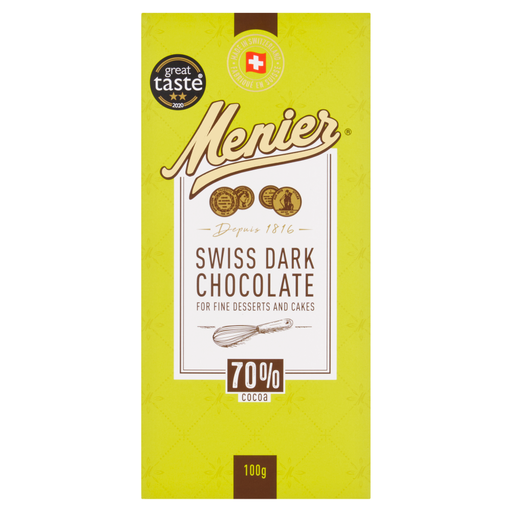
Menier Dark Cooking Chocolate 70% Cocoa 100g
A cooking-chocolate option for a cake recipe calling for 70% dark chocolate. Its listing describes baking uses, including cakes and brownies. It contains milk; check the current pack’s allergen information and Fairtrade status before choosing it for those requirements.
View on Joybuy
 No image available
Green & Black's Dark Chocolate 70% 90g
A plain 70% bar to consider when a recipe calls for that cocoa percentage; check whether its 90g size covers the quantity needed. The listing names Fairtrade cocoa, sugar and vanilla with a mass-balance qualification, so check the current pack for the Fairtrade Mark and its scope. It also lists possible allergen cross-contact.
View on Joybuy
Frequently asked questions
Does the Fairtrade Mark cover every ingredient in a chocolate bar?
It depends on the mark. The Fairtrade Foundation says the classic Fairtrade Mark covers every ingredient that can be Fairtrade-certified; its Fairtrade Sourced Ingredient Mark identifies the named Fairtrade-sourced ingredient. Check which mark appears on the exact bar.
What cocoa percentage should I use for a chocolate cake?
Use the percentage specified in your recipe where possible. If none is given, check the other ingredients and intended flavour before choosing: M&S describes a 70% cooking chocolate for cakes, and Lindt describes its Excellence 70% bar for baking. A 75% or 85% bar should not be assumed to give the same result.
Is vegan dark chocolate suitable for someone with a milk allergy?
Not automatically. Lindt says its vegan-recipe Excellence 70% bar is not suitable for people with a milk allergy because it is made in a facility using milk. Check the ingredients and precautionary allergen statement on the current pack before baking for someone with an allergy.
Does a brand’s sustainable-sourcing claim mean its dark chocolate is Fairtrade?
No conclusion about a particular bar follows from a broader sourcing statement. For example, Montezuma's describes certified cocoa at company level without identifying Fairtrade certification for its FitzRoy bar. Check the Fairtrade claim on the exact product you plan to use.


