Fairtrade-first top-up shoppers
You want the Fairtrade claim to apply to the bar you are buying, not just a general statement about the brand’s sourcing.


For a Fairtrade-led top-up, check the claim and FAIRTRADE Mark on the individual bar rather than treating general ethical-sourcing language as equivalent; Fairtrade International says products need approval to carry its mark. Divine Chocolate and M&S describe Fairtrade cocoa or Fairtrade status for particular dark bars at 70%, 75% and 85% cocoa. Choose a cocoa percentage that suits your taste, then check the current pack’s ingredients and allergen information.
You want the Fairtrade claim to apply to the bar you are buying, not just a general statement about the brand’s sourcing.
You are weighing a 70% or 75% dark bar against an 85% option while keeping its Fairtrade wording in view.
You need the details for the exact variant and pack, including any allergen or cross-contact wording, before deciding whether it suits your household.
Start with the claim on the individual bar, then compare cocoa percentages and read the full label for the variant you intend to buy.
| Priority | What to check | Your needs |
|---|---|---|
| Fairtrade claim | Look for the current FAIRTRADE Mark and read which product or ingredients the wording covers. Fairtrade International says use of the mark requires product approval; broader ethical-sourcing language is a different claim. | I want to know exactly what the Fairtrade claim covers on the bar going into my basket. |
| Cocoa percentage | Compare the stated percentage on the exact bar. Divine Chocolate lists 70% and 85% dark bars with Fairtrade cocoa; M&S describes a 75% bar sourced from Fairtrade cocoa farms and an 85% Fairtrade bar. | A 70% or 75% bar may suit my usual taste; I would choose 85% if I already enjoy a more intense dark-chocolate flavour. |
| Ingredients and allergens | Read the ingredient list and allergen statement for the specific variant and pack size, including any cross-contact wording. A vegan-recipe description is not an allergy assurance: Lindt Shop UK says its EXCELLENCE Dark 90% bar is made in a facility using milk and is unsuitable for people with a milk allergy. | Before I add a bar to a shared shop, I need to check its label against the household’s dietary and allergen requirements. |
Sourcing claims can describe different schemes or apply to particular ingredients. Hotel Chocolat says its model prevents it from obtaining traditional Fairtrade certification; Montezuma’s describes its cocoa as certified without naming Fairtrade in its general sourcing statement.
If Fairtrade is a requirement, check the exact bar’s current mark and accompanying wording rather than relying on a brand-wide claim.
A claim associated with one bar does not establish the status of another bar or a current pack.
For Green & Black’s or any other brand, inspect the bar you are buying for its Fairtrade wording, ingredients, allergens, weight and best-before date.
Neither cocoa percentage nor a vegan-recipe description establishes allergen suitability. Lindt Shop UK specifically warns that its EXCELLENCE Dark 90% bar is unsuitable for people with a milk allergy because it is made in a facility using milk.
Check the complete ingredient and allergen information on the specific pack, including any cross-contact statement.
An 85% bar is a different taste choice from the 70% and 75% products described by Divine Chocolate and M&S; cocoa percentage alone does not make it the right choice for a top-up.
Choose 85% if you already enjoy a more intense dark bar. Otherwise, consider the stated 70% and 75% options alongside their individual Fairtrade claims.
These examples illustrate product-specific claims and different sourcing approaches; a brand name alone does not establish a bar’s Fairtrade status.
Divine Chocolate describes Fairtrade cocoa in its 70% and 85% dark bars and says farmers of Ghana’s Kuapa Kokoo cooperative co-own the business.
M&S describes its 85% dark bar as Fairtrade and its 75% Single Origin bar as sourced from Fairtrade cocoa farms.
Montezuma’s lists dark bars including a 74% organic option and a 100% cocoa option.
Hotel Chocolat describes its own ethical-cacao approach as an alternative sourcing route.
Lindt Shop UK lists EXCELLENCE dark bars at 70%, 90% and 99% cocoa.
Green & Black’s has a listed 70% dark bar, but the brand name is not a substitute for checking the current product’s Fairtrade claim.
These bars offer stated 70% and 85% cocoa choices, a raspberry variant and a larger dark-chocolate bar for a top-up shop. If Fairtrade is essential, confirm the claim and ingredient scope on the current pack of the bar you choose.
 No image available
A 70% cocoa bar for a single-bar top-up. Check the current pack’s Fairtrade wording and ingredient scope, along with its warnings about almonds, hazelnuts and milk.
 No image available
Consider this 85% cocoa bar if you already enjoy a more intense dark flavour. Check the current pack’s Fairtrade wording and its warnings about almonds, hazelnuts and milk.
 No image available
Another 85% cocoa choice for shoppers who prefer an intense dark bar. Check its current Fairtrade claim and pack warnings concerning gluten, milk, nuts and peanuts.
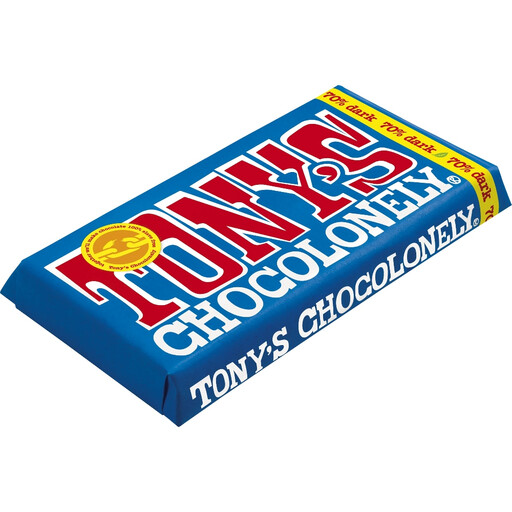 No image available
The 180g bar offers a different pack size for a top-up shop. Read the current pack for its Fairtrade ingredient wording and for soya and other allergen information before choosing it.
 No image available
A 70% cocoa bar with raspberries if you want a fruit addition. Its listing gives conflicting milk and vegan-suitability information: check the current pack’s ingredients and allergens rather than relying on the vegan description. Check its Fairtrade wording on the pack too.
Look at the exact pack for its FAIRTRADE Mark and accompanying ingredient wording. Fairtrade International says a product must be approved to carry the mark; a brand’s general ethical-sourcing statement does not tell you which claim applies to the bar in your basket.
Not on its own. Divine Chocolate and M&S describe different 70%, 75% and 85% dark-bar options; choose a cocoa percentage you expect to enjoy, then check that particular bar’s Fairtrade wording and ingredients.
No. Check the exact pack’s ingredients, allergen statement and cross-contact wording. Lindt Shop UK says its vegan-recipe EXCELLENCE Dark 90% bar is unsuitable for people with a milk allergy because it is manufactured in a facility using milk.
No. Hotel Chocolat says its model prevents it from obtaining traditional Fairtrade certification, while Montezuma’s general certified-cocoa statement does not identify Fairtrade as the certification. If Fairtrade is your requirement, check the specific bar’s current mark and claim.