Cyclists looking for a Fairtrade snack
A product-level Fairtrade claim matters if the chocolate is for a café stop or an off-bike treat. Its sourcing claim and its contribution to ride fuelling are separate questions.


For a Fairtrade dark-chocolate snack around cycling, choose a bar with a product-level Fairtrade claim and a portion that suits when you plan to eat it. A 35 g Divine 70% bar provides a fixed portion, while larger bars need portioning; neither format should be assumed to cover an intense ride’s carbohydrate plan. A 2015 sports-nutrition paper indexed by the U.S. National Library of Medicine advises 30–60 g carbohydrate per hour for intense exercise lasting 1–2.5 hours.
A product-level Fairtrade claim matters if the chocolate is for a café stop or an off-bike treat. Its sourcing claim and its contribution to ride fuelling are separate questions.
For intense exercise lasting 1–2.5 hours, a 2015 sports-nutrition paper indexed by the U.S. National Library of Medicine advises 30–60 g carbohydrate per hour. Check a chocolate portion’s carbohydrate value against the food and drink planned for the session, rather than treating the bar as the whole plan.
A vegan description does not settle whether a chocolate bar is suitable for someone with a milk, nut or peanut allergy. Read the allergen statement on the current wrapper, including any precautionary warnings.
Start with when you expect to eat the chocolate, then check its Fairtrade claim, portion and nutrition information against that use.
| Priority | What to check | Your needs |
|---|---|---|
| Carbohydrate per portion | Read the carbohydrate value for the amount you would actually eat, not just per 100 g. For context, a 2015 sports-nutrition paper indexed by the U.S. National Library of Medicine advises 30–60 g per hour during intense exercise lasting 1–2.5 hours. | If I am planning food for a hard ride, I want to know what the chocolate contributes without relying on it as my entire carbohydrate plan. |
| Fairtrade claim | Look for a current product-level claim or mark and check which ingredients it covers. The Fairtrade Foundation says the classic FAIRTRADE Mark covers all ingredients that can be Fairtrade certified. | I want the bar I choose to carry a Fairtrade claim, rather than assuming a general ethical-sourcing statement applies to it. |
| Portion and carrying | Check whether the chocolate comes as a small wrapped bar or a larger block you would portion yourself. Compare the nutrition panel using the stated serving size where one is given. | For a stop on the ride, a portion I can carry and finish matters more to me than having a full bar in my bag. |
| Cocoa percentage | Choose the cocoa percentage for the flavour you prefer, then read the nutrition panel. Marks & Spencer lists 32.6 g carbohydrate per 100 g for its reviewed 75% bar and 24.6 g per 100 g for its reviewed 85% bar. | I may prefer a higher-cocoa flavour, but I would not use the percentage on the front of the pack to estimate its carbohydrate contribution. |
| Dietary and allergen details | Check ingredients and the current wrapper’s allergen statement separately from any vegan wording. Allow for product information to change between listings and packs. | If I am buying for someone with an allergy, I need a suitable current allergen statement—not just a vegan label. |
A Divine 70% 35 g bar provides about 11.1 g carbohydrate, calculated from Divine Chocolate’s declared 31.7 g per 100 g. That is below the 30–60 g per hour advised in a 2015 sports-nutrition paper indexed by the U.S. National Library of Medicine for intense exercise lasting 1–2.5 hours.
Compare the portion’s carbohydrate with the food and drink planned for the ride. Count chocolate as a contribution, not an automatic replacement for the rest.
Brands use different sourcing descriptions. A programme described as responsible or sustainable does not, by itself, establish the Fairtrade status of an individual bar.
Check the current product’s Fairtrade wording or mark and whether it applies to the bar or to named ingredients.
Vegan wording and allergen information address different things. Chocolate described as vegan can still carry milk or nut warnings, and a listing can contain conflicting dietary information.
Use the current wrapper’s ingredients and allergen statement to assess suitability for the person who will eat it.
A 90–100 g bar requires a different carrying and portioning decision from a 35 g bar. Chocolate can also soften in warmth, making an opened bar awkward to handle.
Decide how much you intend to carry before leaving, and consider whether that portion will stay protected and be easy to open.
A brand’s sourcing approach is useful context, but the Fairtrade decision rests on the claim for the particular chocolate you choose.
Divine Chocolate describes its reviewed 70% dark bars as made with Fairtrade ingredients; the range includes a 35 g format as well as a 90 g bar.
Marks & Spencer identifies Fairtrade cocoa sourcing for its reviewed 75% and 85% dark-chocolate bars.
Fairtrade International identifies Green & Black’s Maya Gold as the first chocolate in the UK to carry the FAIRTRADE Mark.
Lindt describes its cocoa sourcing through the Lindt & Sprüngli Farming Program and other responsible-sourcing standards.
Montezuma’s describes supplier commitments concerning wages, working conditions and farming practices.
Hotel Chocolat lists 70% dark-chocolate slabs and batons among its UK products.
These are full-size dark-chocolate bars whose listings make Fairtrade or Fairtrade-ingredient claims. They suit shoppers considering a portioned snack or off-bike treat; compare the current pack’s claim, nutrition and allergen details before choosing one for a ride.
 No image available
A full-size bar for portioning as a snack or treat around cycling. The listing states a minimum of 70% cocoa solids and identifies Fairtrade cocoa, sugar and vanilla; its Fairtrade-ingredient wording allows certified and non-certified ingredients to be mixed on a mass-balance basis. The listing gives an 18 g serving, but its carbohydrate figures conflict, so check the current pack before counting a portion towards ride food. Vegan-friendly wording also conflicts with milk information in the listing; check the wrapper for dietary and allergy suitability.
 No image available
This 90 g bar suits someone who wants to portion a higher-cocoa chocolate rather than carry a ready-sized bar. Its listing states a minimum of 85% cocoa solids, identifies Fairtrade cocoa, sugar and vanilla, and gives 24 g available carbohydrate per 100 g and 4.2 g per stated 18 g portion. The Fairtrade-ingredient wording allows mass-balance mixing. The listing warns that it may contain almonds, hazelnuts, other nuts and milk; check the current wrapper where allergens matter.
 No image available
This is another full-size, self-portioned option with a product-level Fairtrade claim in its listing. The 100 g bar states a minimum of 85% cocoa solids and gives 23.4 g carbohydrate per 100 g, or 4.7 g per stated 20 g portion; that portion is not a complete carbohydrate plan for an intense ride. The listing warns that it may contain gluten-containing cereals, milk, nuts and peanuts, so check the current pack for allergy requirements.
 No image available
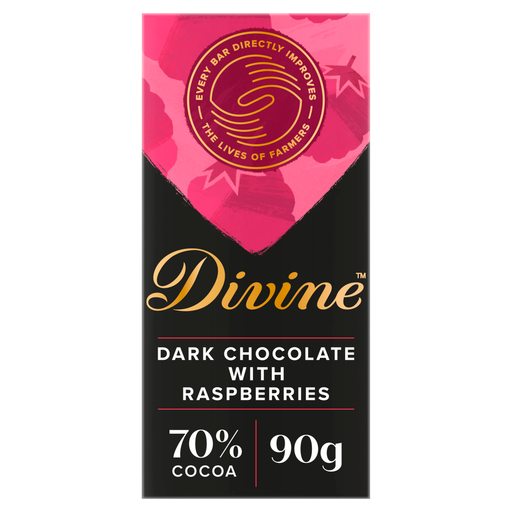
For a raspberry-flavoured dark-chocolate treat around cycling, this 90 g bar’s listing identifies Fairtrade cocoa and sugar and states at least 70% chocolate. It declares 29.7 g carbohydrate and 44.9 g fat per 100 g; check the pack for the amount in the portion you intend to eat. Vegan-friendly wording conflicts with milk information in the listing, which also warns about gluten and nuts. Use the current wrapper to assess dietary and allergy suitability.
Do not assume it can replace the rest of your carbohydrate plan. A 2015 sports-nutrition paper indexed by the U.S. National Library of Medicine advises 30–60 g carbohydrate per hour for intense exercise lasting 1–2.5 hours, while a Divine 70% 35 g bar provides about 11.1 g carbohydrate based on Divine Chocolate’s per-100 g panel. Compare any chocolate portion with the food and drink planned for the session.
No: cocoa percentage is not a substitute for the nutrition panel. Marks & Spencer declares 32.6 g carbohydrate per 100 g for its reviewed 75% dark bar and 24.6 g per 100 g for its reviewed 85% bar. Choose the flavour you prefer, then check the carbohydrate in your intended portion.
According to the Fairtrade Foundation, the classic FAIRTRADE Mark indicates that all ingredients capable of Fairtrade certification are Fairtrade certified. If a bar instead makes a claim about named Fairtrade ingredients, read that wording for its scope; do not treat general responsible-sourcing language as the same claim.
Not automatically. Vegan wording does not override an allergen statement: the reviewed Divine bars carry precautionary warnings, while Marks & Spencer lists its reviewed 75% and 85% bars as vegan but unsuitable for people with milk, nut or peanut allergy. Check the current physical wrapper for the particular product.
Choose a portion you can protect, open and finish conveniently, and keep it away from heat and sunlight where practical. Marks & Spencer instructs shoppers to store its reviewed bars in a cool, dry place away from sunlight; chocolate may soften on a warm ride.