What should you check?
Check the Fairtrade claim first, then match the cocoa profile to the person eating the bar and read its current ingredient information.
| Priority |
What to check |
Your needs |
| Fairtrade claim |
Look for the mark and read which ingredients the product’s wording covers. The Fairtrade Foundation says the classic black-background mark covers ingredients that can be Fairtrade-certified. |
I want the Fairtrade claim to apply to the bar I am buying, not just to a brand’s general sourcing programme. |
| Cocoa and flavour |
Compare the stated cocoa percentage and product-specific tasting description. Divine Chocolate and Marks & Spencer describe 70–75% and more bittersweet 85% bars. |
For a gift, I would choose the stronger cocoa profile only if I knew the recipient enjoyed it. |
| Ingredients and allergens |
Read the current pack’s ingredients and allergen warnings, including precautionary wording. Do not treat a vegan recipe description as an allergy statement. |
If an ingredient matters to me or the recipient, I need to check this exact bar rather than assume all dark chocolate is alike. |
Which brands are relevant?
These brand references help distinguish product-level Fairtrade wording from broader sourcing claims; a brand’s inclusion here does not establish the status of every bar it makes.
Divine
Divine Chocolate describes Fairtrade ingredients on its 70% and 85% dark bar pages.
- The two bars provide different cocoa-intensity choices with product-specific Fairtrade wording.
- Check the chosen pack’s allergen statements; neither percentage alone establishes allergy suitability.
M&S
Marks & Spencer describes Fairtrade cocoa on its 75% single-origin and 85% dark chocolate pages.
- The 75% and 85% options give gift buyers distinct cocoa and flavour descriptions to compare.
- M&S advises reading the current label because online ingredients and allergen information can change.
Green & Black's
Green & Black's describes its range in terms of organic ingredients and ethical sourcing.
- Its dark chocolate range includes 70% and 85% cocoa choices.
- For a Fairtrade-first purchase, check the particular bar’s pack and any qualification about the ingredients covered.
Montezuma's
Montezuma's discusses certified cocoa and offers high-cocoa dark chocolate, including Absolute Black 100%.
- The 100% bar offers a different cocoa-intensity choice from the 70–85% bars discussed here.
- The brand’s certified-cocoa wording does not itself identify that bar as Fairtrade. Check its pack if Fairtrade is required.
Hotel Chocolat
Hotel Chocolat offers dark chocolate gifting formats and describes ethical and sustainable cacao farming for its Better Way bar.
- Its gifting range provides formats to consider when the occasion matters as much as cocoa percentage.
- A sustainability description is not, by itself, confirmation of Fairtrade status for an individual bar.
Lindt
Lindt’s Excellence range includes an 85% cocoa dark bar.
- The stated cocoa percentage makes that bar identifiable for shoppers considering a stronger dark chocolate.
- Its sourcing wording does not establish a Fairtrade claim; Lindt also says this vegan-recipe bar is unsuitable for people with a milk allergy.
Dark chocolate options on Joybuy
These bars offer 70% and 85% cocoa choices for a premium gift or treat, alongside another dark chocolate option. Where Fairtrade matters, check each bar’s current pack for the mark and the scope of its claim before choosing.
 No image available
Morrisons The Best 85% Cocoa Ecuador Dark Chocolate 100g
Consider this 85% bar for someone who already likes a strong dark chocolate. Its listing describes it as Fairtrade; check the pack for the mark and claim scope. The listing also gives precautionary warnings for gluten-containing cereals, milk, nuts and peanuts, so read the current pack if allergens matter.
View on Joybuy
 No image available
Divine Chocolate 70% Dark Chocolate with Raspberries 90g
The raspberry variety offers a fruit-accented 70% option for a recipient who does not specifically want an 85% bar. Check its pack for the Fairtrade mark and claim scope. The listing’s vegan wording conflicts with its milk information, so do not rely on that wording for a dietary or allergy decision; read the current ingredients and allergen statement.
View on Joybuy
 No image available
Green & Black's Dark 70% Chocolate 90g
This 70% bar is an option when the recipient prefers a less intense cocoa percentage than 85%. Its listing refers to Fairtrade ingredients with a mass-balance qualification; check the pack for the mark and its precise scope. The listing also warns that it may contain nuts and milk.
View on Joybuy
 No image available
Green & Black's Dark 85% Chocolate 90g
Choose the 85% variant only if its stronger cocoa profile fits the person eating it. The listing refers to Fairtrade ingredients with a mass-balance qualification; confirm the mark and wording on the pack. Its precautionary allergen information mentions almonds, hazelnuts and milk.
View on Joybuy
 No image available
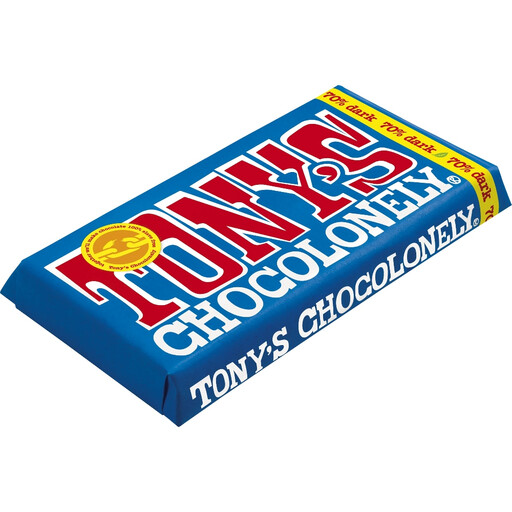
Tony's Dark Chocolate 180g
This larger-format bar may suit a gift where the recipient’s dark chocolate preferences are already known. Its listing says the cocoa mass, sugar and cocoa butter are traded in compliance with Fairtrade Standards; check the pack for the mark and claim scope. The listing identifies soya and gives precautionary warnings for other allergens, so read the current pack.
View on Joybuy
Questions about choosing dark chocolate
How can I tell whether a dark chocolate bar is Fairtrade?
Check the individual pack for the Fairtrade Mark and read any wording about the ingredients covered. The Fairtrade Foundation says its classic black-background mark means that ingredients capable of Fairtrade certification are Fairtrade-certified. Ethical or sustainable sourcing wording alone does not make the same claim.
Should I choose 70%, 75% or 85% cocoa for a gift?
Choose by the recipient’s known taste, not the highest number. Divine Chocolate’s 70% bar and Marks & Spencer’s 75% single-origin bar provide less intense routes than the 85% bars described by those brands; reserve a more bittersweet option for someone who enjoys it. Cocoa percentage does not establish Fairtrade status.
Does a vegan dark chocolate description mean it is suitable for a milk allergy?
No. Lindt states that its Excellence 85% bar is made to a vegan recipe but is unsuitable for people with a milk allergy because it is made in a facility that uses milk. Read the current allergen information for the exact bar.
Which label details should I check before buying?
Read the current pack’s ingredients, allergens, cocoa percentage and Fairtrade wording against your requirements. UK government food-labelling guidance covers ingredient lists including allergens and date marking; an online product description is not a substitute for checking the pack in hand.
How should I store a dark chocolate gift?
Follow the instructions on its pack. Marks & Spencer’s dark chocolate product information specifies a cool, dry place away from sunlight for the bars described here.


