What should you check?
Start with the certification claim, then choose a cocoa level and serving format that suit the people watching.
| Priority |
What to check |
Your needs |
| Fairtrade scope |
Check the exact pack for its Fairtrade claim. The Fairtrade Foundation says the classic FAIRTRADE Mark covers all ingredients that can be Fairtrade-certified; the Fairtrade Sourced Ingredient mark names the particular Fairtrade-sourced ingredient. |
I want to know whether the claim covers the bar’s certifiable ingredients or a named ingredient such as cocoa. |
| Cocoa level |
Compare the stated cocoa percentage with the viewers’ preferences. The cited Divine bar contains 70% cocoa solids, while Marks & Spencer lists Fairtrade bars at 75% and 85%. |
For mixed tastes, I would start around 70–75%. If everyone eating it already prefers intense dark chocolate, I could consider 85%. |
| Serving format |
Check the bar size and whether portions are individually wrapped. Divine Chocolate lists both a 90g 70% bar and a 30-pack of 35g 70% bars. |
I want to hand out portions during the match, or break up one bar for a smaller group. |
| Allergens |
Read the current physical pack, including precautionary statements. Divine Chocolate says its cited 70% bars may contain gluten, milk and nuts; Marks & Spencer states that its cited 75% and 85% bars are unsuitable for people with milk, nut or peanut allergies. |
If someone watching has a food allergy, I need the exact pack’s information before offering them chocolate. |
Brand references for this choice
These examples illustrate different product claims; a brand’s inclusion does not mean that every bar it makes is Fairtrade.
Divine
Divine Chocolate describes its cited 90g 70% bar as made with Fairtrade ingredients and its 35g mini bars as made with Fairtrade cocoa and sugar.
- The cited products offer a standard bar and a 30-pack of individual bars.
- Both cited listings say the bars may contain gluten, milk and nuts.
M&S
Marks & Spencer describes its cited 75% and 85% dark-chocolate bars as Fairtrade options.
- The two cited bars offer different stated cocoa percentages.
- Marks & Spencer states that both are unsuitable for people with milk, nut or peanut allergies.
Lindt
Lindt Shop UK lists 70% and 85% Excellence dark bars and describes its own Farming Program as a cocoa-sourcing standard built on Rainforest Alliance certification.
- The cited bar listings state their cocoa percentages.
- The Farming Program claim does not establish Fairtrade certification for those bars. Lindt says its cited vegan-recipe bars are not suitable for people with a milk allergy.
Montezuma’s
Montezuma’s describes commitments concerning its cocoa suppliers and says its cocoa is certified.
- The brand sets out its cocoa-sourcing commitments.
- That brand-level statement is not a Fairtrade claim for a specific dark-chocolate bar; check the product’s own label if Fairtrade is required.
Hotel Chocolat
Hotel Chocolat describes its Better Way Bar initiative as supporting cacao-farming activities.
- The brand explains what its initiative is intended to support.
- An initiative claim does not establish Fairtrade certification for a particular dark-chocolate bar.
Joybuy product options
These are standard dark-chocolate bars to consider for a small football gathering or for viewers who prefer an 85% cocoa bar. Check each current pack for the Fairtrade claim’s scope and for allergen information.
 No image available
Green & Black’s Dark 70% 90g
A 90g bar for sharing on a small scale, with 70% cocoa stated in its name. Its listing claims Fairtrade ingredients; check the pack for the mark and its scope. The listing also says it may contain almonds, hazelnuts and milk.
View on Joybuy
 No image available
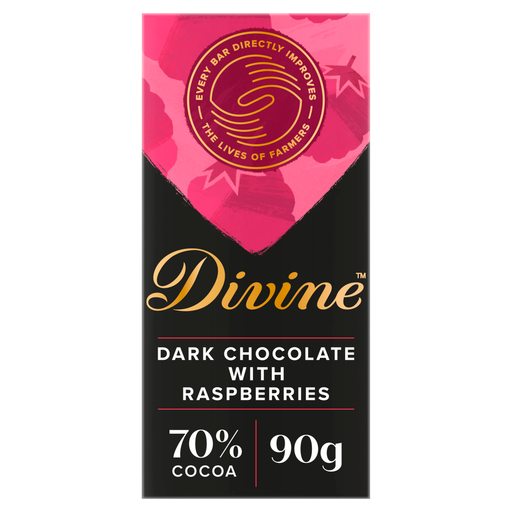
Divine 70% Dark Chocolate with Raspberries 90g
A fruit-flavoured 90g bar for a small group; its listing states at least 70% cocoa solids and claims Fairtrade ingredients. Check the pack for the mark’s scope. The listing’s vegan wording conflicts with its statement that the product contains milk, and it also warns that the bar may contain gluten and nuts; do not rely on the vegan wording when serving it.
View on Joybuy
 No image available
Green & Black’s Dark 85% 90g
A 90g bar to consider when viewers already prefer intense dark chocolate. Its listing states at least 85% cocoa solids and claims Fairtrade certification; confirm the mark and its scope on the pack. The listing says it may contain almonds, hazelnuts and milk.
View on Joybuy
 No image available
Morrisons 85% Cocoa Ecuador Dark Chocolate 100g
A 100g bar to consider for viewers who prefer an intense cocoa flavour. Its listing states at least 85% cocoa solids and identifies the bar as Fairtrade; check the pack for the mark and its scope. The listing says it may contain gluten, milk, nuts and peanuts.
View on Joybuy
Common questions
How can I tell whether a dark-chocolate bar is Fairtrade?
Check the claim on the exact pack and identify any mark shown. The Fairtrade Foundation says its classic FAIRTRADE Mark covers ingredients that can be Fairtrade-certified, while the Fairtrade Sourced Ingredient mark identifies a particular Fairtrade-sourced ingredient, such as cocoa.
Does an ethical or organic claim mean the bar is Fairtrade?
No. A sourcing programme or organic claim does not, by itself, establish Fairtrade certification for that bar. If Fairtrade is your requirement, check the specific product’s claim and its scope.
Which cocoa percentage should I choose for a football gathering?
A 70–75% bar is a practical starting point for mixed tastes; consider 85% when the people eating it already prefer a more intense dark-chocolate flavour. Percentage helps narrow the choice, but it does not replace checking certification and allergens.
What if someone watching has a food allergy?
Read the physical pack’s ingredient and precautionary statements before serving. Divine Chocolate says its cited 70% bars may contain gluten, milk and nuts; Marks & Spencer says its cited 75% and 85% bars are unsuitable for people with milk, nut or peanut allergies. Do not use a vegan description in place of an allergy check.
Is one bar or a pack of individual bars easier to share?
Individual bars are easier to hand round when several people are watching; a standard bar can be broken up for a smaller group. Divine Chocolate lists both a 90g 70% bar and a 30-pack of 35g 70% bars, so check the certification and allergen details of whichever format you choose.


