Fairtrade-first snack shoppers
You want a dark-chocolate bar for a TV night and need a Fairtrade claim on that product, rather than a broad statement about ethical sourcing.


For a TV-night snack where Fairtrade matters, check the claim on the exact bar before choosing a cocoa percentage. A 70–75% bar is a starting point if you do not specifically want an intense dark chocolate; consider 85% if you do. Read the current allergen label even when a bar is described as vegan.
You want a dark-chocolate bar for a TV night and need a Fairtrade claim on that product, rather than a broad statement about ethical sourcing.
You want to choose between bars around 70–75% and 85% cocoa, while comparing the labels of the particular bars you are considering.
You may prefer a vegan recipe, but still need to check the exact bar’s allergen statement. A vegan description does not override a milk or nut warning.
Start with the Fairtrade claim if it is essential to your choice, then compare cocoa percentage and the current ingredients and allergen label.
| Priority | What to check | Your needs |
|---|---|---|
| Fairtrade claim | Check the exact pack or listing for a FAIRTRADE Mark or explicit claim. The Fairtrade Foundation says the classic mark covers ingredients that can be Fairtrade-certified; a Fairtrade Sourced Ingredient mark identifies the named ingredient. | I want the bar I buy to meet my Fairtrade requirement, not just carry general ethical-sourcing wording. |
| Cocoa level | Compare the stated cocoa percentage, ingredients and sugars using the same label basis. Green & Black’s and M&S have Fairtrade options around 70–75% and at 85% cocoa. | For a relaxed TV night, I would start around 70–75% unless I already know I prefer a more intense dark bar. |
| Allergens | Read the current ingredients and may-contain statement on the exact pack. A vegan-recipe description does not cancel an allergy warning. | If milk or nuts are a concern for me, I need the product’s allergen information before sharing the bar. |
| School provision | If the chocolate is for pupils rather than home snacking, check the applicable nation, school type and menu rules. The Department for Education’s school-food guidance concerns state-funded schools in England; the 2014 regulations include chocolate in the definition of confectionery. | For a school event, I would ask the school or caterer to assess the proposed food against the rules that apply there. |
A general sourcing statement does not establish the scope of a Fairtrade claim. The Fairtrade Foundation distinguishes its classic mark from the mark for a named Fairtrade Sourced Ingredient.
If Fairtrade is essential, check the mark or explicit claim on the exact bar and, for an ingredient mark, which ingredient it names.
Some dark bars described as vegan also carry milk or nut warnings. M&S states that its cited 75% and 85% bars are unsuitable for people with milk, nut or peanut allergies.
Use the current pack’s ingredients and allergen statement when deciding whether a bar meets an allergy requirement.
A cocoa percentage does not tell you every ingredient, allergen warning or labelled sugar value for a particular recipe.
Compare the labels of the bars you are considering, and choose the cocoa intensity you expect to enjoy.
The Department for Education’s cited guidance addresses school food in England, not rules for every UK nation. Chocolate’s classification also needs to be considered in the applicable menu context.
For school provision, confirm the nation and school type, then have the school or caterer check the current requirements.
Fairtrade and allergen claims belong to particular products or ranges; a brand name alone is not a substitute for checking the bar.
Ocado lists the brand’s 70% and 85% organic dark bars as Fairtrade and suitable for vegans.
Divine describes its dark-chocolate collection as made with Fairtrade cocoa and offers plain and flavoured options.
M&S describes its 75% single-origin bar as sourced from Fairtrade cocoa farms and its cited 85% bar as Fairtrade.
Montezuma’s offers high-cocoa dark chocolate, including its 100% cocoa Absolute Black bar.
Lindt Excellence has cited UK dark bars at 70% and 85% cocoa.
Hotel Chocolat’s dark range includes selectors, slabs and batons, including options at 70%, 80% and 85% cocoa.
These two Joybuy bars offer around 70% cocoa for a TV-night snack: one plain and one with raspberry. Check each current wrapper for the Fairtrade claim and allergens that matter to you.
 No image available
A plain 70% cocoa bar to consider if you want Fairtrade dark chocolate without choosing an 85% option. The corresponding product information describes it as Fairtrade and warns that it may contain milk and nuts; check the current pack, including the scope of its Fairtrade claim.
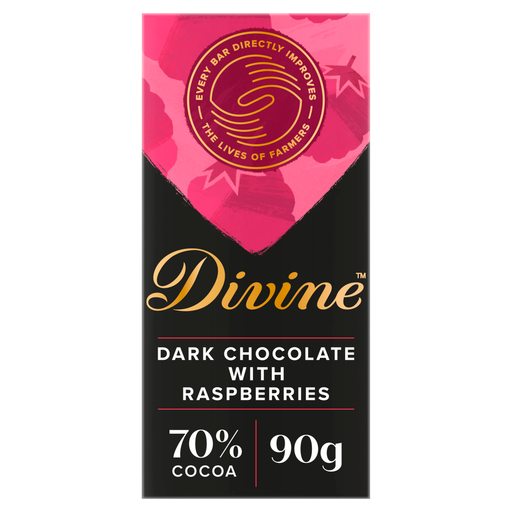 No image available
A raspberry-flavoured 70% dark bar if you want fruit alongside the chocolate. Its product information makes a Fairtrade claim, but lists milk as an ingredient despite separate vegan-friendly wording. Do not rely on the vegan wording for dietary or allergy decisions; check the current wrapper for ingredients, allergen warnings and the Fairtrade claim.
No. Responsible-sourcing wording alone does not establish a Fairtrade claim. The Fairtrade Foundation distinguishes its classic FAIRTRADE Mark, which covers ingredients that can be Fairtrade-certified, from a Fairtrade Sourced Ingredient mark naming a particular ingredient. Check the exact bar.
Choose by the intensity you enjoy: around 70–75% is a starting point if you do not specifically want an intense dark bar, while 85% is worth considering if you do. Compare the ingredients and labelled sugars of the exact products rather than assuming cocoa percentage determines every other characteristic.
Not necessarily. The cited Green & Black’s bars carry may-contain warnings, while M&S says its cited vegan 75% and 85% bars are unsuitable for people with milk, nut or peanut allergies. Read the current pack’s allergen statement before deciding.
Do not assume a Fairtrade claim changes the school-food rules. For state-funded schools in England, the Department for Education says school-food standards are a legal requirement, and the 2014 regulations include chocolate in the definition of confectionery. Ask the school or caterer to assess the proposed provision under the current rules; England’s guidance should not be applied automatically to the other UK nations.