Fairtrade-first pantry shoppers
You want a decaf coffee with a Fairtrade claim for the product you are buying, rather than relying on general sourcing language.


Choose a decaf coffee you can prepare with the equipment in your kitchen: ground coffee for a cafetière or filter machine, instant for kettle-only cups, or whole beans if you can grind them. If Fairtrade matters, check the claim on the specific product rather than treating “responsibly sourced” as equivalent. Pods add another check: they must fit your machine.
You want a decaf coffee with a Fairtrade claim for the product you are buying, rather than relying on general sourcing language.
Your preparation routine determines whether kettle-ready instant coffee or ground coffee for a cafetière or filter machine makes sense.
You want decaffeinated coffee but do not want to mistake “decaf” for a promise that it contains no caffeine.
Start with the coffee format and its Fairtrade claim. Then compare the product details that matter to your household’s preparation and storage routine.
| Priority | What to check | Your needs |
|---|---|---|
| Fairtrade sourcing | Look for a Fairtrade claim applying to the selected product. Do not treat general sourcing wording as the same claim. | I want to know that the decaf coffee I put in the cupboard is presented as Fairtrade, not just described in broad ethical terms. |
| Preparation format | Check whether it is instant, ground, whole bean or a pod. For pods, confirm the exact machine system. | Will I make quick cups with a kettle, brew ground coffee, grind beans or use a compatible pod machine? |
| Caffeine information | Check the decaf description and any product-specific residual-caffeine statement on the pack. Do not assume decaf means caffeine-free. | If a particular caffeine level matters to me, I need information for the coffee I am actually buying. |
| Roast and coffee style | Compare descriptions on the specific products: Sainsbury’s lists a Strength 3 ground House Blend, while M&S describes medium-roasted Arabica in its Gold Decaf instant coffee. | I would rather choose a stated coffee style alongside the format than expect all Fairtrade decaf products to taste alike. |
| Pack and storage | Check pack size, best-before information and the selected pack’s instructions for storage after opening. | For occasional decaf cups, I want a pack I can use while following its own storage directions. |
| Seller and fulfilment | For a marketplace listing, confirm who sells and sends the coffee, how delivery works and whether store collection is offered. | If I plan to stock up through a retailer marketplace, I need to know how the order will reach me. |
NESCAFÉ describes Original Decaf as responsibly sourced; that wording does not itself establish a Fairtrade claim for the product. By contrast, Sainsbury’s explicitly describes its Fairtrade Decaff House Blend as Fairtrade certified.
If certification is essential to your choice, check the claim for the particular pack or product before buying.
Instant coffee, ground coffee and whole beans require different preparation. Whole beans are an impractical pantry choice without a way to grind and brew them.
Choose a format that matches your equipment before comparing product styles: instant for kettle-only cups, ground for a suitable cafetière or filter setup, and beans when you can grind them.
Decaffeinated coffee can retain caffeine, so the word alone does not tell you a product’s precise residual amount.
Check the selected pack for a product-specific figure if that amount matters to your decision.
Tesco Marketplace lists the Equal Exchange whole beans through a third-party seller rather than as a Tesco store-collection product.
Check the seller, delivery arrangements and local availability before ordering pantry supplies.
Third-party fulfilment may not fit a shopping trip planned around collecting groceries in store.
These examples show why the claim and format need checking at product level; a brand’s inclusion does not make every decaf product it sells Fairtrade.
Sainsbury’s lists Fairtrade ground decaf options, including its 227g House Blend and 227g Taste the Difference Colombian coffee.
M&S offers a 200g Gold Decaf instant coffee and states that its tea and coffee is Fairtrade certified.
Tesco Marketplace lists Equal Exchange 227g decaffeinated whole beans; this is a marketplace product, not a Tesco own-label coffee.
NESCAFÉ Original Decaf is an instant option described by NESCAFÉ as decaffeinated using only water.
Kenco describes its Decaf as a medium-roast instant coffee.
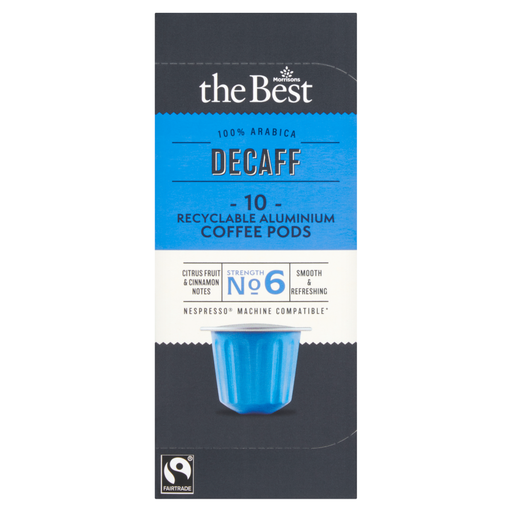
This pod option is for a pantry with a suitable coffee machine. Confirm the exact pod system before choosing it.
 No image available
For households using coffee pods, this is a decaffeinated Fairtrade option if the pods fit the machine. The product description identifies 100% Fairtrade Arabica coffee in aluminium pods and a 54g pack. Check the exact machine system before buying, and consult the pack if you need a product-specific caffeine figure.
Check the specific product or pack for an explicit Fairtrade claim. Sainsbury’s describes its Decaff House Blend as Fairtrade certified, while NESCAFÉ’s “responsibly sourced” description for Original Decaf is not the same claim.
Choose the format you can prepare: instant for kettle-only cups, ground coffee for a suitable cafetière or filter setup, or whole beans if you can grind them. A Fairtrade claim does not make one format interchangeable with another.
No. Decaffeinated coffee can retain caffeine. If the precise amount matters to you, check whether the selected product gives a residual-caffeine figure on its pack.
No. Check the exact machine system named on the pod pack or in the full product specifications before buying Morrisons The Best Fairtrade Decaf Pods; the product’s Fairtrade and decaf descriptions do not establish machine compatibility.
Follow the instructions on the selected pack rather than applying one product’s directions to every ground coffee. Check those instructions alongside pack size when deciding how much to stock.