Evening coffee drinkers
Decaf offers a coffee option for an after-dinner or winter-evening mug when reducing caffeine matters. It is not necessarily caffeine-free, so check the exact product’s stated caffeine content if you need that detail.


Choose Fairtrade instant decaf for a quick mug, ground coffee or filters when you want to brew, and pods only when they fit a machine you already own. Check the Fairtrade claim on the exact pack and remember that decaf can still contain some caffeine.
Decaf offers a coffee option for an after-dinner or winter-evening mug when reducing caffeine matters. It is not necessarily caffeine-free, so check the exact product’s stated caffeine content if you need that detail.
If Fairtrade is a requirement, look for an explicit claim on the coffee you are buying. Fairtrade International’s coffee standard covers certification and auditing of operators handling certified coffee; a brand’s general sourcing message is not a substitute for a product-level check.
Instant coffee needs a mug and hot water, while ground coffee and filters call for a different preparation routine. Pods make sense only when the pack’s stated system matches your machine.
Choose it when: You want a winter coffee with only a mug and hot water to prepare.
Bear in mind: Instant coffee will not give you the same brewing routine as ground coffee or filters.
Choose it when: You want to make a brewed mug and have a suitable way to prepare it.
Bear in mind: Ground coffee and filters take more preparation than instant coffee.
Choose them when: You already use a machine that accepts the specified pods.
Bear in mind: A pod’s format ties it to a compatible machine system.
| Priority | What to check | Your needs |
|---|---|---|
| Fairtrade claim | Check the exact jar, bag, filter pack or pod box for Fairtrade wording. Fairtrade Foundation explains that its Sourced Ingredient Mark identifies a Fairtrade-sourced ingredient, rather than necessarily every ingredient in a product. | I want the coffee I buy to carry a clear Fairtrade claim, not just a general responsible-sourcing message. |
| Preparation | Decide between instant, ground coffee, filters and pods. For pods, compare the stated system with your machine before ordering. | A quick mug suits some evenings; at other times, I would rather spend time brewing coffee with equipment I already have. |
| Remaining caffeine | Read any product-specific caffeine statement. Sainsbury’s states that its Fairtrade Decaff House Blend ground coffee has a caffeine content below 0.1%; that figure does not describe every decaf coffee. | I am reducing caffeine in an evening drink and want to know what the particular coffee says about the amount remaining. |
| Roast and flavour | Read the product’s roast and strength description, then consider the format. A strength number is not a standardised measure of caffeine or flavour across brands. | Whether I drink it black or add milk, I want a flavour description that helps me choose a winter cup I am likely to enjoy. |
A brand can describe farmer programmes or other sourcing work without making a Fairtrade claim for the decaf product in your basket.
Check the exact pack or product listing for explicit Fairtrade wording and read what any mark covers.
Decaf coffee can retain some caffeine, and a figure stated for one product cannot be applied to another.
If the remaining amount matters to your choice, look for a caffeine statement on the specific pack or listing.
Coffee pods are not universally interchangeable. Pods that do not fit cannot be used in that machine.
Compare the system named on the pod pack with your machine model before buying.
A retailer’s strength number describes its coffee’s intended flavour profile; it is not a cross-brand caffeine scale.
Use roast and strength to explore flavour, and check caffeine information separately when you need it.
These examples show how decaf format and Fairtrade wording can differ between individual products; a brand name alone does not establish the status of every coffee it sells.
Sainsbury’s lists Fairtrade Decaff House Blend as ground coffee in a 227 g pack.
M&S Fairtrade decaf examples include instant coffee, coffee filters and pods.
Nescafé Original Decaf is an instant coffee; Nescafé says it uses water to remove most of the caffeine.
Kenco lists Decaf as a medium-roast instant blend and Millicano Decaff as a finely milled Arabica option.
Taylors of Harrogate has Decaffé coffee in brewed formats, including individually portioned coffee bags.
This pod option is relevant if you want Fairtrade decaf for a machine-made winter coffee. Check its compatibility with your machine before choosing it.
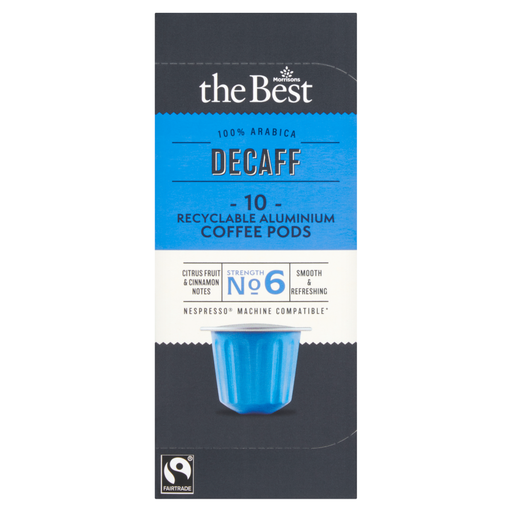 Image unavailable
These 54 g Fairtrade decaf pods are a choice for a pod-based coffee routine if the pack confirms they fit your machine. Check the pack for a product-specific caffeine statement if the amount remaining matters to you.
No. Decaf can still contain some caffeine. Sainsbury’s states a caffeine content below 0.1% for its Fairtrade Decaff House Blend ground coffee, but you should check the statement for the particular coffee you are considering rather than applying that figure to other products.
Look for an explicit Fairtrade claim on the exact pack or product listing. Fairtrade Foundation explains that a Fairtrade Sourced Ingredient Mark identifies a Fairtrade-sourced ingredient, so read the wording beside the mark to understand what it covers.
Instant coffee needs only hot water and a mug. Ground coffee or filters suit a brewed cup if you want that preparation routine, while pods are an option only when their stated system matches a machine you own.