Hosts making a shared pot
Ground decaf suits a cafetière or filter machine when several friends will be served together. Sainsbury’s House Blend and Cafédirect Machu Picchu are listed as Fairtrade ground coffees suitable for these brewing methods.


For a shared cafetière or filter pot, choose ground Fairtrade decaf; choose whole beans if you have a grinder or bean-to-cup machine, or instant coffee if guests will make individual cups with just a kettle. Check the Fairtrade claim on the particular coffee you buy, and remember that decaf does not necessarily mean caffeine-free.
Start with how you plan to serve the coffee: one pot, freshly ground beans or cups made separately.
Ground decaf suits a cafetière or filter machine when several friends will be served together. Sainsbury’s House Blend and Cafédirect Machu Picchu are listed as Fairtrade ground coffees suitable for these brewing methods.
Whole beans are an option if the equipment is already in place. Sainsbury’s Colombian Decaff is listed as Fairtrade 100% Arabica whole-bean coffee; it needs grinding or a compatible machine before serving.
Instant coffee needs hot water rather than brewing equipment, so guests can prepare cups at different times. Clipper Fairtrade Organic Decaf is listed as freeze-dried instant coffee.
Confirm the claim on the exact product, then match its format to your equipment and serving plans.
| Priority | What to check | Your needs |
|---|---|---|
| Fairtrade claim | Look for the FAIRTRADE Mark or explicit Fairtrade wording on the exact pack or product listing. Fairtrade International says products using its Mark must meet the relevant Fairtrade Standards. | I want the coffee I serve to carry a product-level Fairtrade claim, rather than relying on a familiar brand name or the word “decaf”. |
| Serving format | For ground coffee, check whether it suits your cafetière or filter machine. Whole beans need a grinder or bean-to-cup machine; instant coffee needs hot water. For pods, confirm machine compatibility. | Will I pour several cups from one pot, grind beans before friends arrive, or let people make their own cups? |
| Caffeine information | Read any product-specific caffeine statement if the amount matters to you. Nescafé’s decaf explainer notes that decaffeinated coffee is not necessarily caffeine-free. | I’m choosing decaf, but I do not want to mistake it for a product with no caffeine at all. |
“Decaf” describes the coffee’s caffeine status, not how it was sourced. A brand-level statement also may not identify the particular coffee in your basket.
Check the exact pack or listing for the FAIRTRADE Mark or an explicit product-level Fairtrade statement.
Whole beans cannot be prepared in the same way as ground or instant coffee. That distinction matters when friends are waiting for a drink.
Check that you have a grinder or compatible bean-to-cup machine before choosing beans. Otherwise, consider ground coffee for a cafetière or filter pot, or instant coffee for kettle-only preparation.
Decaffeinated coffee can retain some caffeine, as Nescafé explains in its decaf guidance.
If you need a stated residual-caffeine amount, check the individual product’s information. For an individual medical restriction, seek advice from an appropriate healthcare professional.
These are examples of product lines and listings to check, not a claim that every coffee from each brand is Fairtrade.
Its Fairtrade decaf listings include House Blend ground coffee and Colombian 100% Arabica whole beans.
Clipper Fairtrade Organic Decaf is listed by Sainsbury’s as freeze-dried instant coffee.
Tesco lists Decaf Machu Picchu as Fairtrade-certified Arabica ground coffee suitable for filter and cafetière brewing.
M&S describes its tea and coffee sourcing as Fairtrade-certified and lists a Fairtrade Decaf Ground Coffee.
A Tesco Marketplace listing describes Equal Exchange organic, Fairtrade-certified decaf whole beans as Swiss Water processed.
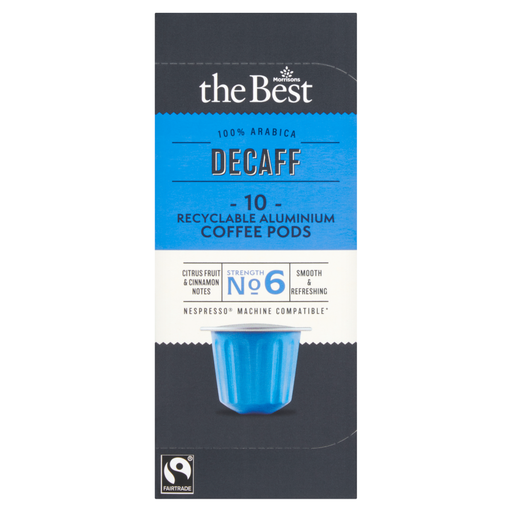
This pod option is for individual cups if you have a compatible coffee machine; check the capsule fit before choosing it.
 No image available
Pods offer individual servings when they fit your machine. The product description identifies decaffeinated 100% Arabica coffee and states 100% Fairtrade; confirm capsule compatibility before buying, and check the pack if you need a stated caffeine amount.
Check the particular pack or current product listing for the FAIRTRADE Mark or explicit Fairtrade certification or standards-compliance wording. Fairtrade International says the Mark is used on products whose ingredients meet its relevant standards; the word “decaf” alone makes no Fairtrade claim.
Not necessarily: Nescafé’s decaf guidance says some caffeine can remain. If the amount matters to you, use a caffeine statement for the particular product rather than assuming all decaf coffees have the same amount.
Instant decaf lets people make individual cups using hot water. Pods can also make individual cups if they fit your machine; ground coffee suits a shared cafetière or filter pot, while whole beans need grinding equipment before brewing.
Follow the storage instructions on the coffee’s own pack. Instructions can differ between products, so do not apply another brand’s storage period or method to the one you bought.