Hosts with a cafetière or filter machine
Ground Fairtrade decaf can serve several guests from one bag. Whole beans are another option if you have a grinder; check the brewing directions on the particular pack.


Choose the format your afternoon-tea setup can use: ground coffee for a cafetière or filter machine, whole beans if you also have a grinder, instant for quick individual cups, or pre-portioned filters or pods for individual servings. Then check the exact decaf product for a Fairtrade statement; a brand’s general sourcing claims or the word “decaf” alone do not establish it.
Ground Fairtrade decaf can serve several guests from one bag. Whole beans are another option if you have a grinder; check the brewing directions on the particular pack.
Instant coffee needs little preparation, while pre-portioned filters avoid measuring loose grounds. Pods are worth considering only after checking that they fit the machine you will use.
Look for Fairtrade wording on the exact decaf product, not just a general claim about its brand. Fairtrade status and decaffeination are separate product characteristics.
Start with the equipment and number of cups, then compare product-level Fairtrade wording, flavour descriptions and any caffeine information that matters to you.
| Priority | What to check | Your needs |
|---|---|---|
| Fairtrade claim | Check the exact decaf pack or listing for Fairtrade certification or a statement that its coffee is traded in compliance with Fairtrade standards. Do not rely on the brand name or decaf wording alone. | I want the Fairtrade claim to apply to the coffee I am actually serving, rather than to a different product from the same brand. |
| Preparation format | Match ground coffee to a cafetière or filter machine, and beans to a setup with a grinder. For filters, check how each portion is brewed; for pods, confirm machine compatibility. | For several guests, I need a format that works with my brewing equipment. If people will make their own cups, quick or pre-portioned preparation matters more. |
| Flavour description | Compare descriptions for the specific product rather than treating a roast or brand name as a taste test. Marks & Spencer describes its medium-roast filters as subtle; choose according to the style your guests prefer. | I would like a coffee style that fits the afternoon spread, but I can use the pack description only as a guide to flavour. |
| Residual caffeine | Read the current pack for a product-specific caffeine statement if the amount is important. “Decaf” by itself does not give a numerical residual-caffeine value or mean zero caffeine. | If I need to know the caffeine amount, I will check the particular product rather than assume every decaf coffee is identical. |
Decaffeination does not establish how the coffee was sourced. A decaf product without its own Fairtrade statement may not meet that requirement.
Check the exact pack or listing for Fairtrade certification or Fairtrade-standards wording before choosing it.
Whole beans need grinding, and loose ground coffee needs suitable brewing equipment. Pods also need to fit the machine.
Check your equipment against the product’s preparation instructions and, for pods, its stated compatibility before ordering.
Choosing beans or loose grounds may mean allowing extra preparation time or using a grinder or brewer.
The word “decaf” does not by itself specify how much caffeine remains in a particular coffee.
If a specific caffeine limit matters to you, check the current product label for the relevant information.
These examples concern particular UK-listed decaf products and formats; a Fairtrade statement for one product does not establish the status of an entire range.
Sainsbury’s lists Fairtrade Colombian decaf in ground and whole-bean formats, giving hosts a choice based on their brewing setup.
Tesco Groceries lists Cafédirect Machu Picchu Decaf as Fairtrade-certified Arabica ground coffee for filter or cafetière brewing.
Clipper’s Fairtrade Organic Decaf Latin American Instant Coffee is an instant option for individual cups.
Marks & Spencer lists 10 Fairtrade Decaf Medium Roast Coffee Filters for pre-portioned cups.
Tesco Groceries Marketplace describes Equal Exchange decaffeinated whole beans as Fairtrade certified, organic and Swiss Water processed.
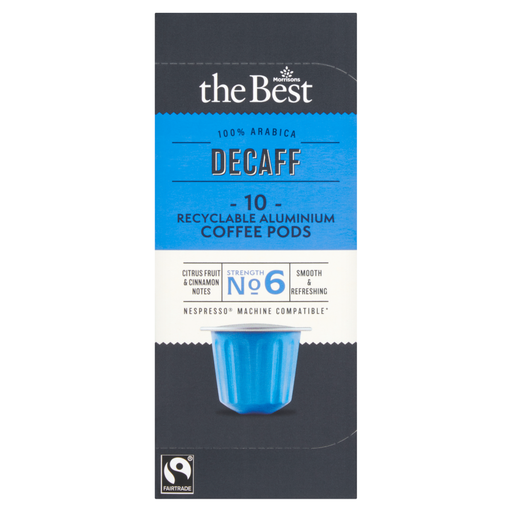
This pod option suits individually prepared afternoon-tea cups if it is compatible with your coffee machine. It does not replace the ground, bean, instant and filter-format checks above.
 No image available
The pod format offers individual servings for afternoon tea. The product description identifies decaffeinated 100% Arabica coffee and states 100% Fairtrade. Check compatibility with your machine before buying, and consult the current pack if a specific residual-caffeine amount matters to you.
Read the exact product listing or pack for explicit Fairtrade wording. For example, Sainsbury’s says its Colombian decaf whole beans are Fairtrade certified, while the Clipper instant listing says its coffee is traded in compliance with Fairtrade standards. Neither “decaf” nor a general brand sourcing message establishes the status of another product.
Ground coffee suits several cups if you have a cafetière or filter machine; instant suits quick individual preparation. Choose whole beans if you also have a grinder, pre-portioned filters if you want to avoid measuring loose coffee, or pods after confirming machine compatibility.
No: “decaf” should not be read as a zero-caffeine guarantee. If the remaining amount matters, look for caffeine information on the current label of the specific coffee you intend to serve.
Check the product details, seller, delivery arrangements and applicable returns terms. Tesco Groceries Marketplace lists Equal Exchange whole beans through a Marketplace seller, so do not assume its fulfilment arrangements are the same as a standard grocery order.