For a cream tea with several guests, choose a Fairtrade-certified ground decaf if you have a cafetière or filter machine and want to make a pot. If you only have a kettle, an M&S Fairtrade instant decaf offers an individually prepared option; whichever format you choose, check the exact product’s Fairtrade claim, and remember that decaf can retain traces of caffeine.
Who is this for?
Hosts serving several guests
If you have a cafetière or filter machine, ground coffee lets you prepare a pot. With only a kettle, Fairtrade instant decaf lets you make mugs individually. Tesco, Sainsbury’s and M&S describe products in these respective formats.
Shoppers who require Fairtrade certification
Check the claim on the exact decaf coffee rather than relying on a general sourcing statement. The cited Tesco and Sainsbury’s ground-coffee pages explicitly identify Fairtrade coffee, as do M&S’s descriptions of its selected instant decafs.
Guests keeping track of caffeine
Decaf is not necessarily caffeine-free: Nescafé’s UK guidance says it can retain small traces. That distinction matters if a guest needs to account for all the caffeine they consume.
What matters when choosing?
Start with the Fairtrade claim on the exact product, then choose a preparation format that fits your equipment and the way you plan to serve guests.
| Priority |
What to check |
Your needs |
| Fairtrade claim |
Look for the FAIRTRADE Mark or explicit Fairtrade wording for the exact coffee. Fairtrade International advises shoppers to look for the Mark; a general responsible-sourcing claim is a different statement. |
I want to know that the decaf I serve, rather than just its brand, has a stated Fairtrade claim. |
| Pot or individual mugs |
Check whether ground coffee is labelled for a cafetière or filter machine, or whether an instant product suits kettle-only preparation. Sainsbury’s directions for its Fairtrade Decaff House Blend specify one tablespoon per 200ml of off-the-boil water and 3–5 minutes in a cafetière. |
For several guests, I may prefer to prepare a pot; if people want coffee at different times, individual mugs may be simpler. |
| Equipment fit |
Whole beans require a grinder. For pods, confirm the named machine system before buying; pod shape or material alone does not establish compatibility. |
I would rather use equipment I already own than discover I cannot prepare the coffee on the day. |
| Caffeine |
Check whether guests need to account for residual caffeine. Nescafé’s UK guidance notes that decaf can contain small traces; the word “decaf” does not mean zero caffeine. |
If I am keeping track of caffeine, I need to count decaf as a possible source rather than assume it contains none. |
What should you watch for?
-
Assuming any ethical-sourcing claim means Fairtrade
Tesco describes Taylors Decaffé as Rainforest Alliance Certified, while Nescafé describes Original Decaf as responsibly sourced. Those statements do not, on their own, establish a Fairtrade claim for either decaf product.
If Fairtrade is essential to your choice, check the current pack or product page for the exact coffee’s FAIRTRADE Mark or explicit certification wording.
-
Choosing ground coffee without a way to brew it
The cited Cafédirect and Sainsbury’s ground decafs are intended for cafetière or filter preparation. Instant coffee offers a different route when only a kettle is available.
Match the format to your equipment before choosing a coffee for guests.
Ground coffee may also mean finding a cafetière, filter machine or compatible filters if you do not already have them.
-
Treating decaf as caffeine-free
Nescafé’s UK guidance says decaffeinated coffee can retain small traces of caffeine. A decaf label should not be used as a zero-caffeine guarantee.
If a guest needs to monitor caffeine closely, ask about their requirements rather than assuming any decaf coffee will meet them.
-
Overlooking the current pack information
Product details matter for individual guests: the M&S Decaf Americano Micro-Ground Instant Coffee page, for example, says it is not suitable for people with a milk allergy.
Check the pack’s Fairtrade wording, preparation directions and allergen statement before serving, as well as whether the product is available locally.
Relevant brand references
These examples show why the claim and format of a particular decaf matter more than a brand name alone.
Cafédirect
Tesco lists Cafédirect Machu Picchu Decaf as Fairtrade ground coffee suitable for a filter machine or cafetière.
- The Tesco product page states that the coffee is Fairtrade certified, traded, audited and sourced from Fairtrade producers.
- Its ground format calls for brewing equipment rather than kettle-only preparation.
M&S
M&S describes its Gold Decaf and Decaf Americano Micro-Ground products as Fairtrade instant coffees for individual mugs.
- The Gold Decaf listing describes Arabica from Fairtrade farms; the Micro-Ground listing explicitly describes its coffee as Fairtrade.
- M&S says its Decaf Americano Micro-Ground product is not suitable for people with a milk allergy. Check the current pack when serving guests.
Sainsbury’s
Sainsbury’s lists Fairtrade decaf in ground and whole-bean formats.
- Its Fairtrade Decaff House Blend page explicitly states Fairtrade sourcing and gives cafetière preparation directions.
- The whole-bean option requires a grinder; check the details of the particular product you intend to buy.
Taylors of Harrogate
Tesco describes Taylors Decaffé ground coffee as using a natural water decaffeination method and as suitable for cafetière or filter brewing.
- The cited product information identifies its brewing formats and decaffeination method.
- That information identifies Rainforest Alliance certification, not a Fairtrade claim for this particular product.
Nescafé
Nescafé describes Original Decaf as instant coffee decaffeinated using water.
- Its instant format can be prepared with a kettle and mug.
- Nescafé’s cited product description uses a responsible-sourcing claim; that alone does not establish Fairtrade certification for Original Decaf.
Joybuy product options
This Fairtrade decaf pod option is for a host who wants to prepare coffees individually. Confirm that the pods fit your machine before choosing them for a cream tea.
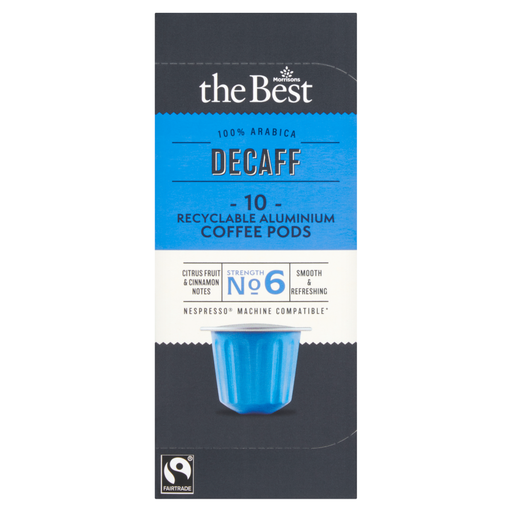 Image unavailable
Morrisons The Best Fairtrade Decaf Pods 54g
A pod option for preparing decaf coffees individually if you have a compatible machine. The Joybuy description identifies aluminium pods containing decaffeinated, 100% Fairtrade Arabica coffee; check machine compatibility before buying.
View on Joybuy
Frequently asked questions
How can I tell whether a decaf coffee is Fairtrade?
Look for the FAIRTRADE Mark or explicit Fairtrade wording for the exact coffee. Fairtrade International directs UK shoppers to look for the Mark, while the cited Tesco and Sainsbury’s ground-decaf pages explicitly describe their products as Fairtrade certified. “Responsibly sourced” on its own does not make the same claim.
Should I serve ground or instant decaf at a cream tea?
Choose Fairtrade ground decaf if you have a cafetière or filter machine and want to prepare a pot; choose a Fairtrade instant decaf if you only have a kettle or want to make mugs individually. For its Fairtrade Decaff House Blend, Sainsbury’s gives cafetière directions of one tablespoon per 200ml of off-the-boil water, brewed for 3–5 minutes.
Is decaf coffee completely caffeine-free?
No. Nescafé’s UK guidance says decaffeinated coffee can still contain small traces of caffeine, so do not assume a decaf serving has none.
Should I check allergens before serving decaf coffee?
Yes, particularly if a guest has an allergy. The M&S Decaf Americano Micro-Ground Instant Coffee page says that product is not suitable for people with a milk allergy; read the current pack for the specific coffee you serve.


