People with only a kettle at work
If your lunch break leaves little room for brewing and clearing up, instant decaf can be made in a mug with hot water. Clipper and M&S describe instant decaf products with product-level Fairtrade statements.


If lunch means a mug and hot water, choose an instant decaf coffee with an explicit Fairtrade statement for that product; Clipper and M&S each describe a qualifying instant option. Ground coffee and whole beans need brewing equipment and more preparation, while decaf should not be mistaken for caffeine-free coffee.
If your lunch break leaves little room for brewing and clearing up, instant decaf can be made in a mug with hot water. Clipper and M&S describe instant decaf products with product-level Fairtrade statements.
If Fairtrade status is a condition of purchase, check the statement for the exact decaf product rather than relying on a brand-wide responsible-sourcing message. Fairtrade International describes its coffee minimum price as a safety net against falls in market prices.
Decaf is not necessarily caffeine-free: Nescafé’s UK guidance says small traces can remain after decaffeination. Check the product information if caffeine content affects your choice.
Start with the equipment available at lunch, then check the Fairtrade wording and coffee format on the exact product.
| Priority | What to check | Your needs |
|---|---|---|
| Preparation | Check whether the coffee is instant, ground, whole bean or a pod. Ground coffee needs a suitable brewer; beans also need a grinder or compatible machine. | With just a mug and hot water, I want instant coffee rather than a format that needs brewing equipment. |
| Fairtrade status | Look for an explicit Fairtrade statement for the exact decaf product on its current page and pack. Clipper states compliance with Fairtrade standards; M&S says its Gold Decaf comes from Fairtrade farms. | A general responsible-sourcing claim is not enough if Fairtrade is a condition of my purchase. |
| Machine fit | For pods, confirm the named pod system and whether it matches the machine available at work. A pod format alone does not establish compatibility. | I can use pods at lunch only if they fit a machine I can access. |
| Caffeine expectations | Read the product’s decaf information without treating “decaf” as a zero-caffeine claim. Nescafé’s UK guidance says traces of caffeine can remain. | I want to reduce caffeine, but I do not want to assume my cup contains none. |
A broad sourcing statement does not establish Fairtrade status for a particular decaf coffee. Nescafé describes Original Decaf as responsibly sourced without making a Fairtrade claim on that product page.
Check the current pack and product page for an explicit Fairtrade statement about the coffee you intend to buy.
Cafédirect lists Fairtrade decaf in both formats, but neither can be prepared as instant coffee in a mug of hot water.
Choose ground coffee or beans when you have suitable brewing equipment and time to prepare and clear away the cup.
If you do not already have the equipment, that format also means arranging a suitable brewer or grinder.
Nescafé’s UK guidance says decaffeination can leave small traces of caffeine.
If you need to avoid caffeine completely, do not rely on the word “decaf” as a guarantee; check the product information and seek individual clinical advice where appropriate.
M&S describes Gold Decaf as freeze-dried coffee sourced from Fairtrade farms. Its corporate statement says its tea and coffee is Fairtrade certified.
Clipper describes its Latin American Decaf as freeze-dried instant coffee traded in compliance with Fairtrade standards.
Cafédirect lists Fairtrade decaf options including Machu Picchu Decaf ground coffee and House Decaf whole beans.
Nescafé describes Original Decaf as instant coffee decaffeinated using water.
Kenco describes Kenco Decaf as a medium-roast instant coffee.
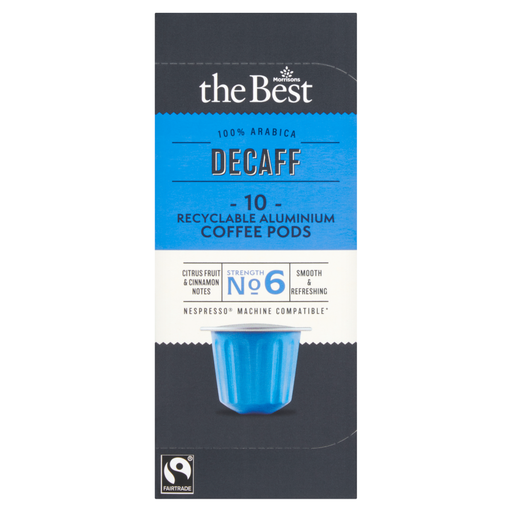
This decaf pod option is relevant to a work lunch with a compatible coffee-pod machine, rather than a desk with only a kettle.
 No image available
A decaf pod option for lunch where a compatible machine is available; confirm that these pods fit the machine before buying. The pack is 54g, and decaf does not necessarily mean caffeine-free.
Choose an instant decaf product with an explicit Fairtrade statement. Clipper describes its Latin American Decaf as freeze-dried instant coffee traded in compliance with Fairtrade standards; M&S describes Gold Decaf as freeze-dried coffee sourced from Fairtrade farms.
No: check the Fairtrade wording for the exact product. Nescafé calls Original Decaf responsibly sourced, but that statement does not establish Fairtrade status for the jar.
Choose instant when you have only a mug and hot water. Ground coffee and beans are options when you have the appropriate brewing equipment and time to use and clean it; Cafédirect lists Fairtrade decaf in both of those formats.
No. Nescafé’s UK guidance says decaf can retain small traces of caffeine after processing, so do not assume that a decaf label means zero caffeine.