Buyers offering a reduced-caffeine choice
Some customers prefer decaf. Offer it without assuming that every older customer wants to limit caffeine or presenting it as a response to a medical condition.


Check the Fairtrade claim on the exact decaf coffee pack or product page, then choose a format that fits the shop’s equipment and serving routine. Instant coffee needs hot water for individual drinks, filters need a suitable brewing method, and pods need a compatible machine. Decaf may still contain very low levels of caffeine, according to Nottingham and Nottinghamshire NHS.
A retirement shop can offer decaf as a customer choice while selecting a coffee its team can serve consistently and describe accurately.
Some customers prefer decaf. Offer it without assuming that every older customer wants to limit caffeine or presenting it as a response to a medical condition.
Keep the exact product and pack details with its current Fairtrade claim, rather than relying on general statements about a brand’s sourcing.
Choose between instant coffee, filters and pods according to the equipment already in place and the steps staff can manage during service.
Confirm the sourcing claim for the exact coffee first, then check how it will be prepared and described to customers.
| Priority | What to check | Your needs |
|---|---|---|
| Fairtrade claim | Check the current pack or product page for the exact decaf coffee and format. The Fairtrade Foundation says the classic Fairtrade Mark indicates that ingredients capable of Fairtrade certification are Fairtrade-certified. | I need to be able to support the sourcing claim for the coffee the shop actually serves, not just for its brand. |
| Serving format | Check whether staff will prepare individual instant drinks, brew coffee using suitable filters, or use a pod machine. For pods, confirm the specific capsule system before ordering. | For a small counter, I want a preparation method that fits the equipment and serving routine already in place. |
| Decaf description | Check that the chosen product is labelled decaffeinated. Nottingham and Nottinghamshire NHS notes that decaf drinks may still contain very low levels of caffeine, depending on production. | I want to offer customers a decaf choice without describing it as completely caffeine-free. |
A general sourcing statement does not establish the Fairtrade status of the particular decaf coffee being served.
Keep the selected product and pack details with its current Fairtrade evidence, and recheck them if the supplier or format changes.
Nottingham and Nottinghamshire NHS says decaf drinks can retain very low levels of caffeine; individual reasons for limiting caffeine also differ.
Call the drink decaf rather than caffeine-free. Refer customers with personal medical questions to an appropriate clinician.
A coffee pod will not necessarily fit the shop’s capsule machine, even when the coffee meets its decaf and Fairtrade requirements.
Confirm the exact machine and capsule system, along with the cleaning routine, before using pods for regular service.
Milk, plant drinks, syrups and powders can introduce allergens into a served drink.
The Food Standards Agency says food businesses must provide allergen information for non-prepacked foods. Keep ingredient and allergen details current for every addition the shop offers.
These brand examples help distinguish product-specific Fairtrade descriptions from decaf products that need a separate pack check; they do not establish what a shop can currently buy from Joybuy.
M&S says its tea and coffee is Fairtrade certified. Its Gold Decaf instant coffee, Decaf Americano micro-ground instant coffee and decaf coffee filters each have product descriptions referring to Fairtrade sourcing.
Nescafé describes Original Decaf as instant coffee with most of its caffeine removed using water.
Kenco describes its Decaf product as a medium-roast instant coffee blend.
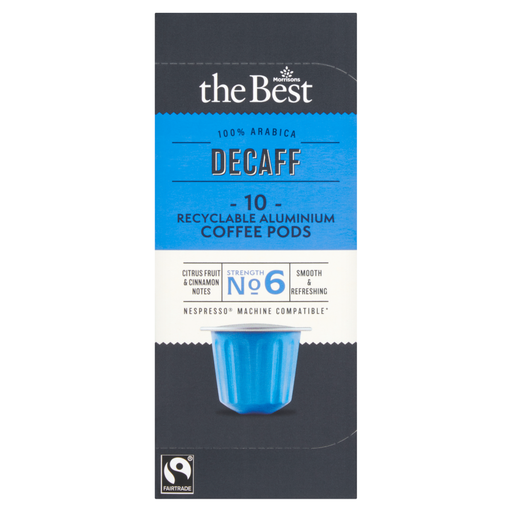
This pod option is relevant to a retirement shop that already has a compatible capsule machine. Check the machine’s capsule system before buying.
 No image available
A pod-format choice for a shop with a compatible capsule machine. Joybuy describes the coffee as decaffeinated, 100% Arabica and 100% Fairtrade. Confirm the capsule system before ordering, and do not describe the coffee as caffeine-free.
Check the exact current jar, filter pack or pod pack. The Fairtrade Foundation says the classic Fairtrade Mark indicates that ingredients capable of Fairtrade certification are Fairtrade-certified. An explicit claim on the current product page can also support a purchasing record, but do not assume it applies to another pack or format.
Not necessarily. Nottingham and Nottinghamshire NHS says decaf drinks may still contain very low levels of caffeine depending on how they were produced. Describe the drink as decaffeinated, not caffeine-free.
Instant coffee fits individual hot-water preparation without a brewer. Filters need a suitable brewing method, while pods are an option only if the shop’s machine accepts the specific capsule type. Choose according to the equipment and preparation steps the team can manage.
Keep accurate allergen information for the milk and any plant drinks, syrups or powders actually offered. The Food Standards Agency says food businesses must provide allergen information for non-prepacked foods; update the shop’s ingredient details when products or recipes change.
A shop operating as a food business should check its registration position with its local authority. GOV.UK states that food businesses in England, Wales and Northern Ireland must register at least 28 days before trading. Confirm how that rule applies to the shop’s location and activities rather than assuming the same position across the UK.