Kettle-only shoppers
If you need a cup without a coffee brewer, compare instant Fairtrade decaf. M&S and Clipper have instant products with Fairtrade statements on their listings.


For a Fairtrade decaf top-up, choose a format you can prepare with the equipment you have: instant for hot-water preparation, ground coffee for a cafetière or filter machine, beans if you have a grinder, and pods only if they fit your machine. Check the Fairtrade statement on the exact pack or listing rather than assuming every decaf product from a particular brand has the same certification.
If you need a cup without a coffee brewer, compare instant Fairtrade decaf. M&S and Clipper have instant products with Fairtrade statements on their listings.
Ground coffee is an option when you already have the right brewing equipment. Sainsbury's lists Fairtrade decaf ground coffees; check the pack's preparation and storage instructions.
Look for a Fairtrade statement for the particular decaf coffee you intend to buy. A brand's wider sourcing statement is useful context, but the current product pack is the closer check.
Start with the brewing equipment available for this top-up, then check certification and the pack details that matter for how often you will use it.
| Priority | What to check | Your needs |
|---|---|---|
| Fairtrade claim | Find an explicit Fairtrade statement on the exact pack or listing. Check whether it describes the coffee itself or only a wider brand range. | I want to confirm the decaf I am buying is presented as Fairtrade, rather than relying on the retailer's reputation. |
| Brewing format | Match instant to hot-water preparation, ground coffee to a cafetière or filter machine, and beans to a grinder. For pods, confirm the named capsule system; coffee filters also need a suitable brewing method. | There is no point adding a pack to a quick shop if I cannot prepare it with the equipment at home. |
| Decaf information | Read the current product statement if residual caffeine matters to your choice. Do not interpret the word ‘decaf’ as a zero-caffeine guarantee. | I want the decaf information for this particular coffee, not an assumption based on the category name. |
| Pack and storage | Compare pack sizes with how often you make decaf, and follow the product's instructions after opening. Pre-portioned filters are another option for occasional cups. | If I only make decaf now and then, I would rather choose a format and pack I can use as directed. |
| Allergen details | Check the current ingredients and allergen statement for the exact product. The M&S Decaf Americano instant listing flags that it is not suitable for people with a milk allergy. | An instant coffee's name alone does not tell me whether its allergen information meets my needs. |
Fairtrade information for one coffee does not establish the status of every decaf product sold under the same name.
Check the statement on the exact listing or pack; Sainsbury's, for example, explicitly identifies Fairtrade coffee on its listed decaf ground products.
Ground coffee needs suitable brewing equipment, beans need a grinder, and pods depend on capsule-system compatibility.
Check your equipment before choosing the format. If you only have hot water available, consider instant coffee instead.
A decaf label should not be treated as a promise of zero residual caffeine.
If that distinction matters to you, read the current product information rather than relying on the word ‘decaf’ alone.
M&S lists Fairtrade decaf in instant coffee and individual coffee-filter formats.
Sainsbury's lists Fairtrade decaf ground coffee in house-blend and Colombian variants, as well as Colombian whole beans.
Clipper has an organic instant decaf listed by Sainsbury's for shoppers preparing coffee with hot water.
Equal Exchange has Fairtrade-certified organic decaf whole beans listed through Tesco Marketplace.
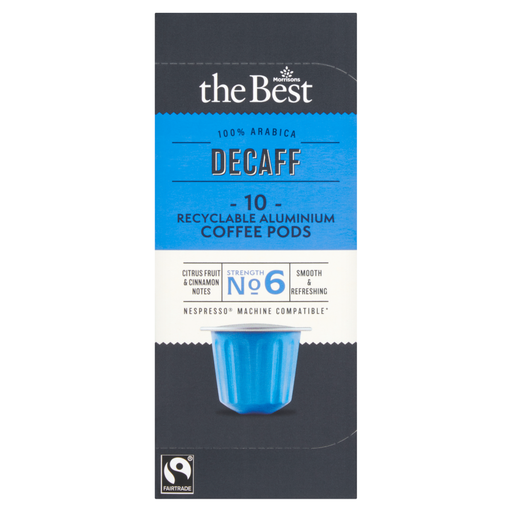
This Joybuy option is for shoppers considering Fairtrade decaf pods. Check your machine's capsule requirements before choosing a pod format for a top-up.
 No image available
Consider these Fairtrade decaf pods if you use a compatible pod machine; confirm the capsule system before buying.
The Joybuy product information identifies the coffee as decaffeinated 100% Arabica.
Look for an explicit Fairtrade statement on the exact pack or product listing. Sainsbury's house-blend ground decaf listing, for example, says its coffee is Fairtrade certified, traded, audited and sourced from Fairtrade producers, total 100%.
Choose a format you can prepare now: instant with hot water, ground coffee with a cafetière or filter machine, or beans if you have a grinder. Pre-portioned coffee filters need a suitable brewing method, while pods require a matching capsule system.
No: do not read ‘decaf’ as a guarantee of zero caffeine. If residual caffeine matters to your choice, check the current information for the particular coffee.
Follow the instructions on the product you buy, as storage guidance differs by format. Check those instructions alongside pack size if you only make decaf occasionally.