Fairtrade-first coffee drinkers
If Fairtrade certification is your priority, check the claim on the exact decaf product before choosing a format. A general responsible-sourcing statement is not the same check.


Choose Fairtrade decaf instant coffee for a quick cup, or ground coffee if you want to make a cafetière or filter pot. Pods offer another route if they fit your machine; whichever format you choose, check the exact product for the FAIRTRADE Mark or an explicit Fairtrade statement.
If Fairtrade certification is your priority, check the claim on the exact decaf product before choosing a format. A general responsible-sourcing statement is not the same check.
Fairtrade decaf instant coffee suits a kettle-and-cup routine without a cafetière, filter brewer or capsule machine. Check the preparation instructions on the jar or pack.
Fairtrade decaf ground coffee suits a breakfast pot when its grind and brewing guidance match your equipment. Allow for the preparation and cleaning that brewing requires.
Start with the Fairtrade claim on the individual product, then choose the preparation method that fits your breakfast.
| Priority | What to check | Your needs |
|---|---|---|
| Fairtrade status | Look for the FAIRTRADE Mark or explicit Fairtrade wording on the exact pack or listing. If the mark names a sourced ingredient, check which ingredient it covers. | I want the decaf coffee I buy to carry a product-level Fairtrade claim, rather than relying on a broader sourcing description. |
| Brewing format | Instant needs hot water; ground coffee needs a suitable cafetière or filter brewer. For pods, confirm the stated capsule system against your machine. | Some mornings I want one quick cup; on others I have time to make a pot. The format needs to fit the equipment I will use. |
| Roast and flavour | Check the roast and flavour description on the particular product, alongside its format. Treat these descriptions as a starting point, not a guarantee of how your cup will taste. | I want to choose a coffee for a black cup, a milk drink or a longer breakfast coffee without assuming all decaf tastes alike. |
| Residual caffeine | Do not read “decaf” as “caffeine-free”. Check the exact product information if residual caffeine matters to your choice. | I need to know whether a decaf label meets my requirements, rather than assuming it means zero caffeine. |
A responsible-sourcing description does not by itself establish a Fairtrade claim for that decaf product.
Check the current pack or listing for the FAIRTRADE Mark or explicit product-level Fairtrade wording.
Ground coffee will not fit a kettle-only breakfast routine in the way instant coffee does.
Choose instant for a cup made with hot water, or check that the ground coffee suits the cafetière or filter brewer you plan to use.
If you do not already have suitable brewing equipment, you would need to obtain it to use ground coffee.
Decaffeinated coffee is not necessarily caffeine-free, so the distinction matters when you need to account for caffeine.
Check the exact product information rather than treating “decaf” as a zero-caffeine claim.
Waitrose & Partners recommends using its No.1 Peru Decaf ground coffee within two weeks of opening for best taste.
Choose a pack size that fits how often you make coffee, and follow its storage instructions after opening.
These examples show where to check for Fairtrade decaf in different formats; confirm the claim on the product you choose.
M&S describes its Decaf Americano micro-ground instant coffee as Fairtrade and 100% arabica. It also states that its tea and coffee are Fairtrade-certified.
Clipper’s 100g decaf instant coffee is described as Fairtrade, organic and freeze-dried.
Cafédirect lists Fairtrade decaf ground and whole-bean coffees, including Machu Picchu Decaf ground coffee.
Waitrose & Partners lists No.1 Organic Fairtrade Peru Decaf as ground coffee made with Fairtrade arabica coffee, with guidance for most filter brewing methods.
Nescafé UK & IE describes Original Decaf instant coffee as water-decaffeinated and responsibly sourced.
This pod option is for a machine-based weekend coffee; check its capsule system against your machine before choosing it.
 No image available
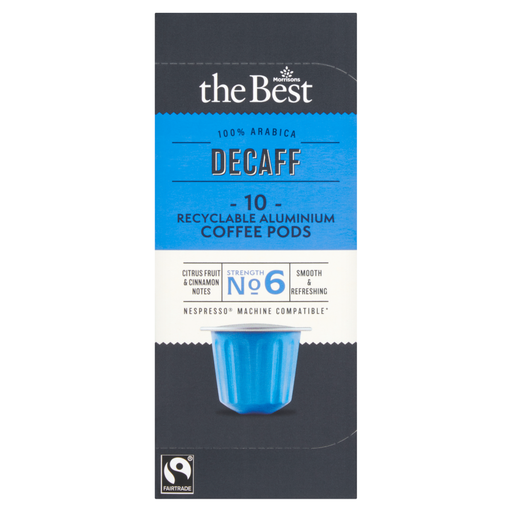
For a machine-made breakfast cup, check that these decaf pods fit your exact capsule system. The product is labelled Fairtrade and comes in a 54g pack; check the current pack for its Fairtrade wording.
Look for the FAIRTRADE Mark or explicit Fairtrade wording on the exact pack or current product listing. The Fairtrade Foundation says its classic mark indicates that all ingredients capable of Fairtrade certification are Fairtrade-certified; if a mark names a sourced ingredient, check which ingredient it covers.
Choose instant for a kettle-and-cup routine, or ground coffee if you want to make a pot and have a suitable cafetière or filter brewer. Check the ground coffee’s brewing guidance against your equipment.
Confirm that the stated capsule system matches your exact machine, then check the pod product’s Fairtrade claim. As Joybuy Insights notes for Nespresso-compatible capsules, Original and Vertuo systems are not interchangeable.
No: decaf does not necessarily mean zero caffeine. If residual caffeine matters to your choice, check the information for the exact product rather than relying on the word “decaf” alone.
No. Check the individual decaf coffee for the FAIRTRADE Mark or an explicit Fairtrade statement; broader sourcing wording does not establish that product-level claim.