For short, interrupted breaks, choose a decaf coffee with an explicit Fairtrade certification or standards statement, then match the format to your routine: instant needs only hot water, ground coffee needs brewing equipment, and pods need a compatible machine. Decaf is not necessarily caffeine-free, so consider caffeine from other food and drinks if you are managing your intake.
Who is this choice for?
Breastfeeding parents keeping track of caffeine
Decaf lets you keep a coffee routine while reducing caffeine from coffee, but it need not contain zero caffeine. The NHS notes that caffeine can make a breastfed baby restless; remember to consider other sources, including tea, chocolate and soft drinks.
Parents making coffee in short breaks
Instant coffee works with a mug and hot water. Ground coffee needs a brewing routine, while pods are useful only with a machine that accepts the particular capsules.
Shoppers who want a checkable Fairtrade claim
Look for a Fairtrade statement on the named coffee rather than relying on broad responsible-sourcing wording. The Fairtrade Foundation explains that the classic Fairtrade Mark covers ingredients that can be Fairtrade-certified; a Fairtrade Sourced Ingredient mark refers to a specified ingredient.
What should you check before buying?
| Priority | What to check | Your needs |
|---|
| Caffeine |
Check that the exact product is decaf and read any residual-caffeine statement. Sainsbury's states less than 0.1% caffeine by weight for its Fairtrade Decaff House Blend; that figure does not describe every prepared cup or other decaf coffees. |
I want to reduce caffeine from coffee without assuming decaf contains none. If I am breastfeeding, I also need to consider caffeine in other food and drinks, as the NHS advises. |
| Fairtrade claim |
Find a product-level Fairtrade certification or standards statement. Check which mark or wording applies to the coffee, rather than treating general sourcing language as equivalent. |
An explicit claim matters to me more than a general description of ethical sourcing. |
| Preparation |
Match the format to what you can use: instant needs hot water; ground coffee needs brewing equipment. Sainsbury's gives a three-to-five-minute cafetière brew for its House Blend. |
If my breaks are often interrupted, I want a preparation routine I can realistically manage. |
| Pod fit |
Check the capsule maker's statement against your machine model. The M&S Fairtrade Decaf pod listing specifies domestic Nespresso and Dualit machines but excludes professional and built-in Nespresso machines; its compatibility does not establish the fit of other pods. |
I would consider portioned pods only after confirming that the particular capsules fit my machine. |
What can make the wrong format a nuisance?
-
Assuming decaf means no caffeine
Decaffeinated coffee can retain caffeine. Sainsbury's, for example, states a residual level for its Fairtrade Decaff House Blend rather than claiming zero caffeine.
Read the exact product label and account for other caffeine sources if you are managing your intake. Ask a clinician or pharmacist for individual advice if you need to avoid caffeine for a medical reason.
-
Equating responsible sourcing with Fairtrade
A general sourcing statement does not tell you whether the named decaf coffee has Fairtrade certification or a Fairtrade-standards claim.
Check the product page or pack for explicit Fairtrade wording and identify which mark, if any, it carries.
-
Ordering pods without checking the machine
Pod fit varies by product. The M&S Fairtrade Decaf listing names compatible domestic machines and excludes professional and built-in Nespresso machines.
Compare the pod's compatibility statement with your machine model before ordering.
Capsules that do not fit your machine may go unused.
-
Choosing ground coffee for a mug-and-kettle routine
Ground coffee requires a brewing method and preparation time; instant coffee can be made with hot water.
If you do not expect to use a cafetière or filter coffee maker during short breaks, consider an instant option with an explicit Fairtrade claim instead.
Which brands offer relevant options?
Sainsbury's
Its Fairtrade Decaff House Blend is a ground-coffee option for a cafetière or filter routine.
- Sainsbury's states that the 227g House Blend coffee is Fairtrade certified, traded, audited and sourced from Fairtrade producers, total 100%.
- It needs brewing equipment; the stated caffeine level of less than 0.1% by weight is not a zero-caffeine claim.
M&S
Its Fairtrade decaf range includes ground coffee and pods, allowing a choice based on brewing equipment.
- Marks & Spencer identifies its 227g ground decaf as Fairtrade coffee made from 100% Arabica beans; the M&S pod listing also states Fairtrade certification.
- The pod listing specifies domestic Nespresso and Dualit compatibility but excludes professional and built-in Nespresso machines.
Clipper
Its organic instant decaf is a mug-and-hot-water option.
- Clipper describes its 100g freeze-dried coffee as decaffeinated using CO2 and spring water and traded in compliance with Fairtrade standards.
- Its product description does not give a caffeine amount per prepared mug.
Nescafé
NESCAFÉ Original Decaf is an instant-coffee option for shoppers considering a water-decaffeinated product.
- NESCAFÉ says most caffeine is removed from this coffee using only water.
- If Fairtrade is essential, check the named product for an explicit Fairtrade claim; water decaffeination and responsible-sourcing wording do not establish one.
Kenco
Kenco Decaf is a medium-roast instant-coffee option.
- The brand describes this named product as an instant decaf roast.
- A shopper requiring Fairtrade certification should check the specific pack for an explicit claim rather than infer it from the brand or format.
Taylors of Harrogate
Taylors Decaff coffee bags provide an individually portioned brew format.
- The Paperstone listing describes these bags as water-decaffeinated coffee from independently certified farms and co-operatives.
- That wording does not itself establish Fairtrade certification for the named coffee bags; check the pack if Fairtrade is a requirement.
How do the Fairtrade decaf examples differ?
This composite ordering moves from instant coffee requiring no machine to ground coffee and then pods requiring suitable equipment; it is not a taste or value ranking. The product statements below come from Clipper Tea Shop, Sainsbury's, the M&S listing on Ocado and Joybuy, respectively.
| Rank | Coffee | Main specifications | Why consider it | Supplier or platform |
|---|
| 1 |
Clipper Fairtrade Organic Decaf Coffee 100g |
Freeze-dried organic instant decaf; CO2 and spring-water decaffeination. |
Clipper Tea Shop states that this coffee is traded in compliance with Fairtrade standards. Consider it when you need an instant format without a coffee machine. |
Clipper Tea Shop |
| 2 |
Sainsbury's Fairtrade Decaff House Blend, Strength 3, 227g |
Ground coffee; Sainsbury's states Fairtrade-certified sourcing, total 100%, and less than 0.1% caffeine by weight. |
Consider it if you already use a cafetière or filter setup. Sainsbury's gives a three-to-five-minute cafetière brew for this product. |
Sainsbury's |
| 3 |
M&S Fairtrade Decaf Coffee Pods |
Decaf Arabica pods with a Fairtrade certification statement. |
The M&S listing on Ocado specifies domestic Nespresso and Dualit machines and excludes professional and built-in Nespresso machines. Check your machine before choosing these pods. |
M&S / Ocado product listing |
| 4 |
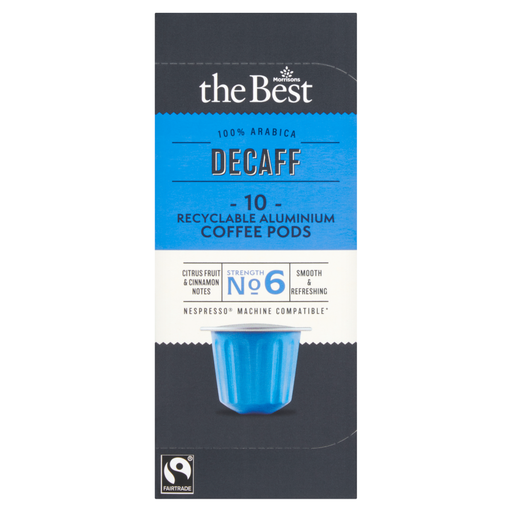
Morrisons The Best Fairtrade Decaf Pods 54g |
Decaf pods described by Joybuy as 100% Fairtrade Arabica coffee. |
Consider this portioned format only after checking its capsule system against your machine; compatibility stated for another brand's pods does not establish a fit here. |
Joybuy |
Joybuy decaf coffee options
This pod option is relevant if you want Fairtrade decaf in a portioned format. Check that its capsules fit your machine before choosing it.
 No image available
Morrisons The Best Fairtrade Decaf Pods 54g
These pods provide a portioned option for short coffee breaks. Joybuy describes the 54g decaf product as 100% Fairtrade Arabica coffee. Check the capsule system against your machine and read the pack for residual-caffeine information if you are keeping track of your intake.
View on Joybuy
Common questions
Is decaf coffee completely caffeine-free?
No. Decaf coffee can retain caffeine: Sainsbury's states less than 0.1% caffeine by weight for its Fairtrade Decaff House Blend, and NESCAFÉ explains that decaf need not be completely caffeine-free. Check the exact product label if its residual caffeine matters to you.
Can I switch to Fairtrade decaf while breastfeeding?
Decaf can reduce caffeine from coffee, but you still need to consider other sources. The NHS notes that caffeine can make a breastfed baby restless; tea, chocolate and some soft drinks can also contribute to intake. Speak to a health visitor or GP about individual concerns.
How do I check a decaf coffee's Fairtrade claim?
Look for an explicit Fairtrade statement or mark on the named product's page or pack. The Fairtrade Foundation says the classic Fairtrade Mark indicates that ingredients capable of Fairtrade certification are certified; a Fairtrade Sourced Ingredient mark identifies a specified Fairtrade ingredient. General responsible-sourcing wording is not the same claim.
Will M&S Fairtrade Decaf Coffee Pods fit every Nespresso machine?
No. The M&S pod listing specifies domestic Nespresso and Dualit machines but excludes professional and built-in Nespresso machines. Check your machine model against the pod's compatibility statement before buying.


