Occasional second-home hosts
If visits are unpredictable, consider a format guests can prepare with the equipment left at the property. Instant coffee needs only hot water and a mug; keep any opened pack according to its storage instructions.


For a second home used only occasionally, Fairtrade-claimed instant decaf is the simplest format to prepare if guests have only a kettle; choose beans or ground coffee when the property has the right brewing equipment and the pack size fits expected use. Check the Fairtrade claim on the exact product rather than treating general responsible-sourcing wording as equivalent, and follow that pack’s storage instructions between visits.
If visits are unpredictable, consider a format guests can prepare with the equipment left at the property. Instant coffee needs only hot water and a mug; keep any opened pack according to its storage instructions.
Check the exact coffee pack, not just the brand’s wider sourcing message. The Fairtrade Foundation distinguishes the classic Fairtrade Mark from the Fairtrade Sourced Ingredient Mark, which identifies a particular Fairtrade-sourced ingredient.
If a grinder and suitable brewer are already available, whole beans are an option. Ground coffee avoids grinding but still needs a brewer that accepts it; check what guests will be able to use.
Start with the claim on the coffee, then match its format and pack size to the equipment and likely use of the second home.
| Priority | What to check | Your needs |
|---|---|---|
| Fairtrade claim | Look for a Fairtrade Mark or an explicit Fairtrade claim on the exact pack or listing. The Fairtrade Foundation says its classic mark covers all ingredients that can be Fairtrade certified, while its Sourced Ingredient Mark identifies a particular ingredient; general responsible-sourcing wording is a separate claim. | I want the decaf coffee I buy to carry a specific Fairtrade claim, rather than relying on a brand-wide sourcing statement. |
| Preparation | Instant coffee needs hot water and a mug. Whole beans need a grinder and suitable brewer; for ground coffee, check the brewer’s required format. Tesco Marketplace describes its Suma ground decaf listing as suitable for espresso and filter. | Guests should be able to make the coffee using the equipment actually kept at the property. |
| Storage and quantity | Check the pack’s best-before date, storage directions and quantity against expected visits. NESCAFÉ says its opened instant coffee generally stays at its best quality for about 12–18 months at room temperature when kept cool, dry and tightly closed; that guidance is not a shelf-life claim for other products. | If visits are sporadic, I would rather choose a pack size I can use than leave several opened bags between stays. |
| Decaf wording | Read the exact product information if caffeine content matters. NESCAFÉ’s UK guidance states that decaf coffee is not necessarily caffeine-free. | I need to distinguish reduced-caffeine coffee from a product described as caffeine-free. |
A general responsible-sourcing statement does not establish that the particular decaf coffee carries a Fairtrade claim. Kenco describes its responsibly sourced wording in terms of an equivalent volume bought through a sourcing programme, while the Fairtrade Foundation explains its marks separately.
Check the exact pack or listing for the Fairtrade wording or mark you intend to buy.
Whole beans need grinding and brewing equipment; ground coffee also needs a suitable brewer. A kettle alone does not prepare either format.
Confirm what is kept at the second home before choosing between instant coffee, beans and ground coffee.
Tesco Marketplace lists the Suma ground decaf as six 227 g bags, totalling 1.362 kg. That is a substantial quantity to leave at a property visited only occasionally.
Compare the quantity with expected visits and check the pack’s storage and best-before information.
NESCAFÉ’s UK guidance states that decaf coffee is not completely caffeine-free.
If avoiding caffeine is important, check the information for the exact product rather than relying on the word ‘decaf’ alone.
These examples illustrate different product claims and formats; a statement about one coffee does not apply to every product from its brand.
A Tesco Marketplace listing describes Clipper Organic Fairtrade Arabica Decaf sachets as freeze-dried instant coffee traded in compliance with Fairtrade standards.
Tesco Marketplace lists a 227 g pack of Equal Exchange organic decaffeinated whole beans as Fairtrade certified, medium roast and Swiss Water processed.
Tesco Marketplace describes Suma Organic Swiss Water Decaf Ground as coffee from Fairtrade and organic co-operatives, suitable for espresso and filter brewing.
NESCAFÉ describes Gold Blend Decaf as freeze-dried instant coffee made with responsibly sourced coffee.
Kenco describes its Decaf as instant coffee offered in 95 g and 190 g jars.
Tesco Marketplace lists the identified Clipper, Equal Exchange and Suma decaf coffees as examples of different formats carrying Fairtrade-related claims.
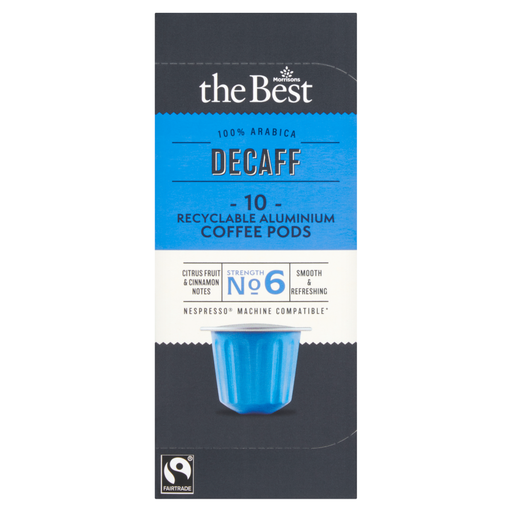
This Fairtrade-claimed decaf option is in capsule form, so it is relevant to a second home only if the property has a compatible capsule machine.
 No image available
For a second home with a capsule machine, this 54 g pack contains decaffeinated coffee in aluminium capsules; the product description claims 100% Fairtrade Arabica coffee. Confirm that the pods fit the machine and check the pack’s best-before date before leaving them between visits.
Check the exact pack or listing for a Fairtrade Mark or explicit Fairtrade claim. The Fairtrade Foundation says its classic mark covers all ingredients that can be Fairtrade certified, while its Sourced Ingredient Mark identifies a particular Fairtrade-sourced ingredient; a company’s general responsible-sourcing wording is a different claim.
Instant coffee needs only hot water and a mug, making it a practical choice where no brewer is kept. For its own opened instant coffee, NESCAFÉ advises cool, dry storage with the lid tightly closed and says best quality generally lasts about 12–18 months at room temperature when stored properly; follow the instructions and date on the product you buy.
No: match the coffee format to the machine’s requirements. Tesco Marketplace describes Suma ground decaf as suitable for espresso and filter brewing, but that does not establish compatibility with capsule machines or every other brewer.
Not necessarily. NESCAFÉ’s UK guidance says decaf coffee is not completely caffeine-free, so check the exact product information if caffeine content affects your choice.